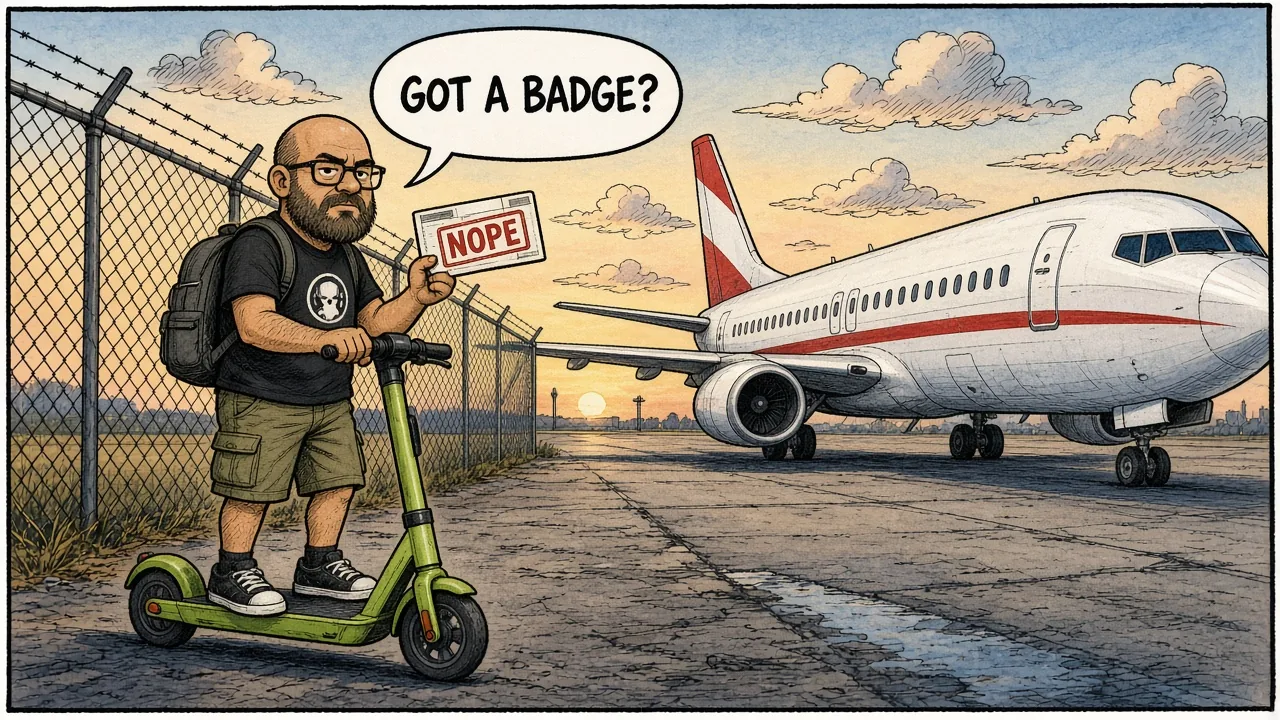
The most honest thing about Janet is the paint job: white jet, red stripe, no logo, no ticket counter. The mystery is not the airplane. It is the passenger list.
The short version
- Janet is a call sign, not a vacation airline. The white 737s shuttle cleared workers between Las Vegas and the classified Nevada ranges.
- You can photograph the jets at a civilian airport. You cannot buy a seat.
- Public FAA registrations and decades of plane-spotting put the fleet in the Department of the Air Force column.
- Contractor names on the operation have changed—EG&G, URS, AECOM/JT3, Amentum—while the red stripe stayed.
- Weekday volume is industrial, not tourist: observer estimates run to many round trips and four-digit headcounts.
- For Area 51 mythology, Janet is awkward evidence. Secret bases still need a Monday morning commute.

What you can see without a clearance
Las Vegas airport has always been a terrible place to hide an airline. Jet bridges, plane spotters, ADS-B hobbyists, and a fenced terminal in the northwest corner of the field made Janet a public fact long before anyone at a podium liked the word “Area 51.”
Dreamland Resort’s Janet page—built from years of schedules, photos, and radio traffic—describes the pattern plainly: unmarked passenger aircraft ferry workers to the classified ranges. The jets are white with a single red stripe. No titles. No smiling gate agents selling upgrades. Smaller Beechcraft/King Air types share the call sign family for other support runs.
That visibility matters. A program can be classified and still leave a Boeing-shaped hole in the civilian airport diagram. The 2013 CIA U-2 history admitted the test site on paper; Janet admits the workforce in aluminum.
Ownership breadcrumbs
Dreamland’s tail-number tables track the 737s and turboprops against public registration data pointing at the Department of the Air Force. Aviation press pieces (The Points Guy and others) repeat the same basic picture: Air Force–linked shuttle, not a branded carrier.
Treat observer tallies as tallies. They are not the official fleet card from a public affairs office. They are good enough to kill the idea that Janet is an urban legend. White jets with USAF registrations landing at a marked secure terminal are not folklore. They are logistics.
Contractors, not elves
Secret paint does not mean secret corporations. Dreamland’s history line walks the operating contractor from EG&G Special Projects into URS, then AECOM’s world (including JT3 range support), and notes Amentum as the operator as of 2023. Corporate acquisitions are public. Badge offices are not.
That split is the whole Janet lesson. The United States can outsource the flying while still classifying the destination. If you are looking for a “hidden airline company” with a comic-book name, you will be bored. If you are looking for how classified labor actually moves, this is the boring answer that works.
Volume without a timetable
Dreamland’s weekday estimate—on the order of twenty-plus round trips moving roughly a thousand to fifteen hundred workers—should be read as field approximation, not HR data. Even if you cut the numbers in half, the implication survives: Groom Lake and Tonopah Test Range are workplaces with shifts, not empty movie sets.
This dossier deliberately skips printable departure boards. The point is industrial scale, not helping anyone loiter a worker gate.
The 2004 reminder
Classified routes are still subject to gravity. Dreamland’s news timeline records a March 16, 2004 Beechcraft Janet crash between Area 51 and TTR that killed everyone on board. No passenger manifest belongs here. The public fact is enough: the commute is real enough to have a crash record.

Myth check
Janet does not prove aliens. It proves payroll. A base that needs hundreds of cleared specialists every weekday is doing engineering and test work at scale—the same story the land withdrawals and the U-2 history tell from other angles. The red stripe is not a cover-up of a flying saucer hangar. It is a cover-up of a badge reader.
| Publicly observable | Still not public |
|---|---|
| White 737s with red stripe at LAS | Passenger names / clearances |
| Call sign “Janet” on radio | Mission details at destination |
| USAF-linked N-number registrations | Interior of the secure terminal process |
| Contractor corporate lineage | Current contract clauses |
| Rough weekday volume estimates | Official headcount |
Why the call sign stuck
Nobody issued a press kit titled “Welcome to Janet Airlines.” The call sign stuck the way range nicknames stick: radio traffic, plane spotters, and repetition. Dreamland’s archive treats “Janet” as the spoken label for the worker shuttle pattern out of Las Vegas toward Groom and Tonopah—not as a certificated airline brand with a frequent-flyer desk.
That distinction keeps this file honest. The public can document paint, terminals, and N-numbers. The public cannot document seat 12A. ErrorZap is interested in the first pile of facts. The second pile is where rumor farms fake boarding passes.
Shared metal, shared desert
Janet is also connective tissue for this whole section. The same weekday lift that feeds Groom Lake feeds Tonopah Test Range. Land withdrawals and FOIA histories explain why the destination stays quiet; Janet explains how the labor still arrives on time. Without the shuttle story, Area 51 looks like a sealed diorama. With it, the place looks like what the paperwork always implied: a remote industrial flight-test campus with a brutal commute.
Sources
- Dreamland Resort — Janet Airline
- Dreamland Resort — Janet Tail Numbers
- The Points Guy — Meet Janet, the Most Mysterious Airline in the World
- Dreamland Resort — Area 51 News and Timeline (2004 Beechcraft crash note)
- Former EG&G Headquarters - Center for Land Use Interpretation (Special Projects / Groom Lake note)