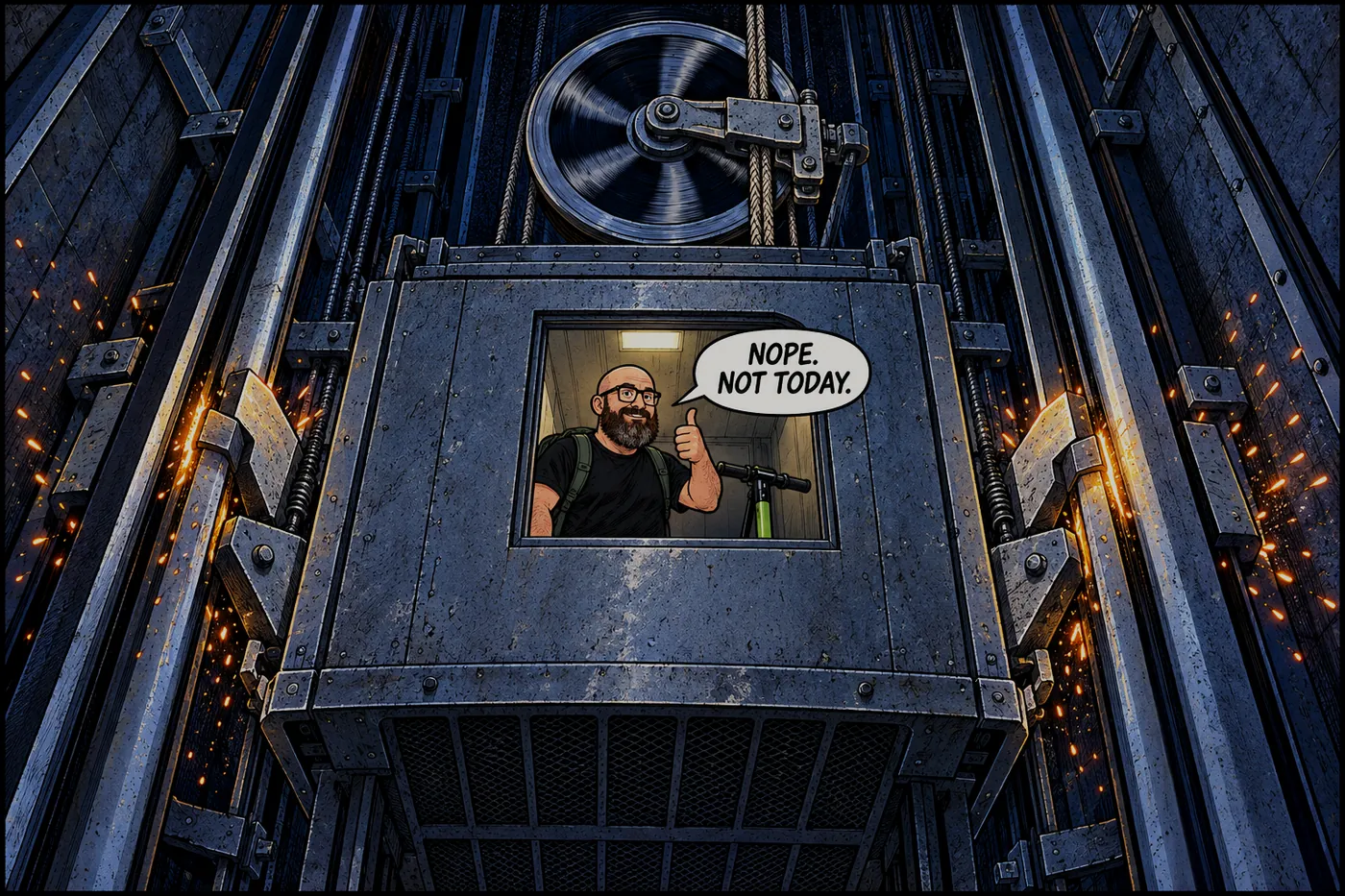
The elevator wasn't the breakthrough. People had hoists for centuries. The breakthrough was a brake that works when everything else has already failed.
The short version
- In 1854, Elisha Otis stood on a platform in New York’s Crystal Palace, had the hoist rope cut with an axe, and a spring-loaded catch grabbed the notched guide rails. He dropped a few inches.
- Today’s version is a chain: an overspeed governor notices the car going too fast, cuts power, then pulls a lever that jams safety wedges against the rails.
- The motor brake is spring-applied and electrically released. Cut the power and it clamps by itself.
- Doors are part of the safety loop. The car can’t run with a landing door unlocked, and a landing door can’t be opened unless the car is there.
- Newer codes add unintended car movement protection (UCMP): if the car creeps away from a floor with the doors open, a separate brake has to stop it within about four feet.
The stunt that sold skyscrapers
Otis’s safety wasn’t an instant hit. Elevator World’s history notes he sold only a handful of elevators in the year after the Crystal Palace show, and the first safety elevator built to carry passengers didn’t go into service until 1857, in the E.V. Haughwout Building in Manhattan. But the idea stuck, and it’s still the foundation: assume the rope is gone, and stop the car anyway.
- 01Car overspeeds
Something goes wrong and the car is moving faster than it should. It doesn't matter whether that's a brake, a drive, or a rope.
- 02Governor wakes up
A wheel spun by its own loop of rope flings weights outward as speed rises. Past the trip speed, often around 115% of rated speed, a switch cuts motor and brake power.
- 03Governor grabs its rope
If the car still hasn't slowed, the governor jaws clamp that little rope. The car keeps moving, the rope doesn't, and that yanks a lever on the car.
- 04Safeties bite the rails
Hardened wedges or rollers under the car jam against the steel guide rails and stop it within a controlled distance. The same idea Otis demonstrated in 1854, just much better.
- 05Buffers, last resort
Spring or oil buffers in the pit soak up whatever energy is left if a car or counterweight runs past the end of the line.
Why the software doesn’t get a vote
Modern controllers are full of computers, but the core safety devices are designed to fail safe without them. The governor is a spinning wheel with flyweights. The safeties are steel wedges. The machine brake is a spring held open by an electromagnet, so a power cut applies the brake.
Electrically, all the critical switches (door locks, the governor switch, pit stop switches, final limit switches at the top and bottom of the shaft) sit in one long series loop called the safety chain. Open any one of them and power to the motor and brake drops. The software can watch the chain, and newer electronic safety boards are certified to strict functional-safety levels, but it can’t wish a broken chain closed.
The door problem and UCMP
For decades the scariest accidents weren’t falls. They were cars that moved with the doors open, from a brake that slipped or a control fault, catching someone half in and half out. Codes on both sides of the Atlantic now require unintended car movement protection. ASME A17.1 in North America and EN 81-20 in Europe both call for detecting that movement and stopping the car within a short distance, about 1.2 meters (48 inches) in the North American rule, using a brake that doesn’t depend on the thing that just failed.
Many older traction elevators are being retrofitted with rope grippers or dual brakes to meet this, on deadlines set by local code.
The one famous fall
Real free falls are so rare that the most famous one needed a B-25 bomber. On July 28, 1945, an Army plane lost in fog hit the Empire State Building. Debris cut the cables on the elevator that operator Betty Lou Oliver was in, and it fell about 75 stories. She survived, and Guinness still lists it as the longest survived elevator fall. Accounts credit the pile of coiled cable in the pit and the air cushion in the shaft for slowing the car.
Stay in the car. It's the safest place in the building. Press the call or alarm button, wait for the voice, and don't try to pry the doors. Cars aren't airtight, so you won't run out of air. Most stuck-elevator injuries happen when people climb out.
Sources
- Elevator World: Elisha Otis at the Crystal Palace, Part 2
- National Inventors Hall of Fame: Elisha Graves Otis
- FIRGELLI: how elevator safety gear works
- HydraSafe: understanding the code update on unintended car motion
- Elevator World: compatibility of systems and subsystems in UCMP
- ASME A17.1-2022 table of contents
- People: Betty Lou Oliver still holds the record for the longest elevator fall survived
- Brouss Elevators: what to do if you're stuck (elevators aren't airtight)