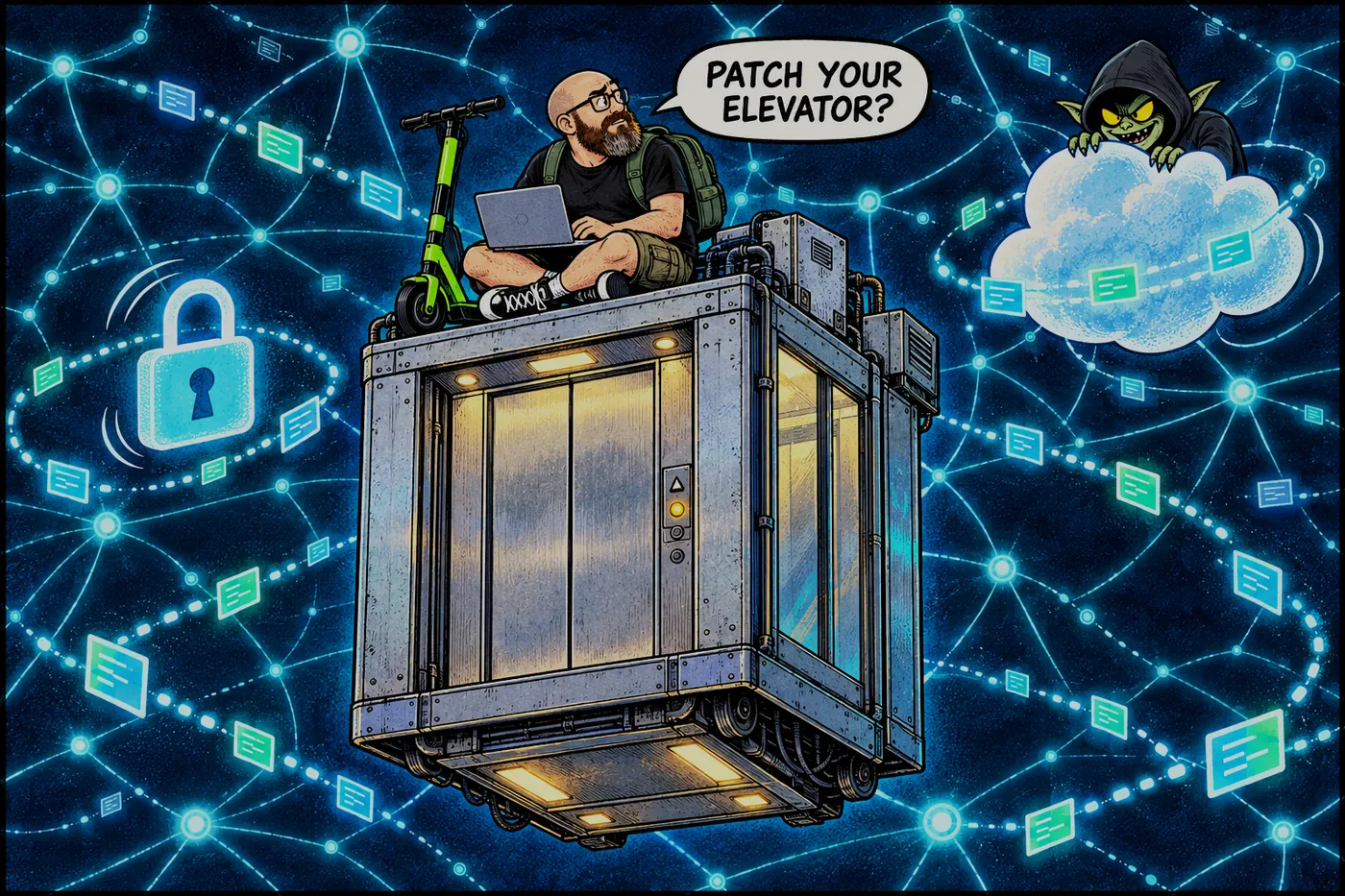
Somewhere there's a dashboard that knew your office elevator's door was getting sticky before anyone in the building noticed.
The short version
- All the big makers sell connected service: an edge gateway reads the controller and sensors and streams data to the maker’s cloud.
- The pitch is predictive maintenance: catch a door that’s slowing down or a brake switch that’s drifting before it strands someone.
- Elevators also expose APIs now, so delivery robots and building apps can call cars.
- The core safety systems still work locally. If the cloud goes down, the car should lose features, not safety.
- We couldn’t find a publicly documented ransomware attack that stopped passenger elevators. Security folks still treat these gateways as operational technology that belongs on its own segmented network.
The big four’s platforms
- Otis ONE. Launched in 2019 as Otis’s IoT service platform. It combines decades of remote elevator monitoring with cloud analytics and machine learning, and gives building owners a live view of their equipment. Otis has talked publicly about a cloud data lake taking in data from controllers, drives, and doors across its fleet.
- KONE 24/7 Connected Services. Built with IBM’s Watson IoT platform after a 2016 partnership. KONE and IBM material describes monitoring hundreds of parameters per unit across a very large connected fleet.
- Schindler Ahead. An on-site gateway called the Ahead Cube connects the elevator, with a technical operations center and apps on top. Schindler says it can push updates to the gateway’s apps over the air, which is a different thing from updating the safety-rated controller firmware.
- TK Elevator MAX. A cloud predictive-maintenance platform running on Microsoft Azure. TK Elevator cites well over 100,000 connected units and claims large cuts in downtime and breakdowns. Those are the company’s own numbers.
What the sensors actually watch
Past the controller’s own fault codes, connected elevators track things like door cycles and door timing (doors open and close hundreds of times a day, so they wear fast), trip counts, motor and bearing temperature, machine vibration, brake switch timing, and in some systems rope or belt condition. A door that takes a little longer to close each week is exactly the kind of drift a model can flag before it turns into a stuck car on a Friday night.
Robots take the elevator
Once an elevator has an API, it doesn’t care whether a human or a robot is calling it. Otis markets robot integration through its dispatch system, and Schindler publishes a REST-style integration API that supports robots and credentials like QR codes, faces, and phones. Hotel and hospital delivery robots that ride elevators by themselves already work this way. Some of them just push the buttons with an arm.
The honest security picture
Here’s what we could and couldn’t find:
- Safety stays local. The safety chain, governor, and brakes don’t depend on the network (Floor 2). A cloud outage should degrade monitoring and fancy dispatch features, not make a car unsafe.
- Lots of the installed base is offline, or reaches its maker only through a modem or VPN. We didn’t find a reliable public count of how many US elevators are connected.
- No confirmed public case of ransomware shutting down passenger elevators at a major maker turned up. The closest public material is training and research. The DFRWS 2023 forensics challenge, “Troubled Elevator,” was built around a malfunctioning bank elevator controller with network captures and memory dumps to analyze.
- The advice from the industry is the same as for any operational technology: authenticate remote sessions, keep the elevator gateway off the general office network, and never expose controller engineering ports to the internet.
If your building has connected elevators, ask the maintenance company three things. What network is the gateway on? Does it phone home over the building's internet or its own cellular link? Who patches it? The answer to the last one is often "not you," and that's worth knowing before something else on that network needs fixing.