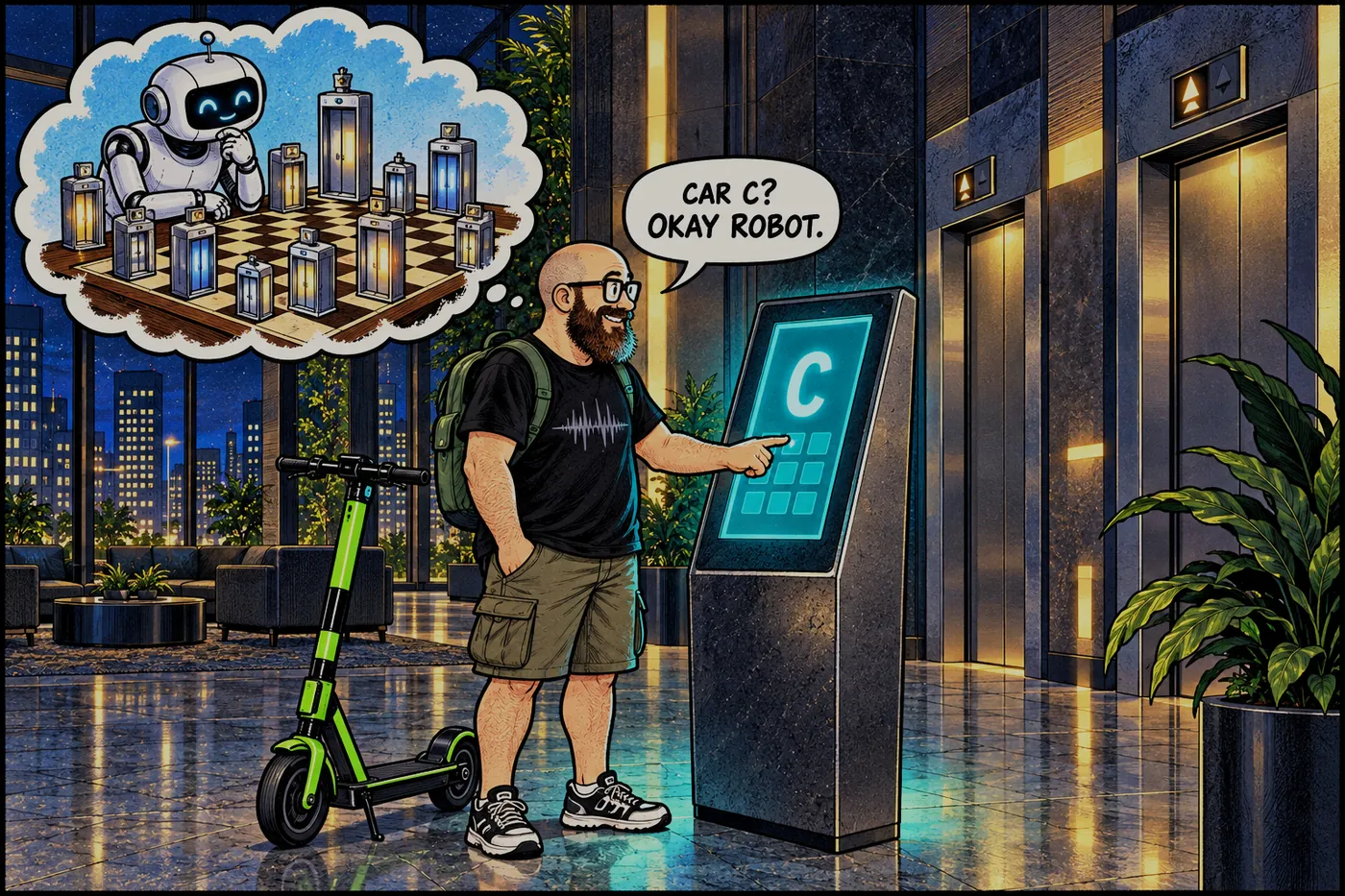
Pressing "up" doesn't call an elevator. It files a request with a scheduler that's juggling every car in the bank and guessing what everyone else is about to do.
The short version
- The classic rule is collective control: a car answers every call in its direction of travel, then turns around. If you’ve studied disk scheduling, it’s basically the SCAN algorithm.
- Banks of cars add a group supervisor that assigns each hall call to the car with the best estimated arrival time, and switches strategy for morning rush, lunch, and evening.
- Destination dispatch asks for your floor in the lobby, then groups people going to the same floors into the same car. Schindler invented the first practical one, the Miconic 10, in 1990 and introduced it in 1992.
- Modern makers advertise fuzzy logic, neural-network traffic prediction, genetic algorithms, and machine-learning tuning. Some of that is well documented, and some of it is brochure language.
- Below, you can race the two approaches yourself.
Classic: up, down, and hope
With plain up/down buttons, the system knows that you want to go up, but not where. So a car stops for you, everyone piles in, and then everyone presses a different floor. In a morning rush, a car leaving the lobby with 12 people can easily end up stopping at 8 or 9 floors, and its round trip gets long. The next person waiting in the lobby pays for every one of those stops.
Destination dispatch: tell it where first
Destination dispatch moves the floor buttons into the lobby. You type 14 on a kiosk (or badge in, or tap your phone), and the screen tells you which car to take. The computer now knows every rider’s destination before they board, so it can send the three people going to 14 and the two going to 15 together, and put the people going to 6 in a different car.
Each car makes fewer stops, so it gets back to the lobby sooner, and waits get shorter. That’s why many of these buildings have no floor buttons inside the car at all. It’s also why you shouldn’t follow your friend into Car B if the kiosk told you Car D. Car B doesn’t know you exist.
Classic up/down buttons, pick your floor inside
Destination dispatch type your floor in the lobby, get a car
A toy model, not any company's algorithm: 16 floors, 4 cars of 12 people, 2 s per floor, 8 s per stop, and everyone starting in the lobby. The destination tower groups riders so each car makes at most 4 stops. Real group controllers also juggle lunch rushes, people going between floors, energy use, and hundreds of tuning knobs. Above about 22 people a minute, the classic tower's line starts growing and doesn't stop. Drag the slider down to 10 and you'll see the flip side: in light traffic, destination dispatch can make you wait a little longer, because it holds cars to group riders.
What the big makers say they’re doing
Group control algorithms are proprietary, so what we have is what the manufacturers choose to publish. Treat the fancier claims as marketing unless there’s detail behind them.
- Mitsubishi Electric ΣAI-2200C. The best-documented. The brochure describes fuzzy logic and expert-system rules, neural-network traffic prediction, a “Dynamic Rule-set Optimizer” that simulates competing strategies every few minutes and picks the winner, “psychological” waiting-time scoring, and an energy-saving mode that prefers the cheaper move (like a heavy car going down) when several cars could arrive at about the same time.
- Otis Compass 360 / Compass Infinity. Destination management with “SmartGrouping.” Otis says Compass Infinity uses machine learning to tune the hundreds of dispatch parameters that would otherwise be set by hand and go stale as a building’s traffic changes.
- KONE Destination. KONE’s brochure language lists traffic forecasting, fuzzy logic, and genetic algorithms. That’s a vendor claim. Nobody outside KONE has published the internals.
- Schindler PORT. The descendant of the 1992 Miconic 10. It adds identity: your badge can carry your default floor, access rights, and accessibility needs, like extra door time.
- TK Elevator TWIN. Two cars in one shaft, so the scheduler also has to keep them from ever meeting. More on Floor 8.
The access-control twist
Once the elevator knows who you are, it becomes part of building security. Access control integrator AMAG describes two patterns. In one, the elevator asks the badge system, in real time, “may this person go to floor 12?” In the other, the cardholder database is copied into the elevator system, which decides locally. Either way, your floor choice is now tied to your badge. That’s handy for tenants, and it’s one more system for the building’s IT people to think about.
Elevator Saga is a free browser game where you write the JavaScript that dispatches the elevators. Its API uses the same ideas real group controllers worry about: destination queues, load factor, and what to do with an idle car. It's harder than it looks.
Sources
- Wikipedia: Destination dispatch
- Schindler: Miconic 10 (1992) and PORT
- Mitsubishi Electric: ΣAI-2200C group control brochure (PDF)
- Otis: Compass 360
- KONE: Destination brochure (PDF)
- Schindler: PORT destination control
- AMAG: destination dispatch and access control white paper (PDF)
- Elevator Saga: documentation