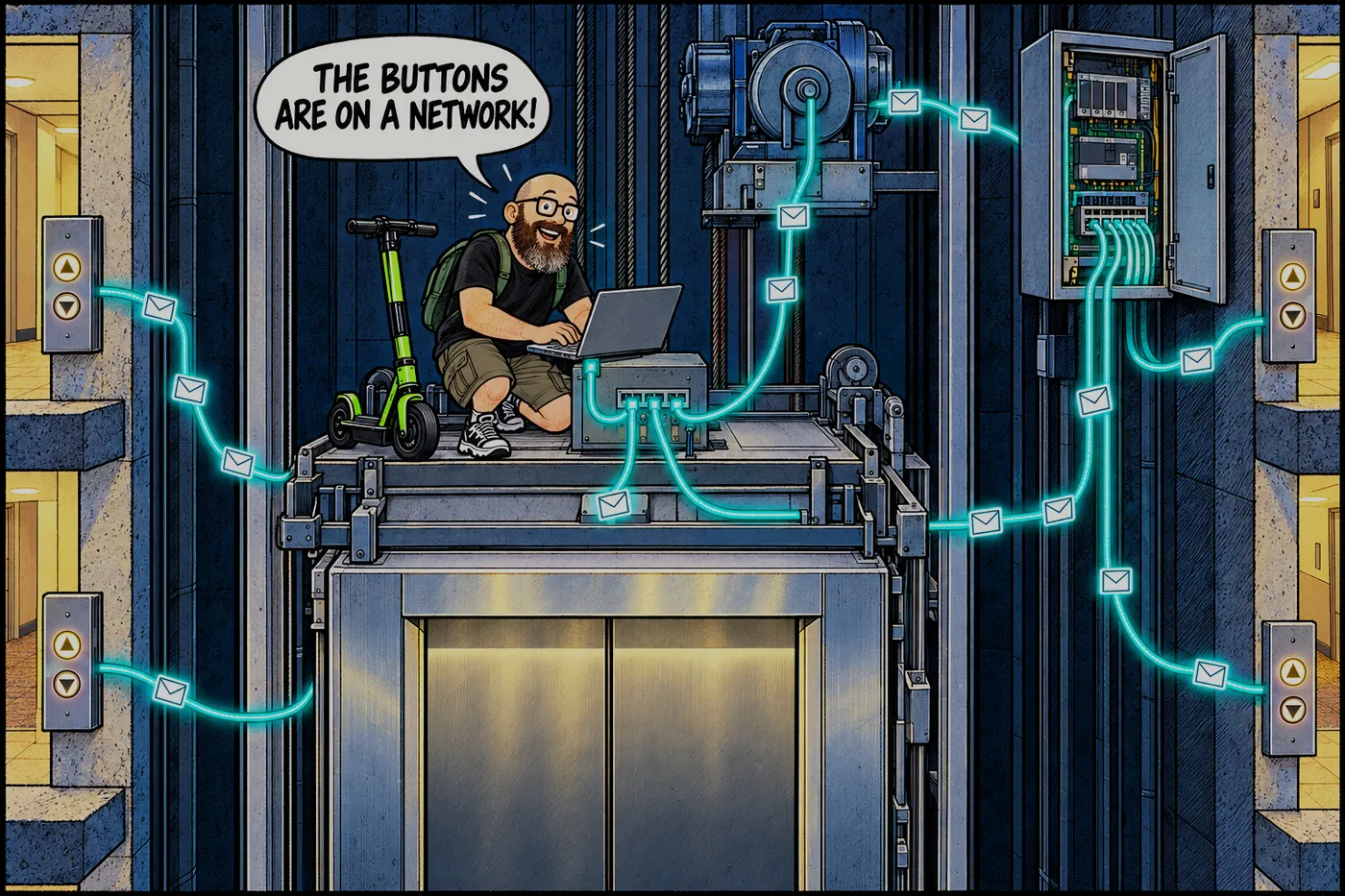
That lit button in the hallway may be closer to a network endpoint than to a lamp on a wire.
The short version
- Inside many modern shafts, the parts talk over CAN bus, the same kind of network that runs cars and factory machines. There’s a published standard for lifts: CANopen Lift, CiA 417, which got its latest revision, version 2.4, on April 30, 2026.
- CiA 417 treats the elevator as a set of virtual devices: panels, the door controller, the drive, the position encoder, load measuring, the light barrier, and more. One physical box can host up to eight instances.
- Talking between shafts is still manufacturer-specific. The standard stops at one shaft.
- Building dashboards get their own view. BACnet, the protocol most building automation speaks, added standard Lift, Elevator Group, and Escalator objects, with properties like car position, direction, door status, landing calls, and passenger alarm.
- Health monitoring on the bus is deliberately small: status flags, counters, and a green/yellow/red condition, because classic CAN doesn’t have the bandwidth for a firehose.
Why a bus at all
Picture an old elevator. Every hall button, every lantern, every door switch had its own wire back to the controller, and the traveling cable hanging under the car was a thick bundle of individual conductors. Serial buses replaced a lot of that copper with a few wires carrying messages. That cut wiring, and it let the controller ask a device what’s wrong instead of just seeing a contact open.
CAN was a natural fit. It’s robust against electrical noise (elevator shafts are full of big motors), it’s cheap, and it was already everywhere in industrial gear. CAN in Automation says its members started developing the CiA 417 lift profile in 2002, and it has been revised steadily since.
Virtual devices: the elevator as a distributed computer
CiA 417’s big idea is to describe each function as a virtual device, not each box. A hall panel, a car door controller, a drive, an encoder, and a light barrier each get a defined role and defined messages. That means a door operator from one supplier can, in principle, talk to a controller from another, as long as both follow the profile.
It’s also a nice mental model for anyone who’s run a network: the car controller is the core, the fixtures and door gear are endpoints, and a handheld service tool is just another node plugged into the bus.
BACnet: what the building dashboard sees
Building owners want elevators on the same screen as the HVAC. ASHRAE’s BACnet standard answered that with addendum 135-2012aq, which added Lift, Elevator Group, and Escalator objects. A building management system can read standard properties such as car position, direction of travel, door status, landing calls, and whether a passenger has pressed the alarm. The property names read like a network admin wrote them:
Car_Position            Car_Moving_Direction
Car_Door_Status         Car_Door_Command
Car_Load                Next_Stopping_Floor
Assigned_Landing_Calls  Registered_Car_Call
Passenger_Alarm         Fault_Signals
Energy_Meter            Out_Of_Service
Yes, there’s an Energy_Meter property, so a building can chart what each
elevator uses.
Two catches worth knowing:
- “BACnet compatible” doesn’t tell you much. The standard defines what can be represented. Which properties a given elevator gateway actually exposes, and whether it accepts any commands at all, varies by product.
- It’s a window, not a steering wheel. These objects exist so dashboards can see and report. Nothing about them gives the building network a path into the safety chain or the brake.
A door can describe its own decline
Doors open and close hundreds of times a day, so they’re a favorite target for condition monitoring. CAN in Automation’s working group describes a CANopen Lift health object with more than 30 monitored functions and a simple green, yellow, or red status. It says the group rejected bulk “big data” over classic CAN on purpose, because the bus doesn’t have the throughput. A few well-chosen bytes beat a flood.
Research goes further. A 2025 open-access study on an elevator-door test bench recorded whole door-motion cycles, compressed the data about 300-fold, and classified 11 kinds of fault with over 97% recall. The researchers then built the data-reduction step into the door drive controller itself. That’s a lab result on one rig, not real-world fleet accuracy, but it shows where “predictive maintenance” is heading: the door’s motion curve changes before the door fails.
Ropes get their own trick. Coated ropes and belts hide the steel inside, so inspectors can’t just look. Magnetic flux leakage testing magnetizes the rope and reads how the field leaks around broken or corroded wires, spotting damage a camera would never see.
If an elevator shows up on your building's BACnet network, treat that gateway like any other piece of operational technology: its own VLAN, only the reads you need, and no path from the office network. The elevator's safety doesn't depend on it, but its dispatch and access features might (see Floor 12).
Sources
- CAN in Automation: CiA 417 series, profile for lift control systems
- CAN Newsletter, March 2022 (history of CANopen Lift, PDF)
- ASHRAE: BACnet addendum 135-2012aq, elevator objects (PDF)
- CAN Newsletter, June 2023: predictive maintenance in CANopen Lift (PDF)
- Applied Sciences 15(13), 7017 (2025): elevator door fault diagnostics
- ASTRJ: magnetic flux leakage detection in coated elevator ropes