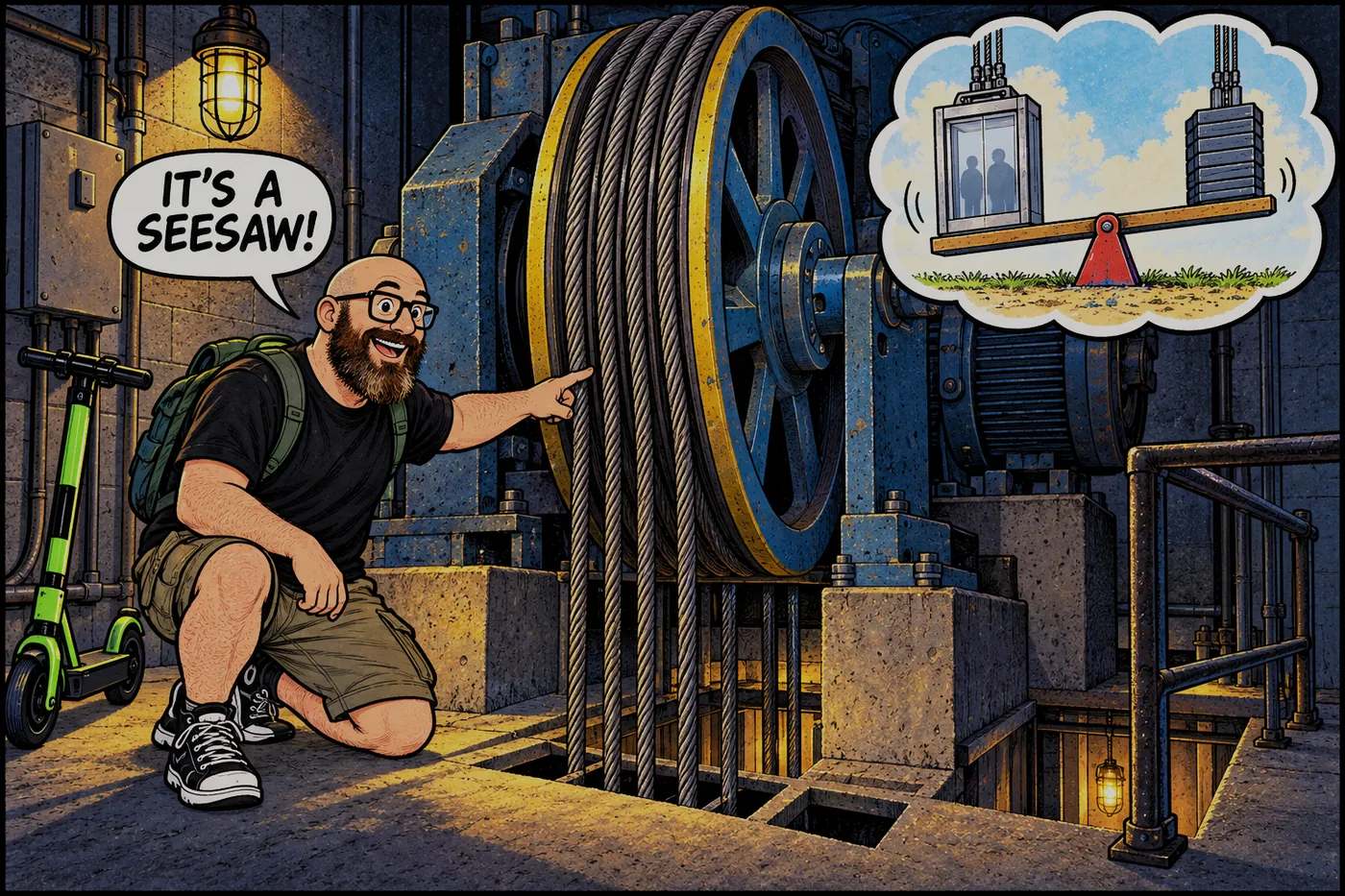
The motor in a traction elevator isn't hauling your whole weight up the building. It's tipping a balance that's already almost level.
The short version
- Most mid- and high-rise elevators are traction elevators: steel ropes or flat belts run over a grooved wheel (the sheave), with the car on one side and a counterweight on the other.
- The counterweight usually weighs about as much as the empty car plus 40 to 50% of its rated load. So the motor only moves the difference.
- Short buildings often use hydraulic elevators instead: a pump pushes oil into a cylinder and a piston shoves the car up. Cheap, simple, slow.
- Since 1996, many traction elevators have had no machine room at all. A flat motor bolted inside the shaft does the work.
- Fun consequence of the seesaw: an empty car going up is actually the light side winning. The motor has to hold it back, and a modern drive turns that braking into electricity.
- Counterweight ≈ the empty car plus 40–50% of its rated load.
- Traction is friction: the ropes just drape over the grooved sheave.
- Pit buffers (red, at the bottom) catch anything that overruns.
Traction: friction does the lifting
Nothing is tied to the motor. The ropes just drape over the sheave, and friction in the grooves grips them. Turn the sheave one way and the car rises while the counterweight falls. Turn it the other way and they swap. That’s where the name “traction” comes from.
The counterweight is the whole trick. With it sized at roughly an empty car plus 40 to 50% of capacity, a half-full car is almost perfectly balanced, and the motor barely works. The worst cases are the extremes. A packed car going up means the motor lifts the difference. An empty car going up means the counterweight is heavier and wants to fall, so the motor acts as a brake.
In old buildings that braking energy went into big resistor banks and became heat, which is one reason old machine rooms were so hot. Modern regenerative drives push it back into the building’s electrical system instead.
Tall buildings add two more details. Roping ratios like 2:1 loop the rope through pulleys on the car, trading speed for pulling force, like a block and tackle. And compensation chains hang under the car and counterweight so the weight of the ropes themselves doesn’t pile up on one side as the car travels.
Hydraulic: the car on a stick
For two to six stops, a lot of buildings skip all that and use a hydraulic elevator. A pump pushes oil into a cylinder, a piston (the “jack”) pushes the car up, and a valve lets the oil back out to lower it. Gravity does the downhill work. Classic installs bury the cylinder in a hole under the pit. “Holeless” versions stand the jacks up beside the car.
They’re cheap and simple, but slow (roughly walking speed to jogging speed), and the pump motor works hard on every up-trip, since there’s no counterweight helping.
Geared, gearless, and the machine room that disappeared
Older traction elevators used a geared machine: a fast motor turning a worm gear that turned the sheave. Rugged, but it wears, leaks oil, and loses energy in the gearbox.
Gearless machines bolt the sheave straight to a big slow motor. Smoother, faster, and the standard for high-rise work.
Then in 1996 KONE shipped the MonoSpace, the first machine-room-less (MRL) elevator, powered by a flat, disc-shaped gearless motor called the EcoDisc. KONE says the idea came to one of its engineers, Harri Hakala, while jogging. The motor got thin enough to mount on the guide rails inside the shaft, and the penthouse full of iron went away. Every major maker followed.
Otis went a different direction with Gen2: instead of round steel ropes, it uses flat polyurethane-coated steel belts. They bend around a much smaller sheave, so the machine can shrink too, and there’s no metal-on-metal contact to grease.
If an elevator has no machine room door on the roof, there's a good chance the motor is sitting at the top of the shaft and the controller is in a locked closet next to the top-floor landing. That little closet is the whole brain. Floor 3 opens it up.
Sources
- Wikipedia: Elevator (traction design, counterweight sizing, hydraulic types)
- KONE: Making room for more since 1996 (MonoSpace, EcoDisc, the jogging idea)
- Otis: Gen2 Premier (coated steel belts)
- TK Elevator: conventional traction vs. machine-room-less
- KEB America: regenerative drives for elevator applications