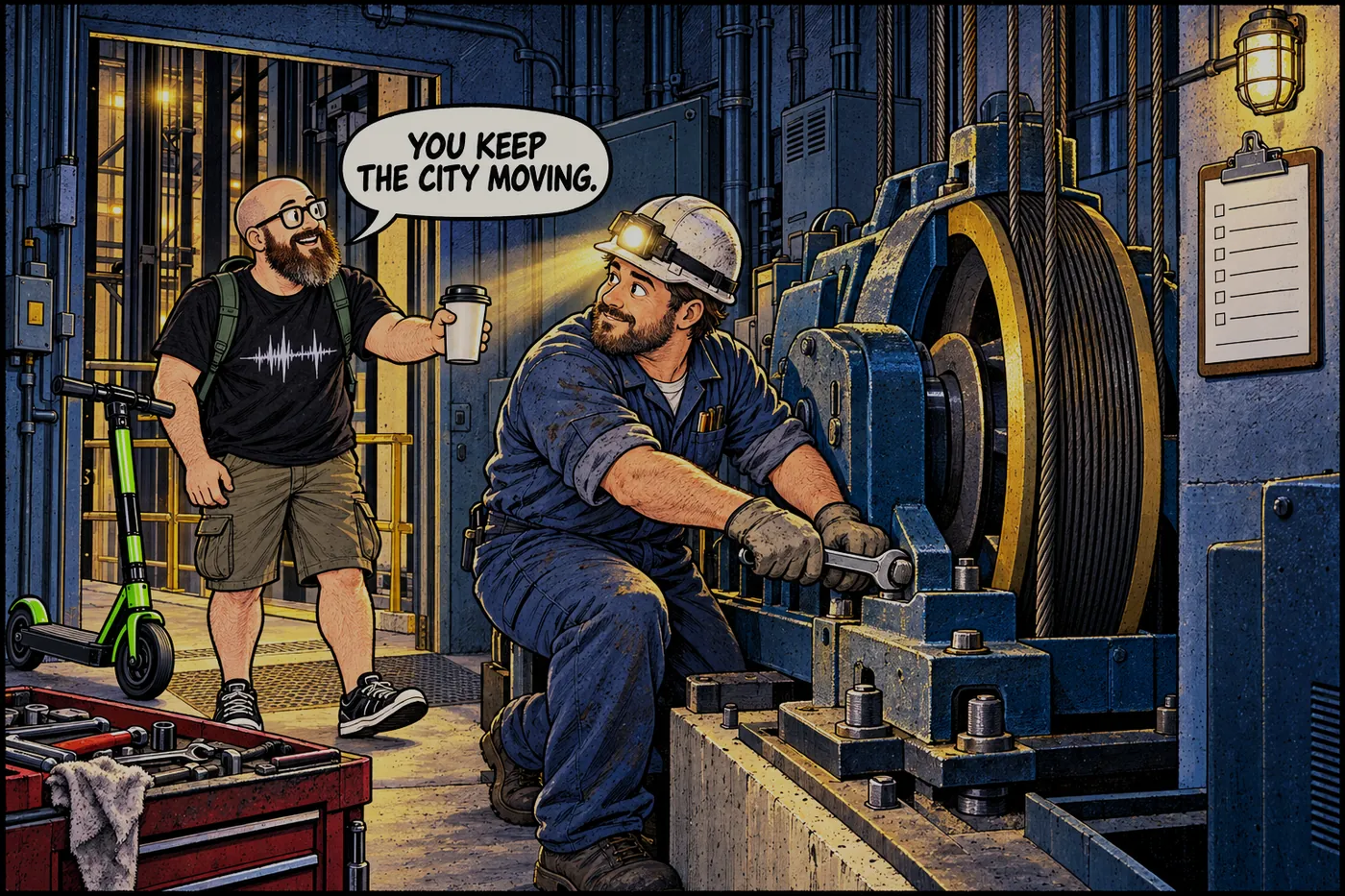
Elevator companies sell you the machine once. Then they sell you the mechanic every month for the next 25 years. That's the whole business, and it's a lot like managed IT.
The short version
- About 24,700 people work as elevator and escalator installers and repairers in the US. Their median pay was $109,910 in May 2025 (BLS).
- Getting there takes a four-to-five-year apprenticeship, with about 8,000 hours of supervised field work before the mechanic exam.
- One elevator has several inspection clocks. New York City requires two periodic inspections a year, a yearly owner-arranged test, and extra tests every three and five years.
- The people most at risk aren’t riders. From 2011 to 2016, 145 construction workers died in elevator-related incidents, more than half of all such worker deaths, mostly from falls in the shaft.
- At Otis in 2025, service brought in $9.4 billion and $2.4 billion in segment profit. New equipment brought in $5.0 billion but only $240 million in profit.
- The biggest deal in the industry’s history is in progress: KONE agreed to combine with TK Elevator in April 2026.
The trade
Elevator mechanics are one of the best-paid construction trades, and one of the smallest. The Bureau of Labor Statistics counts about 24,700 jobs and roughly 1,900 openings a year through 2035, many of them replacing people who retire.
The training path is long. The union’s apprenticeship program, NEIEP, describes four to five years of paid on-the-job training, about 2,000 hours a year under a mechanic’s supervision plus classroom time, adding up to around 8,000 work hours before the mechanic’s exam. It covers everything from rigging and hydraulics to motor control, electronics, and the codes on Floor 2.
The inspection clocks
“The elevator was inspected” usually means several different things. New York City’s rules are a good example of how layered it gets:
- Periodic inspections
Done by an inspection agency contracted by the city. The owner provides access.
- Category 1 test
The owner hires an approved independent agency.
- Category 3 test
Water-hydraulic elevators only.
- Category 5 test
Run with rated load and speed. The owner hires an approved agency.
The UK does it differently. Its workplace-equipment rules call for a thorough examination of passenger lifts at least every six months and goods-only lifts every twelve. Your local jurisdiction’s certificate in the car is the public end of all this paperwork.
Who actually gets hurt
Floor 9 says riding an elevator is very safe, and it is. Working on one is different. CPWR, the construction-industry research center, counted 286 elevator-related worker deaths across all US industries from 2011 to 2016, and 145 of them were in construction. 53.5% of those construction deaths were falls to a lower level, and nearly half of those falls were from more than 30 feet. Another 25.7% involved being caught in or crushed by equipment.
The open shaft, not the moving car, is the dangerous place. That’s why so much of a mechanic’s training is about locking out power and guarding openings before anything else.
Two New York cases
Some accidents change procedures. Two from New York City:
- December 2011, 285 Madison Avenue. Suzanne Hart was killed in an elevator accident in an office building. The Department of Buildings found that workers had failed to follow basic safety procedures that would have prevented it. The city then inspected 658 elevators and found no similar conditions.
- December 2015, the Bronx. Olegario Pabon, an 84-year-old resident, was injured in an elevator accident on December 24 at NYCHA’s Boston Road Plaza senior building and died three days later. The city’s Department of Investigation found that the Housing Authority failed to respond properly to a resident’s report of a hazardous, malfunctioning elevator, hadn’t complied with a 2014 Building Code revision, and that 7.4% of its elevator brake monitors weren’t working. After that case and a second December accident at Morris Houses, NYCHA disciplined five employees and announced new brake-monitor protocols, a 911 protocol for hazardous elevators, and safety-device training.
The second case is a reminder that maintenance is an organizational job, not just a mechanical one: a broken monitor and a complaint that went nowhere mattered as much as any part.
Service is the real business
Otis’s 2025 results show the economics plainly. Service, meaning maintenance, repair, and modernization, brought in $9.44 billion in net sales and $2.37 billion in segment operating profit. New equipment brought in $4.99 billion but only $240 million. By those two segments, service was about two-thirds of the revenue and over 90% of the profit. Otis also said modernization orders grew 43% in the fourth quarter.
And the maker isn’t always the maintainer. Schindler said in 2023 that third-party units make up around 45% of its global maintenance portfolio. That’s a mixed fleet, exactly like an MSP supporting three brands of firewalls, which is also why the service-tool fight on Floors 5 and 12 matters so much.
The megadeal
On April 29, 2026, KONE announced it would combine with TK Elevator, at an enterprise value of €29.4 billion for TKE. The combined company would have roughly €20.5 billion in sales and about 3.2 million units under maintenance, by KONE’s numbers. It isn’t done yet: KONE expects closing in the second quarter of 2027 at the earliest, and the UK Competition and Markets Authority opened an inquiry, inviting comment on September 22, 2026.
Modernization: a live migration
Old elevators don’t get replaced. They get modernized, one car at a time, while the building stays open. Otis says the Empire State Building’s modernization covered 73 elevators over eight years, added three new Gen2 elevators, and used Otis’s regenerative ReGen drives. At the small end, a Washington State public bid (bids due February 2026) estimated $245,000 to $270,000 just to replace the controller on one Tacoma Community College elevator. It’s the building equivalent of migrating a production network without downtime.
Sources
- BLS Occupational Outlook Handbook: elevator and escalator installers and repairers
- NEIEP: National Elevator Industry Educational Program
- NYC Department of Buildings: elevator inspections and tests
- UK HSE: work equipment FAQs (lift examinations)
- CPWR: elevator-related deaths and injuries in construction (PDF)
- NYC DOB Buildings News, February 29, 2012
- NYC DOI: communication failures and a broken safety device in fatal 2015 NYCHA elevator accident (PDF)
- NYCHA: disciplinary action against five employees (April 2016)
- Otis: fourth quarter and full year 2025 results
- Schindler: maintaining a multi-brand portfolio
- KONE: KONE and TKE to combine (April 29, 2026)
- UK CMA: KONE / TK Elevator merger inquiry
- Otis: Empire State Building project showcase
- Washington OMWBE: Tacoma Community College elevator controller replacement bid (project 2024-788)