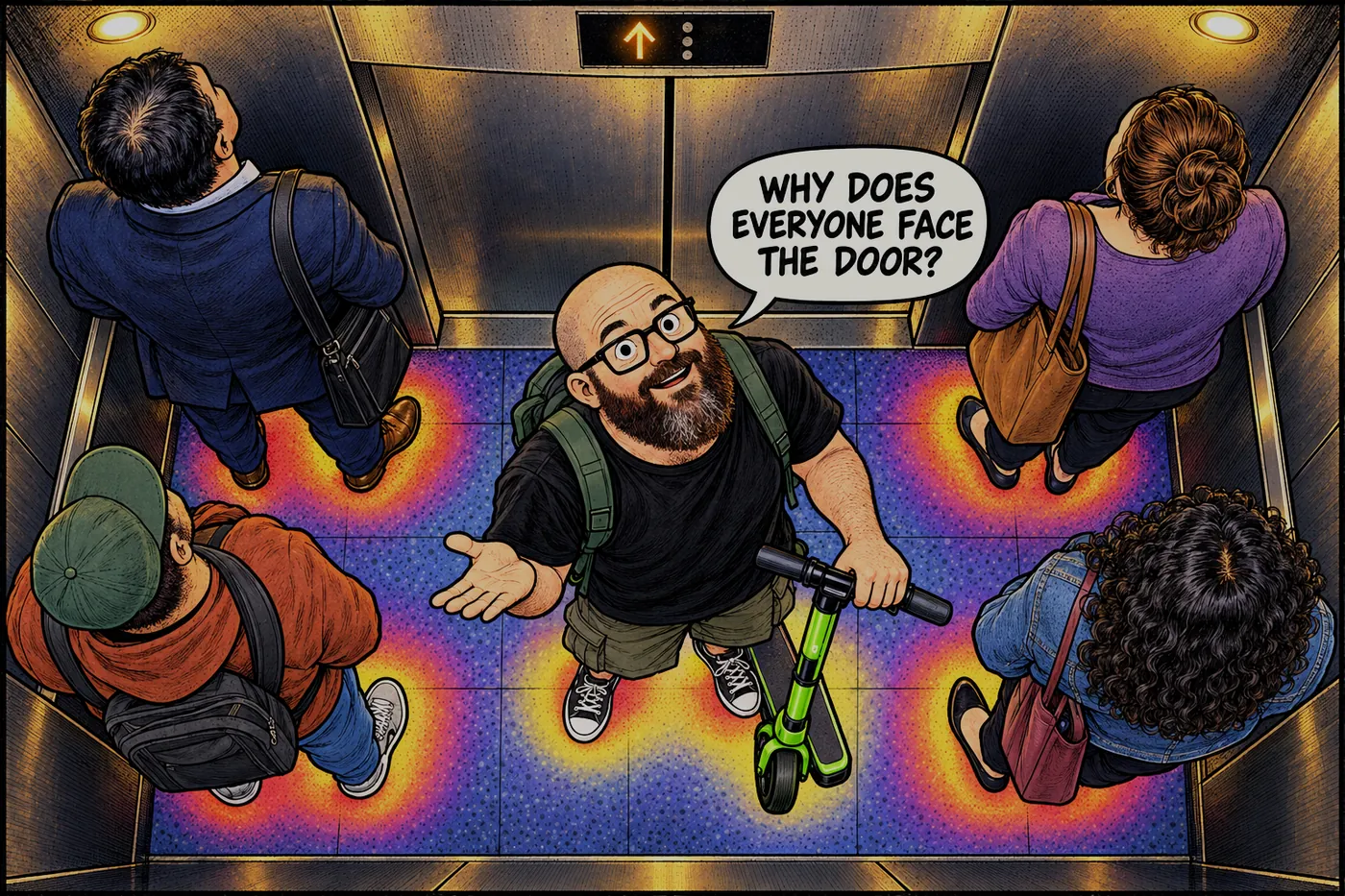
An elevator is a small room where strangers share a few square meters for thirty seconds and agree to pretend nobody else is there. Somebody measured it.
The short version
- Researchers at Tallinn University of Technology tracked 11,731 rides over 61 days on a smart elevator. 67.9% were solo. Alone, people stand in the middle. With company, they spread to the walls, away from the buttons and the door.
- Sabbath elevators run automatically, stopping at floors without anyone pressing a button, so observant Jews can ride without operating electrical switches. Rabbinic authorities disagree about whether riding is allowed at all.
- In 1999, Nicholas White was stuck in an elevator in Manhattan for 41 hours. The New Yorker turned it into a short film.
- “Tallest elevator” depends on the category: 578.5 m of travel inside Shanghai Tower, a 326 m elevator up a cliff in China, and a paternoster in Sheffield with 38 cabins.
- And yes, there’s a whole elevator-fan community that films rides, makes, and models, with YouTube channels like DieselDucy.
Where people stand
The Tallinn study used ceiling sensors in a working office elevator during April and May 2021 to see how people actually use the cab. The findings match everyone’s gut, now with data:
- Alone, riders tend to stand in the center of the car.
- With others, they keep their distance. Positions cluster against the wall opposite the button panel and floor indicator, and opposite the side where the door opens.
Two caveats: it’s one building, and the data comes from the pandemic era, when people may have spaced out more than usual. It’s still the best measured picture of the most awkward thirty seconds of the workday.
Sabbath mode
Jewish law restricts operating electrical devices on the Sabbath, so pressing a call button is out. The workaround is a Sabbath elevator: a car set to run on its own, stopping at every floor, or a preset list of floors, on a loop. Many elevators in Israel and in buildings with observant residents have it as a mode the controller can switch into.
It isn’t a settled question, though, and the debate is surprisingly technical. Peninei Halakha lays out three positions. Some authorities forbid riding, partly because a passenger’s weight makes the motor use more electricity. Some allow riding up but not down, because on the way down your added weight helps generate electricity (remember Floor 1’s regenerative drives?). A third view, which that source calls the primary one, allows riding because everything was set up before the Sabbath and the rider does nothing to operate it. It also asks riders not to step in while the door is closing, so the door doesn’t reopen because of them. From Floor 5’s point of view, Sabbath mode is just one more operating mode the controller has to get right.
Forty-one hours
Around eleven o’clock on a Friday night in 1999, Nicholas White, a production manager at Business Week, left his desk in the nearly empty McGraw-Hill Building to smoke a cigarette. His elevator stopped, and he was trapped for 41 hours, most of a weekend. The New Yorker covered it in a famous 2008 article and later in a short film, Up and Then Down.
The lesson echoes Floor 2 and Floor 7: nobody falls, but the wait can be brutal. It’s also why today’s codes insist the emergency button reaches a live person, around the clock.
Records need a category
“World’s tallest elevator” can mean very different things. Guinness keeps separate records:
The Hammetschwand ride originally took about three minutes. Schindler says upgrades now get it done in under one.
The elevator-fan community
There’s a whole online world of people who love elevators: filming rides, cataloguing makes and fixtures, and arguing about their favorite door operators. DieselDucy runs one of the best-known elevator channels on YouTube, full of ride videos. If Floor 3’s relay controllers made you happy, you’re one of them now.
Stand wherever you want. But if you're alone and drift to the middle, or you're with strangers and end up against the back wall facing the door, congratulations: you're a data point.
Sources
- Robal and Reinsalu (2025), How Do You Ride an Elevator? Passenger in-cabin behavior analysis on a smart-elevator platform
- Peninei Halakha: elevators on Shabbat
- The New Yorker: Up and Then Down (video)
- The New Yorker: Up and Then Down, by Nick Paumgarten (2008)
- Guinness World Records: tallest elevator in a building
- Guinness World Records: Bailong Elevator
- Guinness World Records: largest paternoster elevator
- Schindler: the Hammetschwand Lift
- DieselDucy (YouTube channel)