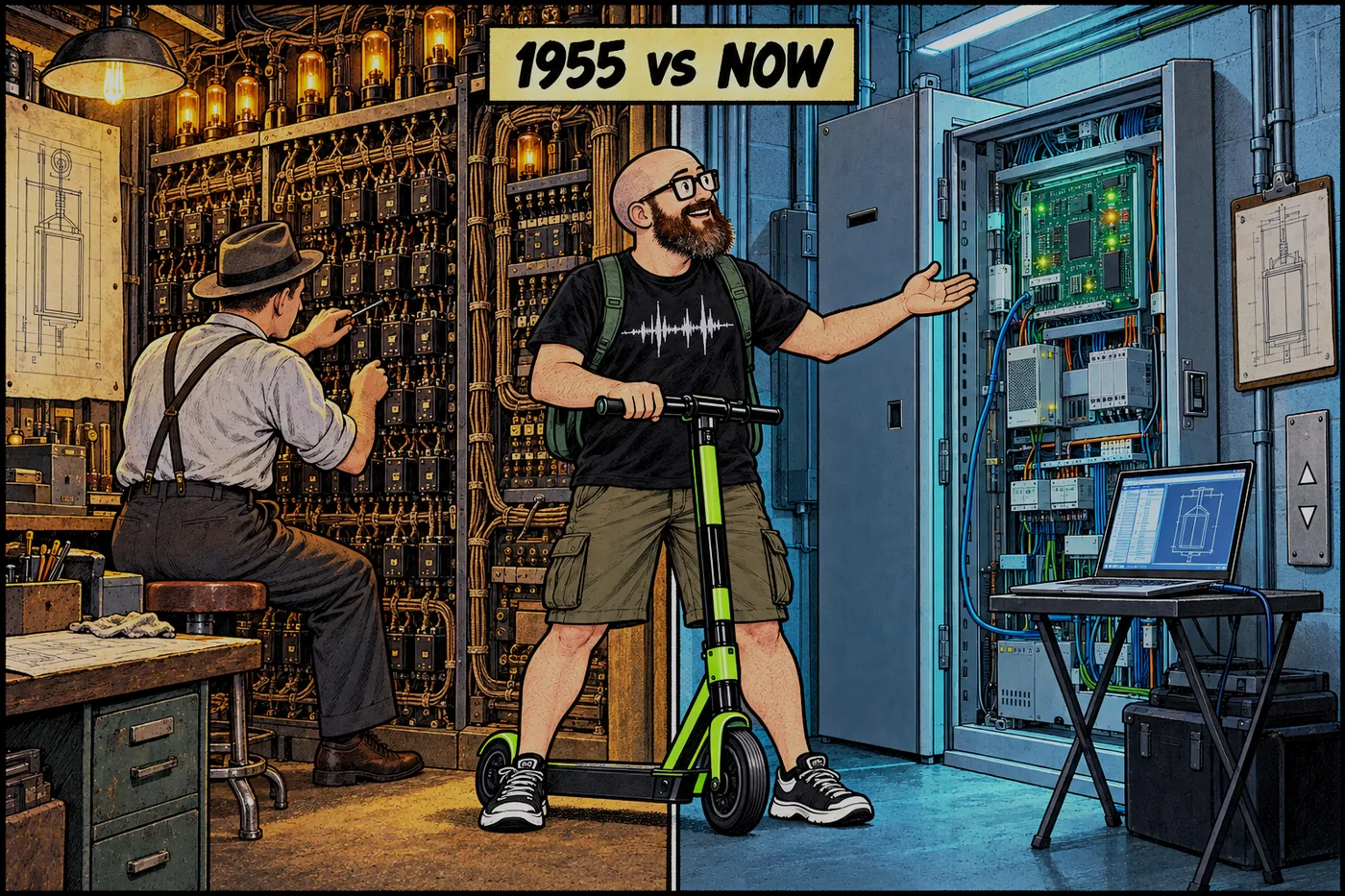
For most of the 20th century, the elevator's program was a wiring diagram. You could hear it think.
The short version
- Early electric elevators had a human operator running a lever. Automation didn’t take over until the 1940s and ’50s.
- For about 90 years, smooth speed control came from Ward Leonard motor-generator sets: a motor spinning a DC generator whose output drove the hoist motor.
- Logic lived in walls of relays. Floor selectors, timers, and interlocks were all mechanical and electrical, and techs debugged them by ear.
- Microprocessor controllers arrived in the 1980s, and variable-frequency drives replaced the motor-generators.
- A modern elevator is a small network: car controllers, a group supervisor, a drive, door operators, and fixtures, talking over CAN bus, serial links, and Ethernet.
- First electric elevator
Werner von Siemens shows an electric elevator in Mannheim, Germany.
- Ward Leonard control patented
A constant-speed motor spins a DC generator; varying the generator’s field gives smooth, stepless speed. Elevators use it for roughly 90 years.
- Relay logic grows up
Automatic “collective” controls answer calls in order without an operator, built entirely from relays, timers, and mechanical floor selectors.
- New York’s elevator strike
About 15,000 elevator operators and building workers walk out, stranding much of Manhattan. Building owners start shopping for automatic elevators in earnest.
- Microprocessors move in
Solid-state controllers replace relay racks. Thyristor and then AC variable-frequency drives replace motor-generator sets.
- The machine room disappears
Flat permanent-magnet motors fit inside the shaft, and the controller moves to a closet.
- The elevator joins the network
Controllers get Ethernet, remote monitoring gateways, and cloud dashboards. See Floor 6.
When you could hear it think
Walk into an old machine room and the controller is a steel cabinet, or a whole wall, of relays. Each floor has relays that latch when you press its button. A mechanical floor selector, basically a scale model of the shaft driven by the machine, tracks where the car is and trips contacts to slow it down at the right place. Timers are dashpots and thermal relays. When a call gets answered, you hear a cascade of clacks.
Troubleshooting meant a meter, the wiring diagram, and a good ear. The upside: everything was visible, and a skilled mechanic could fix almost anything with parts off the shelf.
The modern stack
Today the same job is split into layers, and each layer is its own computer.
- Car controller. One per car. Runs the doors, leveling, direction, special modes (Floor 5), fault handling, and the speed profile sent to the drive.
- Group supervisor. Owns the bank. Decides which car answers which call, parks idle cars, and switches strategies for morning rush, lunch, and evening (Floor 4).
- Drive. A variable-voltage, variable-frequency (VVVF) inverter that synthesizes three-phase power for the motor. It follows jerk-limited “S-curve” speed profiles, which is why a good elevator starts and stops without that stomach lurch. An encoder closes the speed loop.
- Position. Absolute encoders and landing-system magnets or tape in the shaft. After installation, the car does a slow learning trip to map every floor height into memory.
- Buses. CAN bus, RS-485, and proprietary serial links to car panels, hall fixtures, door operators, and load-weighing sensors. Ethernet between cars and the group computer.
Open-architecture controller makers publish enough to show how this is organized. MCE’s Motion series, for example, splits the car into operation control, motion control, and power control boards, with CAN ports where a handheld tool plugs in and Ethernet for a PC monitoring app.
What the technician sees
On a modern controller, the “machine room” is a small screen or a handheld tool. Typical menus include live car status (position, speed, direction, door state, safety chain inputs), a fault log with codes and timestamps, drive parameters (contract speed, acceleration, jerk, encoder counts, motor nameplate), hoistway learning, mode overrides for inspection and testing, raw I/O monitoring, and group screens showing every hall call and car assignment.
Some tools are physical keys to the kingdom. This video shows a technician restoring a Mitsubishi controller board’s program with the manufacturer’s service card, a rare look at OEM maintenance software.
Who gets those tools is a live fight. More on that on Floor 5.