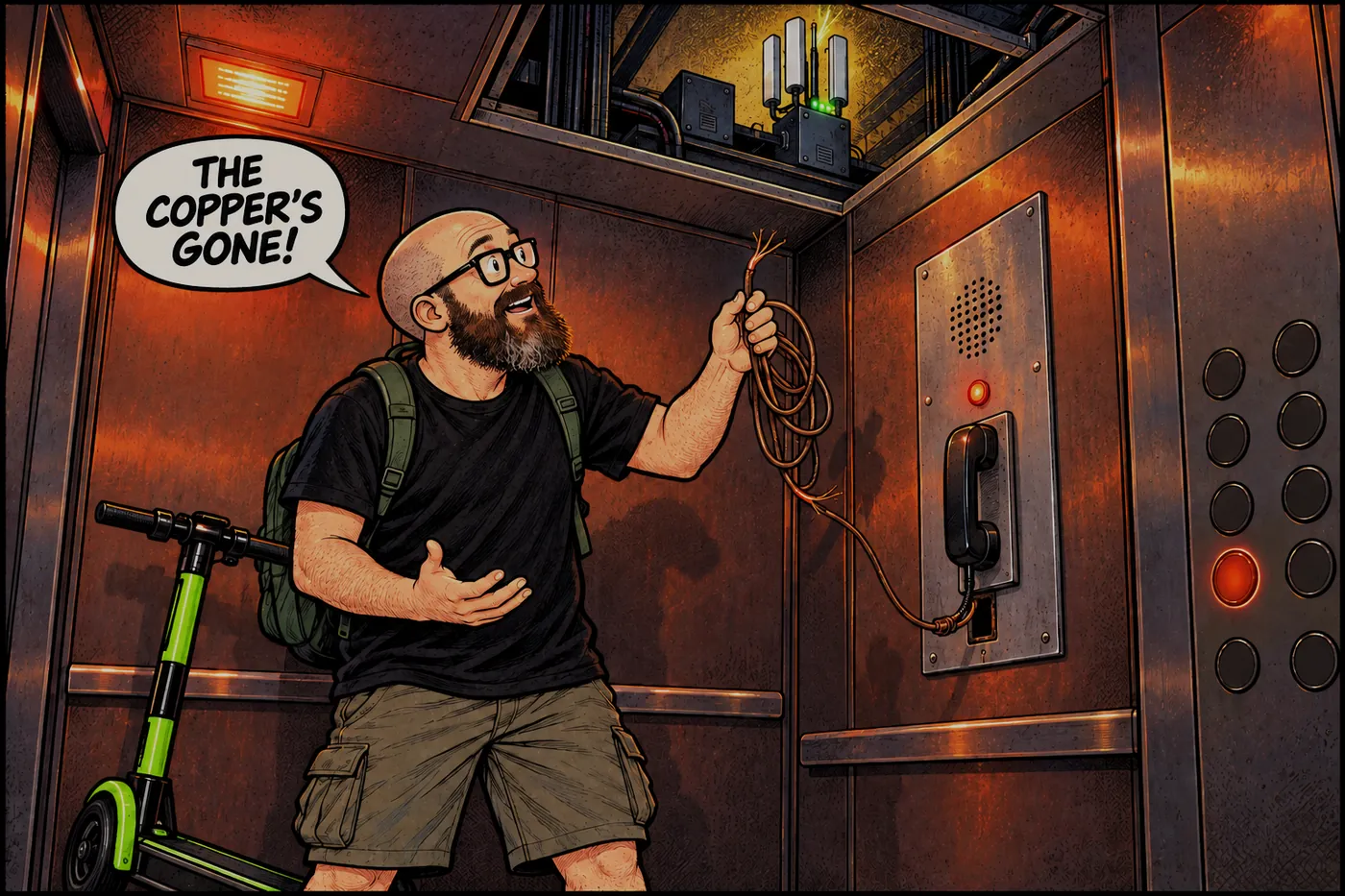
Find the oldest phone line in a modern office building and there's a decent chance it's the one in the elevator.
The short version
- Elevator codes require a two-way emergency communication device in every car. Press the button and you have to reach a real person who can send help.
- For decades, that meant an analog phone on a copper POTS line, usually one line per elevator bank, auto-dialing a monitoring company.
- Carriers are retiring copper. AT&T has said it plans to get out of most traditional landline service by 2029.
- The replacements are cellular communicators (often LTE, with battery backup and the antenna outside the steel shaft) or IP-based systems.
- The 2019 edition of the elevator code added a text or video requirement, so riders who are deaf, hard of hearing, or can’t speak can communicate too.
What the code actually asks for
In North America, ASME A17.1 section 2.27 covers emergency communication. The basics, in plain English:
- A button in the car that starts a two-way voice call, with no handset to pick up and nothing to dial.
- The call goes to authorized personnel who can respond around the clock, typically a monitoring service.
- A visual signal in the car that lights up when the call is acknowledged, so a rider who can’t hear knows help was reached.
- Since A17.1-2019, per the National Elevator Industry Inc., the code spells out requirements aimed at riders who are deaf, hard of hearing, or speech impaired, which in practice means a two-way text or video display in the car for buildings that fall under that edition.
The ADA standards add that the system can’t rely on voice alone.
Why the copper matters
A POTS line is a very simple, very reliable thing. The phone company feeds it power from the central office, so it keeps working when the building’s power is out. It has a dial tone you can test, and old elevator phones were designed around exactly that behavior.
That copper is going away. In late 2024 AT&T said it planned to eliminate traditional landline service in 20 of its 21 states by 2029, and other carriers are shrinking their copper networks too. According to emergency-phone vendor Kings III, an FCC change that took effect in March 2026 means carriers no longer need the agency’s approval before retiring copper, just 90 days’ notice to customers. So building owners are facing a forced upgrade on one of the most safety-critical phone lines they have.
What’s replacing it
- Cellular communicators. A box that presents a phone-line interface to the elevator phone and connects over LTE instead. Since steel and concrete shafts kill cell signal, the antenna usually goes on top of the car, in the machine room, or outside the hoistway, and the unit carries a battery because it no longer gets power from the phone company. Many are sold as “dual path,” with a second connection for backup.
- VoIP / IP systems. The elevator phone rides the building network. That works, but now the phone depends on the building’s power, switches, and internet, so battery backup and network design matter a lot more.
- Car displays. To meet the newer text and video rules, the car gets a small screen, and the monitoring center can type or show video back.
This is the kind of thing that breaks quietly. An analog adapter that doesn't pass the elevator phone's signaling cleanly, a cellular unit mounted where there's no signal, or a battery nobody has tested all look fine until someone actually presses the button. If you manage a building's phone lines, find out where the elevator lines are, what they're really connected to, and when someone last made a test call.
Sources
- NEII: elevator emergency communications and A17.1-2019 requirement 2.27.1
- UpCodes: ASME A17.1 Section 2.27
- Kings III: what the latest elevator code says about emergency phones
- USA Today: AT&T to eliminate most traditional landline service by 2029
- Kings III: POTS emergency phone replacement
- DataRemote: elevator emergency communication
- U.S. Access Board: ADA Accessibility Standards (section 407, elevators)