The fastest elevator on record climbs 440 meters in about 42 seconds, then comes back down at half speed, on purpose.
The short version
- The Guinness record belongs to a Hitachi elevator in the Guangzhou CTF Finance Centre: 21 m/s (47 mph) going up, certified in 2019.
- Before that, Mitsubishi Electric’s Shanghai Tower cars held the title at 20.5 m/s.
- The CTF record car goes down at 10 m/s. Hitachi also engineered cabin pressure control against the ear-popping.
- TWIN puts two independent cars in one shaft. MULTI throws out the rope entirely and uses linear motors, so cabins can move sideways.
- UltraRope swaps steel for carbon fiber so a single elevator run can approach a kilometer.
- And a few hundred paternosters, open cabins on a loop that never stop, still run in Germany.
The speed war
Hitachi’s CTF elevator goes from the ground floor to the hotel lobby on the 95th floor, 440 meters, in about 42 seconds. Hitachi’s spec sheet lists its rated speed as 1,260 m/min going up and 600 m/min going down. To keep that comfortable, the car has a capsule-shaped body borrowed from high-speed-rail design, active guides that damp vibration, and pressure control to fight blocked ears. The brakes use special heat-resistant friction material, because stopping a car from 47 mph turns a lot of motion into heat.
Mitsubishi’s Shanghai Tower cars set the Guinness record at 20.5 m/s in 2016, one of several elevator records the tower collected that year. Hitachi’s certificate came in 2019. If you’ve seen “world’s fastest elevator” attached to both buildings, that’s why.
Two cars, one shaft
TK Elevator’s TWIN runs two completely independent cars in the same shaft, each with its own motor, controller, and safeties. The upper car serves upper floors, the lower car serves lower ones, and the dispatch system has one extra hard rule: they never meet. If they get too close, drives cut out and the safety gear can engage. TK says the payoff is more capacity from the same building footprint, plus parking one car when traffic is light.
MULTI: no rope, and it goes sideways
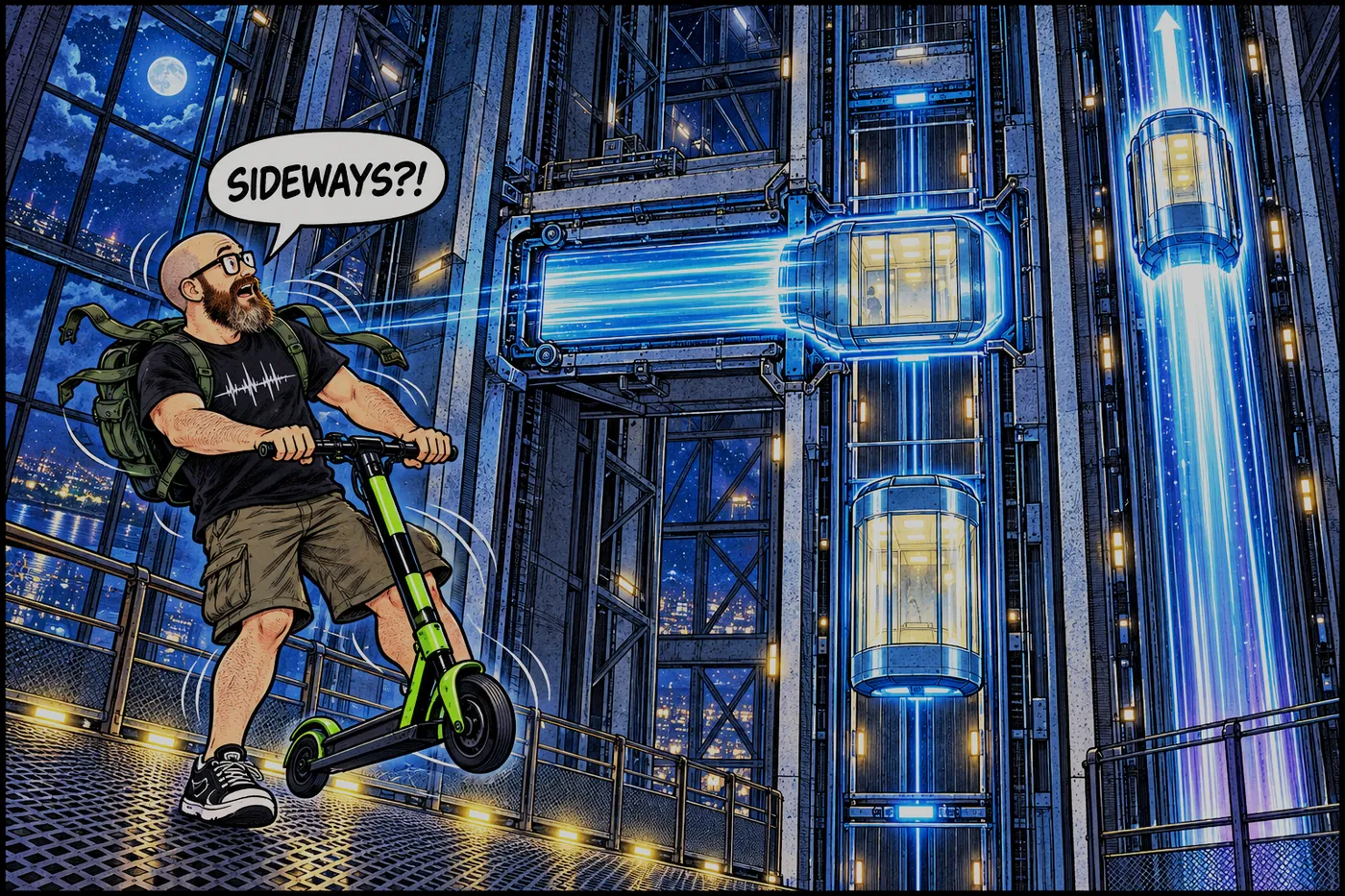
MULTI is the elevator from science fiction. There’s no rope. Each cabin rides on linear motors, the same basic idea as a maglev train, which means several cabins can share a loop of shafts, and a rotating section of rail can send a cabin horizontally into the next shaft. TK Elevator installed it in 2017 in its elevator test tower in Rottweil, Germany.
The honest status check: as of 2024, Wikipedia’s entry lists no MULTI installations outside test sites, so it’s still a test-tower story, not something you’ll ride at the office. Ropeless doesn’t mean brakeless either. The design literature leans hard on layered braking and dense sensors.
Carbon-fiber rope
In a really tall building, the steel rope itself becomes the problem. At some point most of what the motor lifts is rope, not people. That’s why supertall towers use sky lobbies, where you change elevators partway up. KONE’s UltraRope, launched in 2013, replaces steel with a carbon-fiber core. KONE says it’s a small fraction of the weight of equivalent steel rope, and that it makes single elevator runs of around a kilometer practical, roughly double the old limit. It was chosen for the planned Jeddah Tower in Saudi Arabia, a kilometer-class building designed around 58 elevators and all-digital destination dispatch.
The elevator that never stops
A paternoster is a chain of open cabins going up one side and down the other in a continuous loop, about as fast as a slow walk. There are no doors and no buttons. You step on, and you step off at your floor. West Germany banned new ones in 1974, but Germans love the survivors. A few hundred still run there, with more in the UK and Central Europe, and preservation campaigns have fought off attempts to shut them down.
The most-asked paternoster question: what happens if you stay on past the top floor? The cabin shifts sideways across the top of the loop and starts down the other side. It's perfectly safe, and the cabin stays upright.
Sources
- Hitachi: Guangzhou CTF elevator wins Guinness World Records title as the world's fastest (2019)
- Mitsubishi Electric: Shanghai Tower Guinness World Records (2016, PDF)
- Otis: SkyRise brochure (Burj Khalifa double-decks at 10 m/s, PDF)
- Wikipedia: Usain Bolt (top speed)
- Wikipedia: TK Elevator MULTI
- ENR: UltraRope can double the maximum run to 1 kilometer, says KONE
- Elevator World: the elevator designs of Jeddah Tower
- 99% Invisible: paternoster lifts
- Nationwide Lifts: Germans fight to keep paternoster elevators