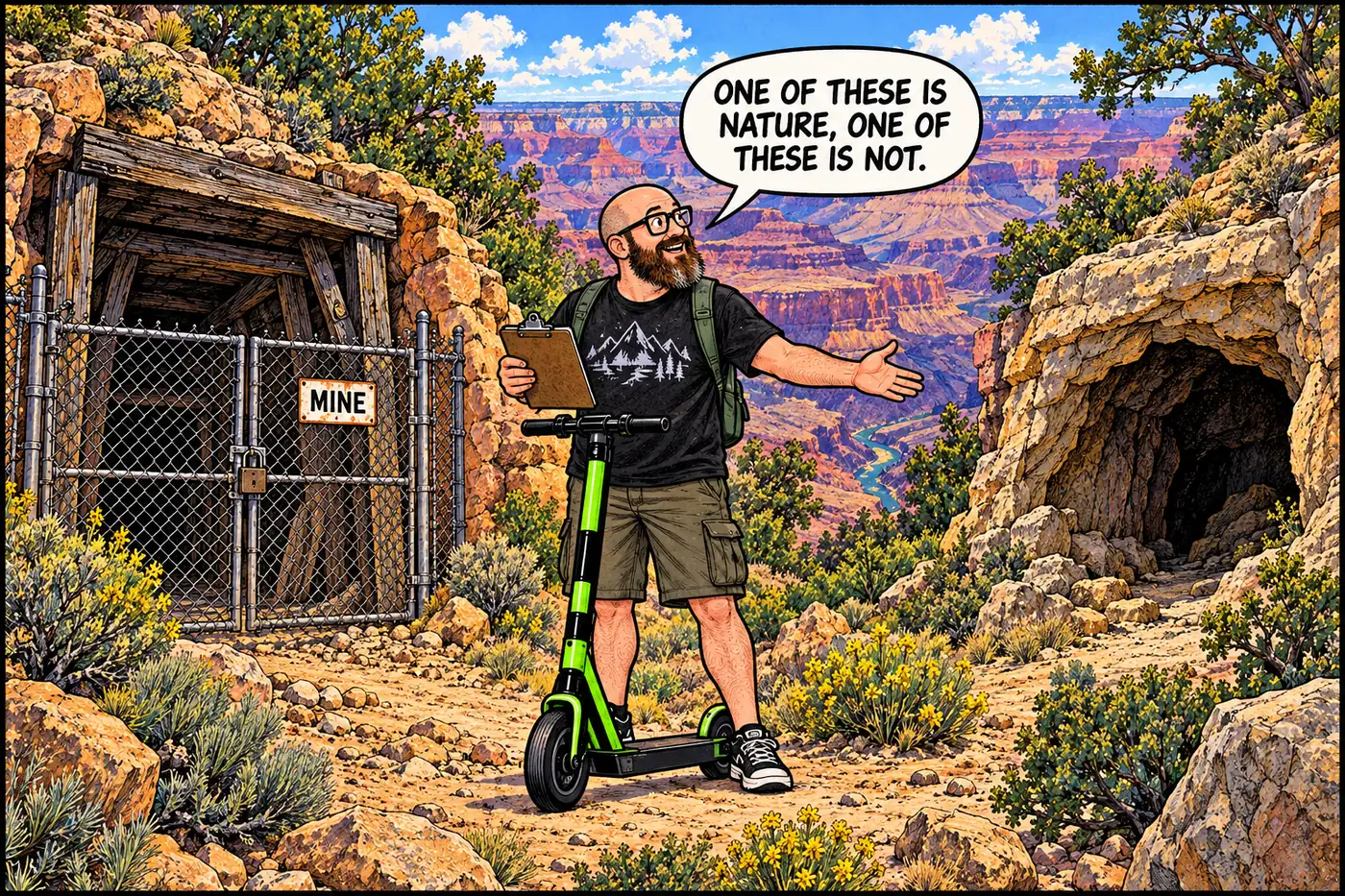
Grand Canyon National Park has a rule most visitors never read: every mine in the park — named or not, mapped or not — is closed to the public, full stop, unless you're doing NPS-sanctioned research. Not because the Park Service is hiding something. Because the region spent a century filling itself with holes nobody ever had to clean up.
The short version
- The park’s rulebook defines “mine” broadly — any excavated feature made for mineral extraction, from a single prospect pit to a tailings pile — and a blanket closure rule under 36 CFR 1.5(a)(2) bars public entry to all of them.
- That’s a deliberate legal distinction from caves: the same rulebook defines a cave as a naturally occurring void, explicitly excluding mines, tunnels, and other manmade excavations.
- The danger is real and well documented: shaft falls, cave-ins, toxic gas, oxygen deficiency, radon, asbestos, and old explosives are the standard hazard list, and drowning is the single most common cause of death in abandoned mines nationally.
- The root cause predates any park rule: the General Mining Law of 1872 let people claim and work hardrock minerals on federal land with no requirement to ever reclaim the site afterward.
- Nationally, federal agencies have identified at least 140,000 abandoned hardrock mine features — about 67,000 physical hazards, 22,500 environmental hazards — and spent roughly $2.9 billion addressing them between 2008 and 2017 alone.
- At Grand Canyon, that plays out as fences, gates, grates, and one 2009 federal closure project covering this park and three other Arizona units at once.
What counts as a “mine” — and what doesn’t
The Superintendent’s Compendium, the park’s official rulebook, defines “mine” for management purposes as “any anthropogenic feature excavated for the purpose of mineral extraction,” a category that includes adits, shafts, pits, tunnels, prospects, and tailings piles. That’s a wide net — it doesn’t matter whether the hole in question produced a fortune in uranium or never got past a single test pit.
The rulebook draws a sharp line next to that definition, borrowed from the Federal Cave Resource Protection Act of 1988: a “cave” is a naturally occurring void or passage, and the definition explicitly excludes “any vug, mine, tunnel, aqueduct, or other manmade excavation.” A lava tube or dissolution cavity gets managed under cave-protection rules; a hand-dug adit fifty feet away gets managed as a mine, under different regulations and a much simpler public-access answer. See Mines vs. Natural Caves for how the park tells the two apart in practice.
The blanket rule
Where cave access at Grand Canyon involves permits and case-by-case judgment (covered in Cave Management and Access Restrictions), mines get no such nuance. Compendium closure item (7), issued under 36 CFR 1.5(a)(2), states it plainly: “public presence, use, and access in all mines, as defined above, is prohibited except for individuals with special, written permission from the superintendent to conduct research or administrative business in the mine.” The stated justification covers four things at once — human health and safety, unrecorded historical or archaeological features, and wildlife habitat, particularly for bats (see Bat Habitat, White-Nose Syndrome, and Cave Closures).
On top of that blanket rule, the current compendium (effective June 16, 2026) names specific sites for emphasis: Orphan Mine, Bass Asbestos Mine in Hakatai Canyon, and river-corridor closures covering Hance Mine (River Mile 77.5 to 78.6) and the Bass Mine talus and camp area (River Mile 111.4). All four get called out by name specifically because they sit near trails, campsites, or river-runner routes where the blanket rule alone might not stop a curious hiker or boater.
Why they’re actually dangerous
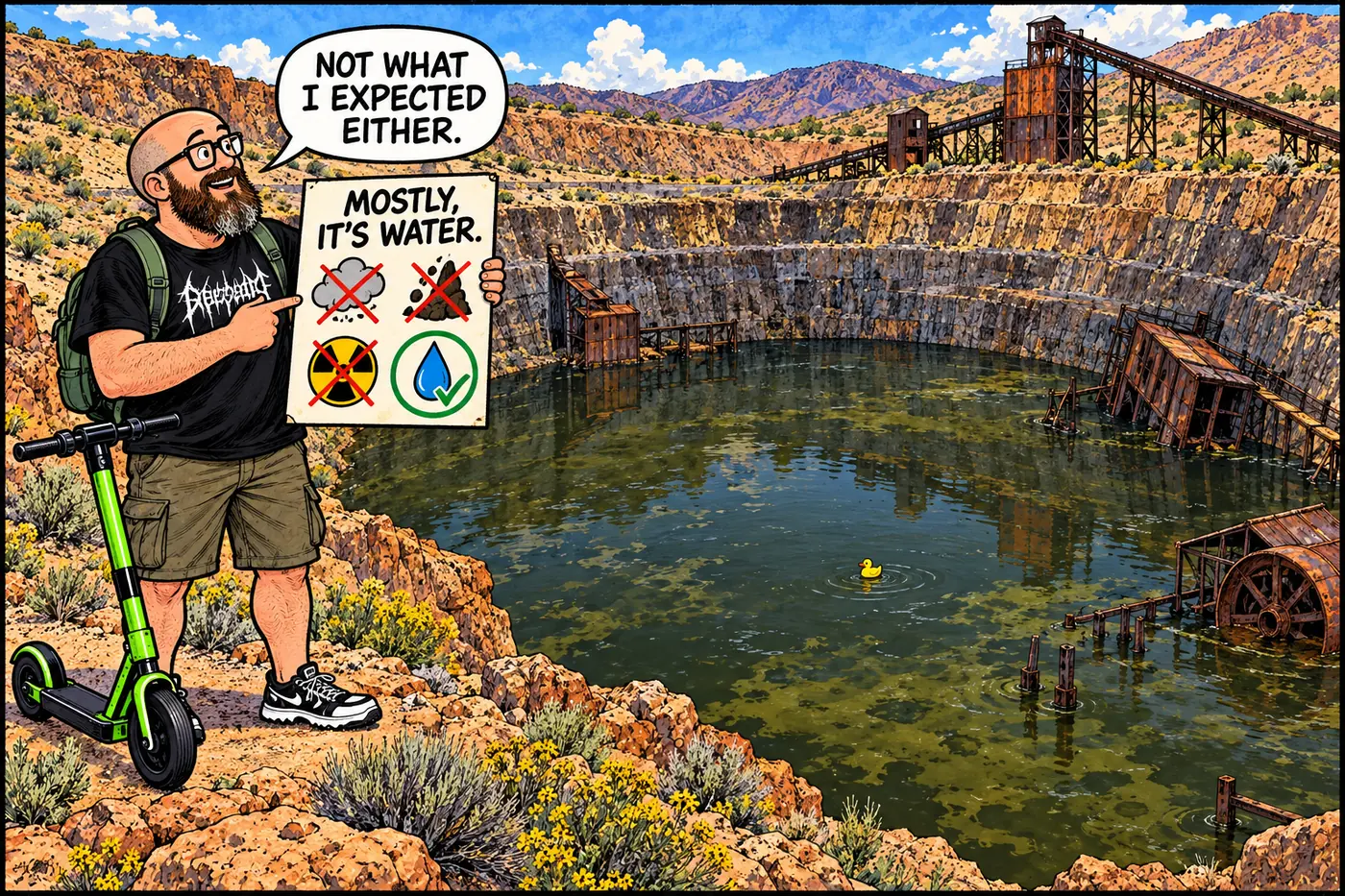
The hazard list isn’t abstract. NPS’s own program guidance for abandoned mineral lands groups the risks into physical and chemical/environmental categories: shaft falls, cave-ins, loose rock shedding off unsupported adit roofs, and drowning in flooded pits and quarries on the physical side; toxic gases (carbon monoxide, carbon dioxide, methane, hydrogen sulfide), oxygen-deficient pockets of still air, radon and other radioactive decay products, asbestos fiber, and old, unstable explosives on the chemical side. Nationally, drowning is the single most common cause of death in abandoned mines — not cave-ins, not gas, water.
A 2003 NPS Park Science study of the Grand View Mine, an old copper claim on the popular Grandview Trail about three miles from the South Rim, shows how those categories play out at ground level. Researchers measured waste-rock uranium readings up to 233 parts per million against a local background of about 1.8 ppm — some lab samples ran over 100 times background levels — largely because the mine’s waste rock sits on a breccia-pipe deposit, the same geology that makes uranium mining viable across the wider region (see Uranium Mining Around the Grand Canyon). The same study found the mine’s shafts and adits still physically open, hikers regularly stopping to explore the main entrance, and almost no warning signage at the trailhead itself — while backcountry permits did include a hazard notice. The researchers’ recommendation was blunt: reroute the trail and manage the worst waste-rock area as restricted. That’s a 2003 snapshot, not a claim about the site’s condition today, but it’s a clear illustration of the reasoning behind the park’s blanket mine closure: the hazard isn’t hypothetical, and warning signs alone don’t reliably keep people out.
Where the problem actually comes from
None of this is a Grand Canyon-specific failure. It traces back to the General Mining Law of 1872, which let individuals stake and work hardrock mineral claims on federal land without ever having to reclaim the site once the ore ran out. Operators pulled out copper, asbestos, and uranium for decades across the region — see Complete Inventory of Grand Canyon Mines for the full catalog — and simply left when the claim stopped paying. There was no legal obligation to backfill a shaft, remove equipment, or fence a tailings pile.
The scale of that legacy nationally is what makes the abandoned-mine problem a standing federal program rather than a one-off cleanup. A March 2020 GAO report found federal land-management agencies had identified at least 140,000 abandoned hardrock mine features on the land they oversee — about 67,000 posing physical safety hazards, 22,500 posing environmental hazards — and that agencies spent an average of roughly $287 million a year, about $2.9 billion total, addressing them between 2008 and 2017, with 88 percent of that money going toward environmental contamination rather than physical hazards. GAO’s own officials expect it will cost billions more to finish the job. Within the National Park System specifically, NPS counts roughly 38,000 abandoned mineral land features across all parks, and has set a goal of mitigating about 50 hazardous features per year using Inflation Reduction Act funding.
How a closure actually gets built
Fencing and signage — what’s visible at Orphan Mine and Bass Asbestos Mine today — is usually the fast, cheap first step while a park lines up money for something permanent. NPS’s toolkit for permanent mine closures includes backfilling, controlled blasting, expandable polyurethane foam, rock-and-mortar walls, steel grates over shafts, and bat-compatible gates or cupolas for adits that double as wildlife habitat. Which method gets used depends on the rock type, how hard the site is to reach, what materials can be hauled or flown in, and cost.
Grand Canyon’s own version of that process ran in 2009: NPS launched an ARRA-funded Abandoned Mine Lands Closure Plan covering this park alongside Coronado National Memorial, Organ Pipe Cactus National Monument, and Saguaro National Park — four Arizona units tackling the same problem under one environmental review. Public scoping ran from August 10 to September 8, 2009; the resulting Environmental Assessment went out for a 30-day comment period starting February 12, 2010. The proposed action was to close hazardous mine openings using methods matched to the specific hazard — bat-accessible gates, shaft grates, backfilling, fencing, or simple administrative closure — while protecting wildlife habitat and any historic value the site carried. No public completion report or final decision document for that specific plan turned up in this research; what’s documented is the scoping and EA stage, not a finished tally of which openings ultimately got gated.
What’s actually off-limits (and why)
The practical rule for a visitor is simple, even if the legal machinery behind it isn’t: don’t go into any mine opening anywhere in the park. That covers famous named closures like Orphan Mine and Bass Asbestos Mine, river-corridor closures like Hance Mine, and every unnamed prospect pit, adit, or shaft scattered through the backcountry that never made it onto a compendium list by name — they’re all covered by the same blanket rule. This is a different kind of closure than a cultural-resource or wildlife closure: it’s not protecting the site from the public so much as protecting the public from the site. For the park’s full closure landscape, see What Is Off-Limits.
Federal law lets individuals claim and work hardrock minerals on public land with no reclamation requirement — the root cause of the abandoned-mine problem nationwide.
Gold, silver, copper, and lead prospecting gives way to 20th-century asbestos mining, then uranium mining from the late 1950s through the mid-1980s.
Federal law defines "cave" as a natural void, explicitly excluding mines and other manmade excavations — the legal line the park still uses today.
NPS researchers document elevated radioactivity in waste rock on the popular Grandview Trail and recommend rerouting it around the worst area.
NPS scopes and drafts an Environmental Assessment to gate, grate, or backfill hazardous mine openings at Grand Canyon and three other Arizona parks.
GAO reports at least 140,000 abandoned hardrock mine features on federal land, with billions more in cleanup costs still ahead.
The current Superintendent's Compendium closes all mines in the park to public entry under 36 CFR 1.5(a)(2), with named emphasis on Orphan Mine, Bass Asbestos Mine, and the Hance/Bass river corridor closures.
Sources
- Grand Canyon National Park Superintendent's Compendium, effective June 16, 2026 — National Park Service
- Abandoned Mine Lands Closure Plan, Project Scoping for an Environmental Assessment — National Park Service, August 10, 2009
- ParkPlanning: Abandoned Mine Lands Closure Plan for Grand Canyon National Park — National Park Service
- Abandoned Mineral Lands — National Park Service
- Hazards and Safety — Abandoned Mineral Lands, National Park Service
- Hazards Mitigation — Abandoned Mineral Lands, National Park Service
- Abandoned Hardrock Mines: Information on Number of Mines, Expenditures, and Factors That Limit Efforts to Address Hazards — U.S. Government Accountability Office, GAO-20-238, March 2020
- The Legacy of the Grand View Mine — Ray Kenny, NPS Park Science, Vol. 22 No. 1, Fall 2003
- Bass Asbestos Mine Hakatai Canyon Superfund Site Profile (EPA ID AZD981680309) — U.S. Environmental Protection Agency
- Hance Asbestos Mine Superfund Site Profile (EPA ID AZD981680424) — U.S. Environmental Protection Agency
- Central Hazardous Materials Fund (CHF) — U.S. Department of the Interior