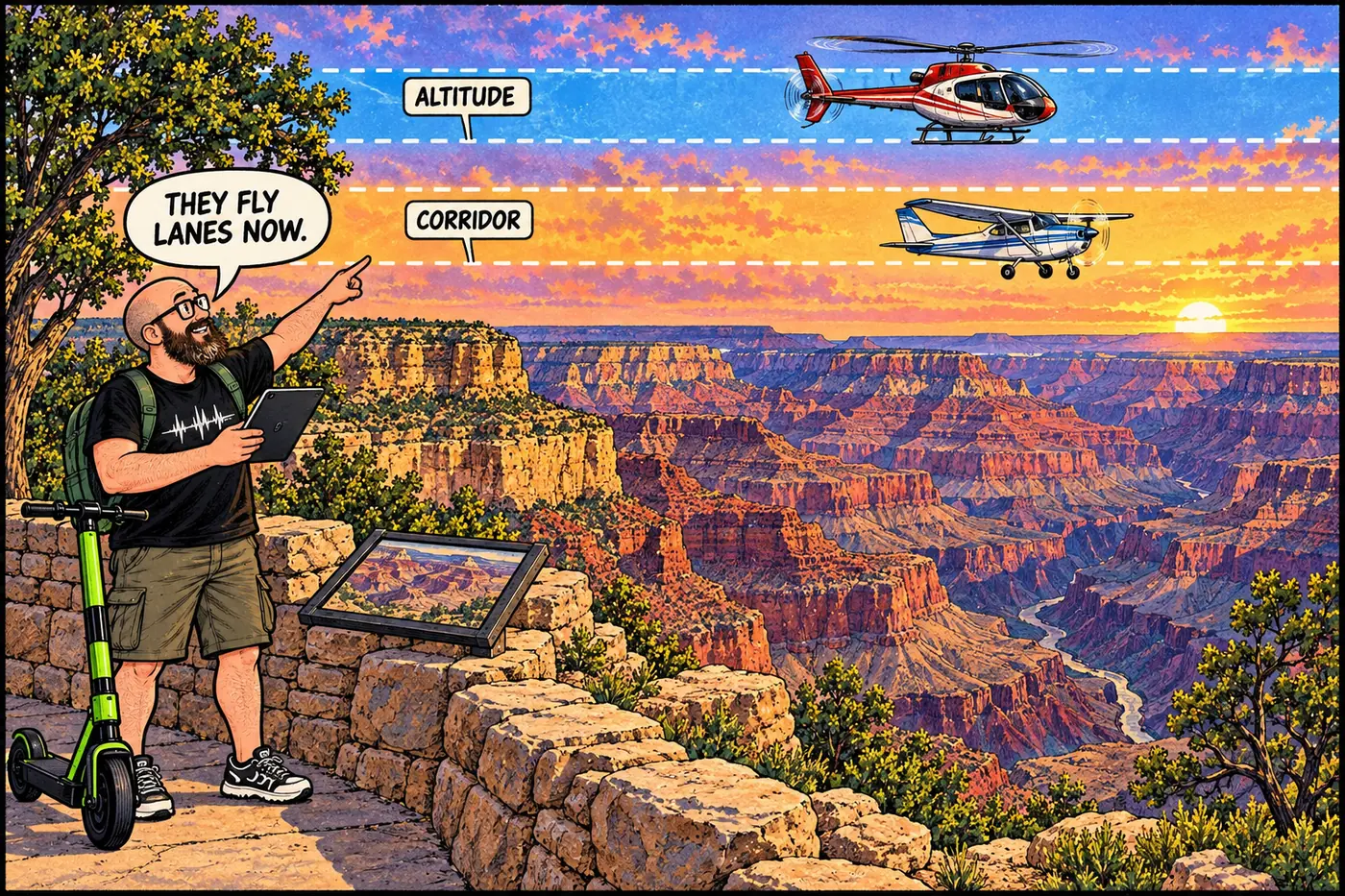
The Grand Canyon didn't just witness the accident that created the modern FAA — it witnessed a second one, thirty years later, that created its own private airspace rulebook. Today a scenic flight over the canyon runs on scheduled corridors, mandatory radio position reports, and a noise budget the park has to publish every year.
The short version
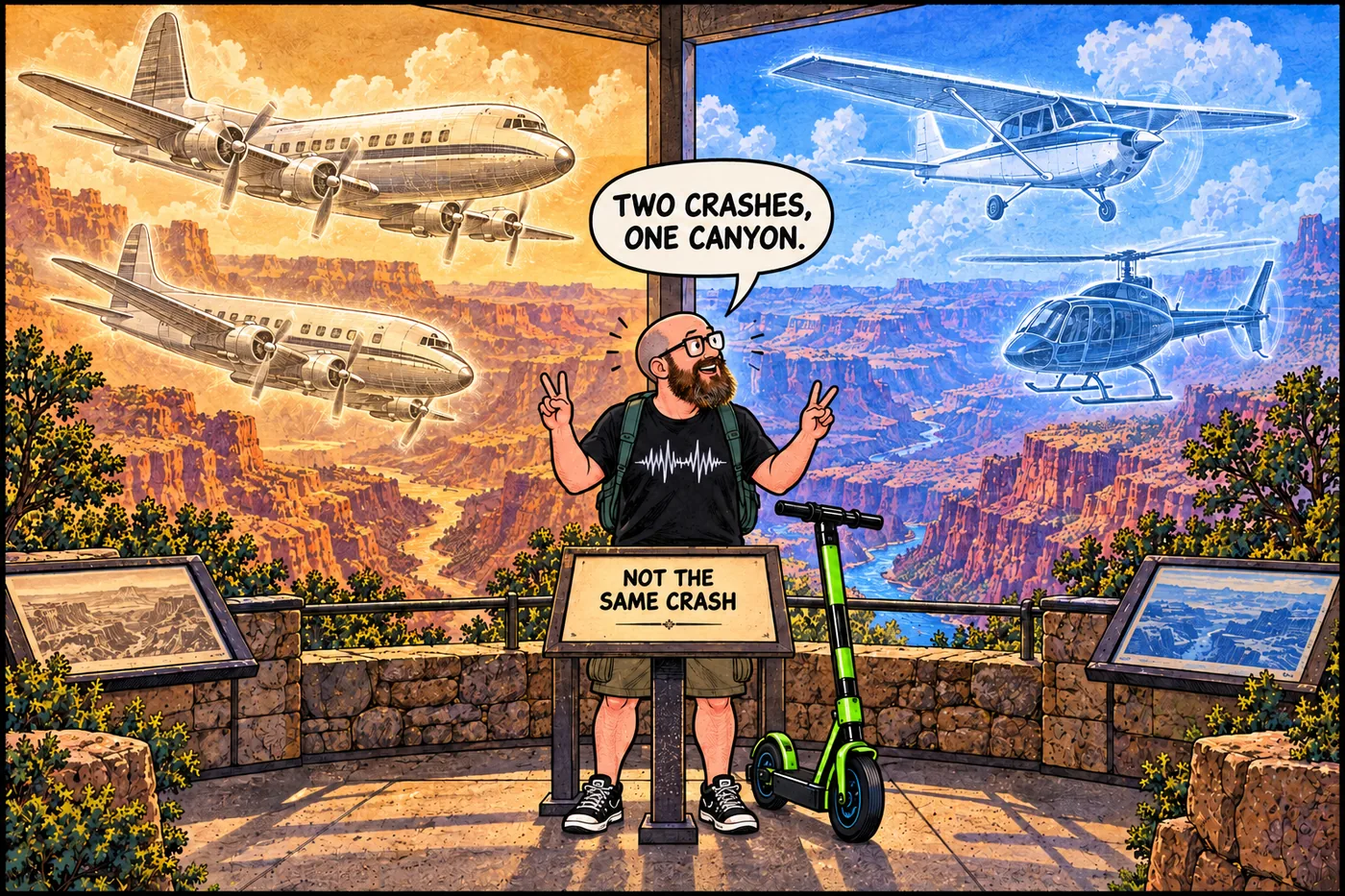
- On June 30, 1956, two airliners collided over the canyon in what was then the deadliest crash in aviation history — a disaster that helped push Congress to create the Federal Aviation Agency in 1958.
- A second, separate collision on June 18, 1986 — this one between two air-tour flights — killed 25 people and is the direct reason Grand Canyon airspace works differently from every other national park’s.
- The FAA answered the 1986 crash with emergency flight rules in 1987, tightened them in 1988, and finally locked them into permanent federal regulation in 2000: the Grand Canyon Special Flight Rules Area (SFRA).
- Grand Canyon is exempt from the general 2000 national-parks air-tour law — it runs on its own 1987 statute instead, aimed as much at noise as at safety.
- Commercial and transiting aircraft inside the SFRA follow fixed corridors, minimum altitudes, and mandatory radio reporting rules — but this page doesn’t carry the frequencies, and neither does the FAA’s public rulebook in a way this site would reproduce.
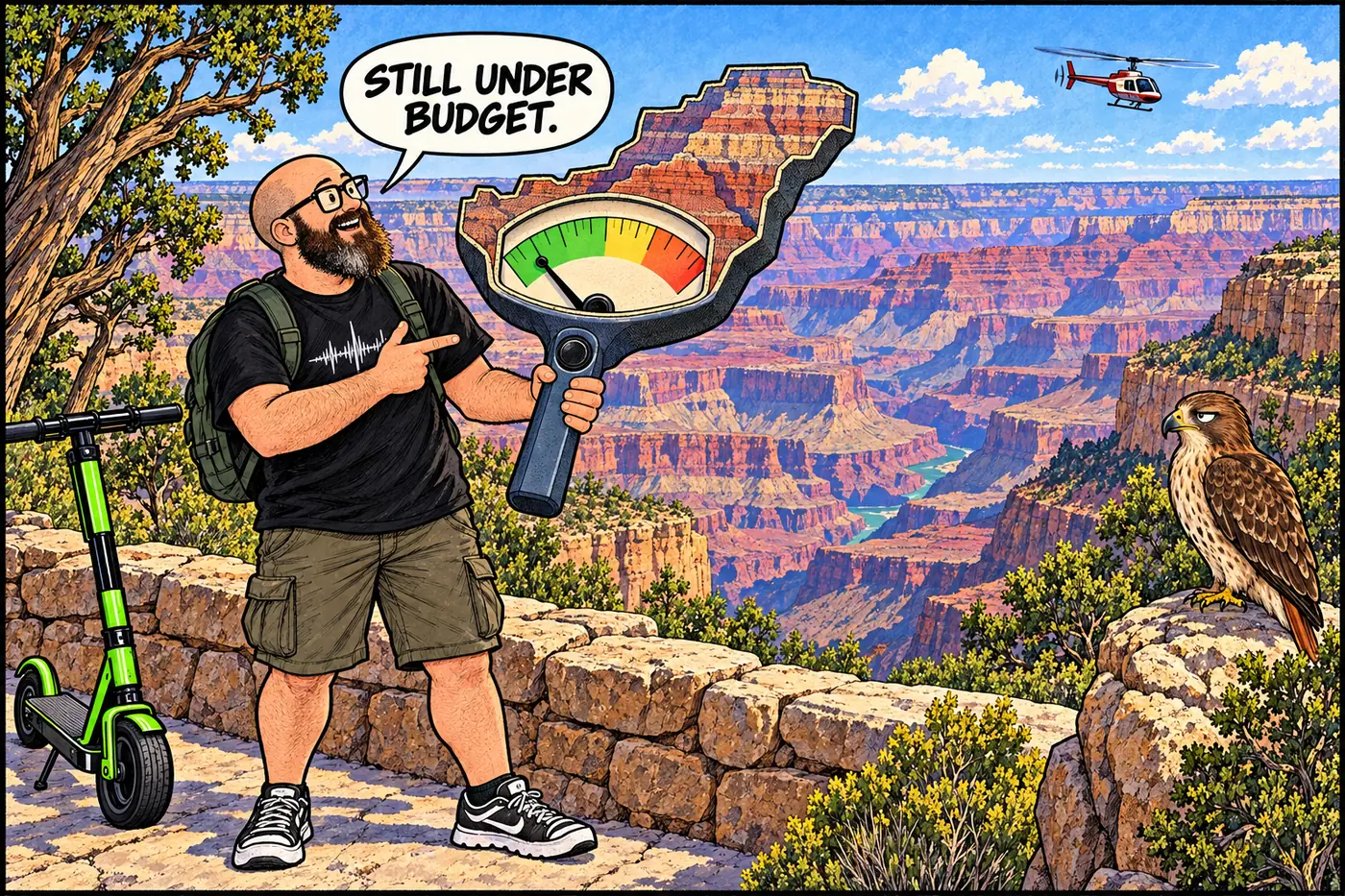
- The park has stayed under its legal noise limit every year since it started formally tracking that number in 2021, even as tour volume climbs back from a pandemic-era dip.
Two collisions, one airspace
Most places don’t have one aviation disaster that reshapes federal law. Grand Canyon has two.
The first came on June 30, 1956. TWA Flight 2, a Lockheed Super Constellation carrying 70 people to Kansas City, and United Air Lines Flight 718, a Douglas DC-7 carrying 58 people to Chicago, left Los Angeles International three minutes apart that morning. Both were flying under instrument flight rules that should have kept them at different altitudes over the canyon — then both pilots switched to visual flight rules, ended up at the same altitude, and never saw each other in time. All 128 people aboard both aircraft died; wreckage came down near the confluence of the Colorado and Little Colorado rivers, on Temple Butte and Chuar Butte, and only 30 bodies were ever recovered. It was, at the time, the deadliest civil aviation accident on record, and it exposed a system where two airliners could legally occupy the same block of sky over unradar’d terrain. That failure is a big part of why Congress passed the Federal Aviation Act of 1958, creating the Federal Aviation Agency (the FAA’s direct predecessor) and putting real teeth into national air traffic control.
That fixed the airline problem. It didn’t touch the canyon’s other aviation industry: scenic air tours, which had been flying tourists over the rim since the 1920s and multiplied through the 1970s and ’80s with no dedicated traffic rules of their own. On June 18, 1986, a Grand Canyon Airlines DHC-6 Twin Otter on an air-tour flight collided with a Helitech Bell 206 helicopter, also on a tour flight, at roughly 6,500 feet over the canyon. All 25 people aboard both aircraft were killed. This is the collision that actually built the regulatory system flying over the canyon today — because unlike 1956, it happened between two aircraft doing exactly the kind of low-altitude sightseeing flying that was, and still is, Grand Canyon’s signature aviation business.
From emergency order to permanent rule
The FAA’s first response to the 1986 crash was fast and blunt: Special Federal Aviation Regulation 50 (SFAR 50), issued in March 1987, imposing emergency flight restrictions over the canyon. It was tightened twice in the following year — SFAR 50-1 (June 1987) raised the minimum operating ceiling to 9,000 feet, and SFAR 50-2 (June 1988) barred flights below 14,499 feet outside designated corridors and established the park’s first flight-free zones.
Congress moved on the same timeline. The National Parks Overflights Act of 1987 (Public Law 100-91) found that aircraft noise was causing “a significant adverse effect on the natural quiet and experience of the park” and that current operations “have raised serious concerns regarding public safety” — pairing the safety argument from 1986 with a second, distinct goal: protecting the canyon’s soundscape. The law directed the Department of the Interior to recommend an air-traffic management plan and required the FAA to adopt it essentially as written, unless doing so would compromise aviation safety.
It took until December 31, 1996 for the FAA to publish a final rule converting the emergency SFAR 50-series orders into permanent federal regulation — a new Subpart U of 14 CFR Part 93. Even then, implementation of the core provisions (the SFRA boundary, flight-free zones, flight corridors, minimum altitudes) was delayed twice, first to January 1998 and then to January 2000, before finally taking effect. Today’s rule spells out flight-free zones and corridors, minimum altitudes, terrain-clearance requirements, a dedicated communications section requiring aircraft to report their position by radio while inside the SFRA, curfew hours for commercial tours, and quarterly reporting requirements for tour operators. None of the specific radio frequencies or reporting formats belong on a public page, and this one doesn’t carry them.
One structural quirk sets Grand Canyon apart from every other national park: it isn’t covered by the general National Parks Air Tour Management Act of 2000, which regulates commercial overflights almost everywhere else in the park system. Grand Canyon runs on its own, older 1987 statute and its own dedicated subpart of the federal aviation code — a separate legal track that exists because the canyon’s airspace problem got solved a decade before Congress tackled it for every other park.
The noise budget
The 1987 law’s other mandate — restoring “natural quiet” — turned into an actual number the park has to hit. The compliance standard, called Substantial Restoration of Natural Quiet (SRNQ), requires that no more than 50% of the park’s area may have aircraft noise audible more than 25% of the time. In plain terms: across at least half the park, the canyon has to be free of aircraft noise for at least three-quarters of every day. NPS and the FAA formally pinned down exactly how to measure that in a 2008 Federal Register notice, after years of the definition itself being disputed.
By the park’s own most recent published numbers, Grand Canyon has never exceeded that SRNQ threshold in any year since it began formally analyzing the data in 2021. Tour volume in the two primary corridors — known publicly as the Dragon and Zuni corridors — is still recovering from a pandemic-era drop: 25,738 tours flew those corridors in 2024, against a pre-pandemic (2015-2019) average of 42,131. Measured average aircraft noise has actually dropped over the same stretch, from a peak of 58.0 decibels in 2018 to 54.9 decibels in 2023 — a byproduct of quieter aircraft entering the commercial fleet under the rule’s technology incentives.
What’s actually off-limits (and why)
There’s no public closure zone tied to this topic the way there is for a fenced mine site — the SFRA is airspace regulation, not ground access. What’s restricted is what a pilot can legally do over the canyon: no operator, tour company, or transiting aircraft can fly outside the designated corridors, below the minimum altitudes, or through a flight-free zone, and none of that depends on where a visitor is standing. The one thing this page deliberately leaves out, per the same logic that governs every other communications topic on this site, is the actual mechanics — frequencies, call signs, specific reporting formats — that operators use to comply. That’s operational detail, not history, and it isn’t published here.
Two long-running commercial operators, Grand Canyon Airlines (flying tours since 1927 by its own account) and Papillon Grand Canyon Helicopters, are the visible face of an industry that’s flown under three different generations of federal rule in the last forty years. The infrastructure that supports search-and-rescue and firefighting aviation inside the park — a separate, non-tour operation with its own helibase — is covered on its own page: Grand Canyon aviation operations area. Where helicopters actually land inside the canyon, and what’s public record about those sites, is covered at helipads and remote helicopter sites.
128 killed when two airliners collide over the canyon after both switch to visual flight rules; a major factor in Congress creating the Federal Aviation Agency in 1958.
A fixed-wing air tour and a tour helicopter collide at roughly 6,500 feet; 25 killed. This crash, not 1956, is the direct origin of Grand Canyon's own flight rules.
The FAA issues emergency Special Federal Aviation Regulation 50; Congress passes the National Parks Overflights Act (PL 100-91), tying safety to a new "natural quiet" mandate.
Flights below 14,499 feet outside designated corridors are barred; the park's first flight-free zones are established.
The FAA converts the emergency orders into permanent regulation (14 CFR Part 93 Subpart U); after two delays, the core provisions take effect January 31, 2000.
NPS and the FAA formally define "Substantial Restoration of Natural Quiet" as no more than 50% of the park exceeding 25% time-audible.
The park stays under its noise threshold every year measured; tour counts and average decibel readings are published annually.
Sources
- Grand Canyon Airliner Collision — EBSCO Research Starters
- 1956 airline crash — Nature, Culture and History at the Grand Canyon (Grand Canyon Historical Society)
- Overflights - Chronology of Significant Events — National Park Service
- National Parks Air Tour Management Program — National Park Service
- Soundscapes: Overhead Flights — Grand Canyon National Park, National Park Service
- Public Notice: Clarifying the Definition of Substantial Restoration of Natural Quiet at Grand Canyon — Federal Register
- 14 CFR Part 93 Subpart U — Special Flight Rules in the Vicinity of Grand Canyon National Park, AZ (eCFR mirror)
- 1986 Grand Canyon mid-air collision — Wikipedia (used only to corroborate date/altitude/fatality count already reported elsewhere; flagged as last-resort source)
- Grand Canyon Scenic Airlines — company site
- Papillon Grand Discovery South Rim Airplane Tour — company site