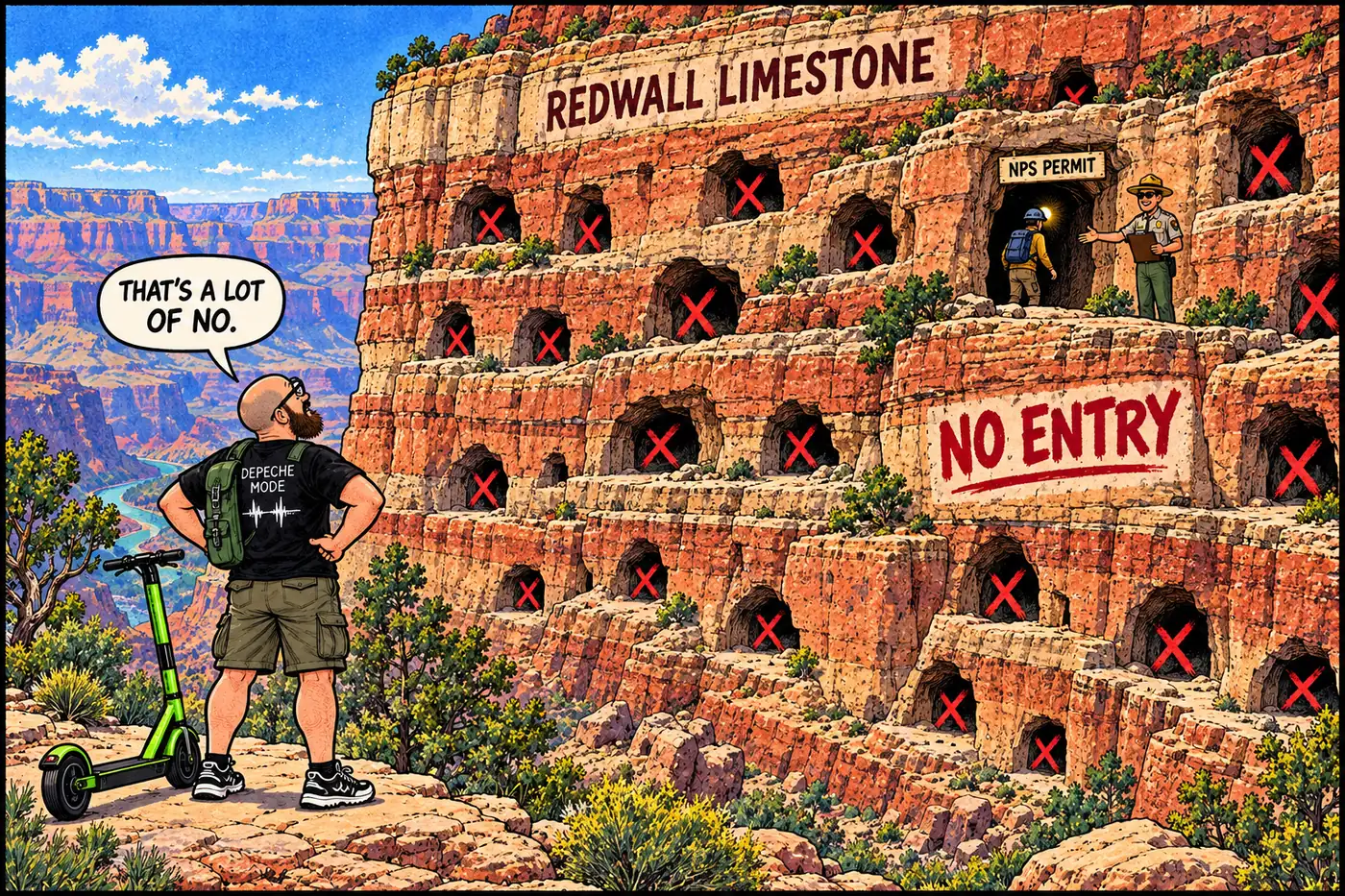
Grand Canyon holds thousands of candidate cave openings and almost no public information about most of them, by design. A 1988 federal law makes cave locations legally confidential, and the park backs it with a blanket permit requirement that predates the law itself.
The short version
- The Federal Cave Resources Protection Act of 1988 (FCRPA) is the national law behind cave secrecy: it lets federal agencies withhold the specific locations of “significant caves” from public-records requests.
- Grand Canyon’s own rule goes further than “don’t publish the address” — it requires a superintendent-issued permit just to enter any cave in the park, full stop.
- That permit requirement isn’t new. The park’s 1988 Backcountry Management Plan already pointed caving activity to a Cave Management Plan, with only one named exception (Cave of the Domes, since closed — see the companion dossier).
- Access splits into two tracks: a basic “cave entry permit” for some caves, and a full NPS research permit — CV, proposal, two peer reviews, up to 90 days review — for surveys and other substantial cave work.
- River-corridor rules stack additional, specific closures on top of the general permit requirement: Bat Cave and Rampart Cave are both flatly off-limits by river mile.
- FCRPA’s definition of “cave” pointedly excludes old mines and tunnels — which is why Grand Canyon’s mine closures and its cave closures run on separate legal tracks even though they look similar from the trail.
The federal law behind the secrecy
Congress passed the Federal Cave Resources Protection Act of 1988 — Public Law 100-691 — on November 18, 1988, after concluding that “significant caves on Federal lands are an invaluable and irreplaceable part of the Nation’s natural heritage” and that some of them were “threatened due to improper use, increased recreational demand, urban spread, and a lack of specific statutory protection.” The law’s stated policy is that federal lands “be managed in a manner which protects and maintains, to the extent practical, significant caves.”
FCRPA is specific about what counts as a cave and, just as importantly, what doesn’t. It defines a cave as “any naturally occurring void, cavity, recess, or system of interconnected passages which occurs beneath the surface of the earth or within a cliff or ledge… but not including any vug, mine, tunnel, aqueduct, or other manmade excavation.” That single clause is why an old copper adit and a limestone cave a hundred yards apart on the same cliff face are managed under completely different legal frameworks at Grand Canyon — the mine falls under abandoned-mine safety and CERCLA cleanup rules, the cave falls under FCRPA and the park’s cave permit system.
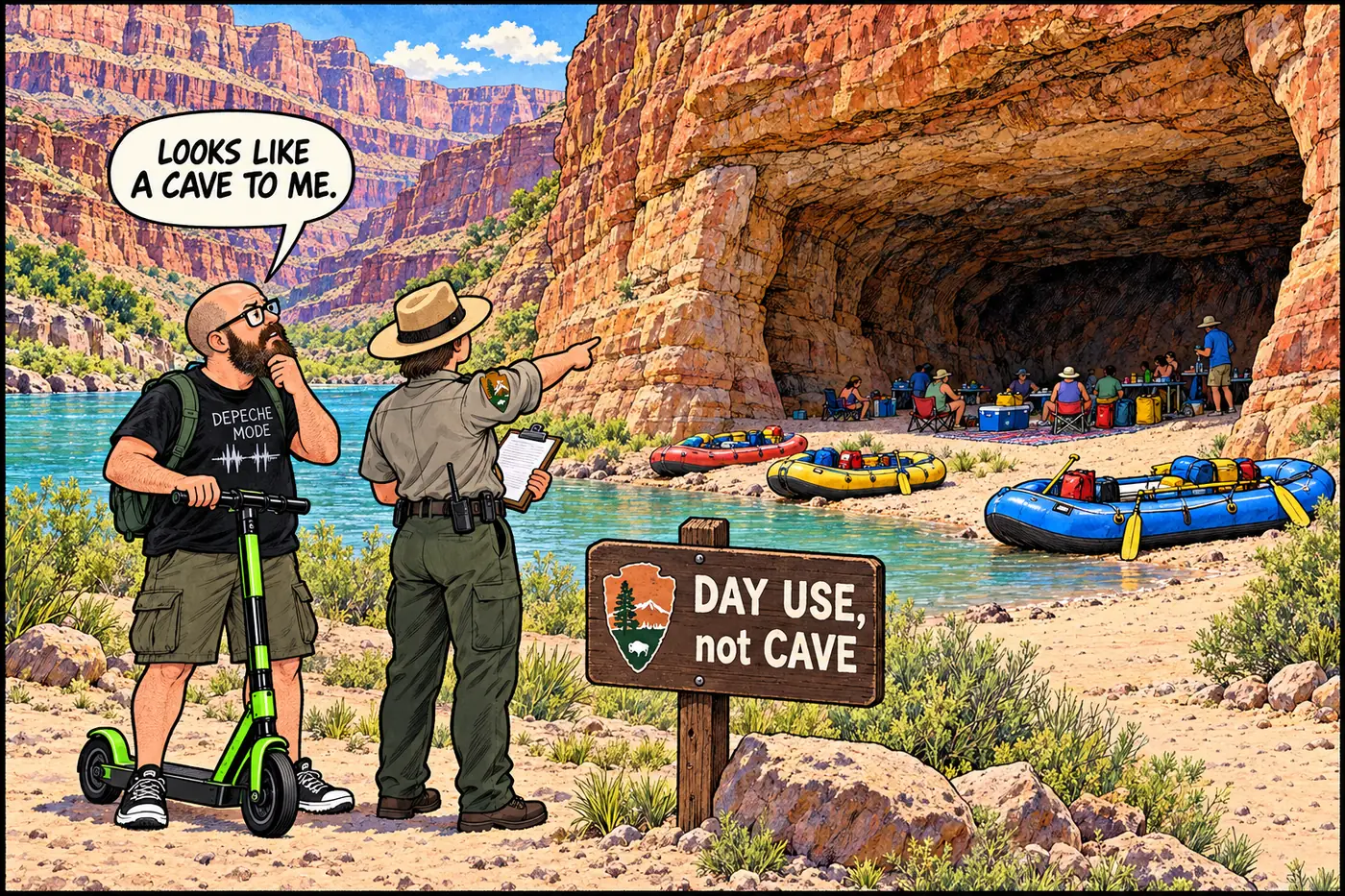
Grand Canyon adds its own wrinkle to the federal definition. The current Superintendent’s Compendium extends the FCRPA definition, for the park’s own management purposes, to “any dissolution or erosion feature 50 feet or longer where the entrance is not wider than the cave is long” — and gives an explicit example of what that excludes: “Redwall Cavern is not a cave by definition.” The Colorado River’s famous, cathedral-mouthed Redwall Cavern is wide open at its entrance, so it gets managed as a day-use river site instead of a cave. It’s a small technical distinction with a real practical consequence: different rules, different signage, different enforcement.
The law’s other major tool is confidentiality. Once a cave is designated “significant,” its specific location “may not be made available to the public… unless the Secretary determines that disclosure of such information would further the purposes of this chapter and would not create a substantial risk of harm, theft, or destruction of such cave.” Federal and state agencies, and bona fide research institutions, can request that information in writing, but they have to describe exactly what they want it for and show they’ll keep it confidential. Violating the Act’s core protections — damaging, removing from, or entering a significant cave to do either — carries up to a year in prison (three years for repeat offenses) and civil penalties up to $10,000 per violation.
Grand Canyon’s own permit wall
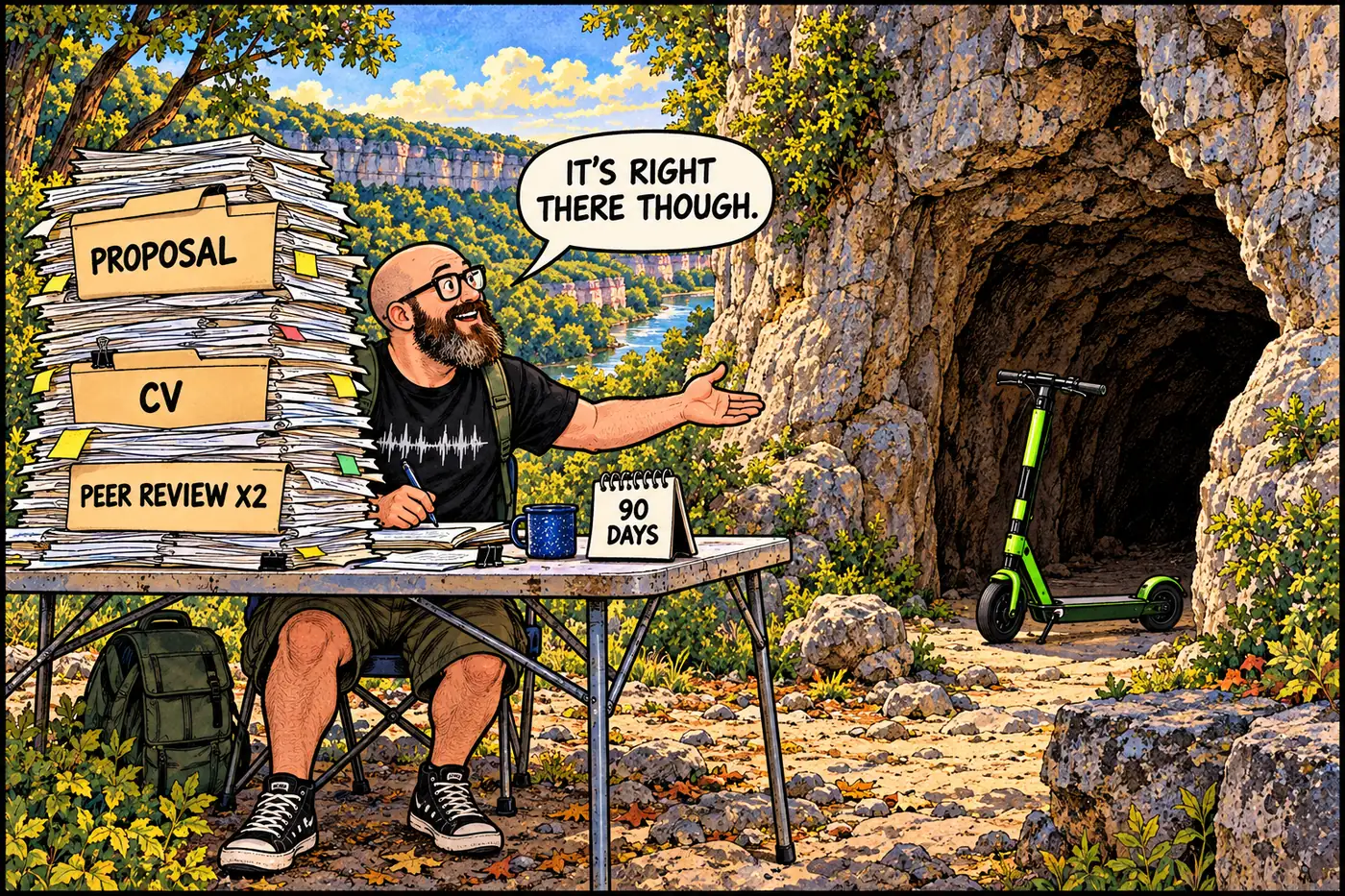
FCRPA sets a floor; Grand Canyon builds well above it. The park doesn’t just protect cave locations — it requires a permit to set foot in a cave at all. The current compendium states it in one sentence: “Because of their sensitive and sometimes dangerous nature, public presence, use and access in all caves… is prohibited without a valid permit authorized by the superintendent explicitly authorizing use of the cave,” citing 36 CFR §§ 1.5 and 1.6. The stated reason isn’t just safety — it’s “to protect the many unrecorded features, archaeological resources, and various life that may reside in the thousands of Grand Canyon caves.” NPS’s own cave-resources page backs that up in plainer language: “Under the current park policy, all caves are currently closed to visitation, except for research purposes,” and lists “unauthorized access (caving in the Park is illegal)” as one of the park’s biggest cave-management headaches.
This isn’t a recent tightening. Grand Canyon’s 1988 Backcountry Management Plan already routed all caving activity through what it called “the park’s Cave Management Plan,” administered by the Resources Management and Planning Division — with a single named exception at the time, Cave of the Domes, which has since lost that special status. This project could not locate a publicly posted copy of that standalone Cave Management Plan itself; what’s documented is that it exists, that it’s been the governing reference for cave decisions since at least the late 1980s, and that its substance shows up consistently across everything the park has published about caves since.
In practice, getting into a Grand Canyon cave today runs through one of two doors. NPS staff and published cave-research papers describe a split system: a narrower “cave entry permit” for basic access to some caves, granted through the park’s science and resource-management office, and a full research permit for anything more involved, like surveying. The general research-permit process — which covers cave science — asks for an application, a complete research proposal, a CV, and two peer reviews, submitted through NPS’s national Research Permit and Reporting System, with review that “can take up to 90 days.” Reviewers weigh questions like whether a project would “result in degradation of the values and purposes of the park” or “unreasonably disturb park resources or visitors.”
Researchers do get in, on those terms. The Grand Canyon Cave Research Project — a National Speleological Society-affiliated volunteer group — works under ongoing NPS permits and has, by its own count, found 195 new caves and mapped more than 73 miles of passage inside the park. Its best-known discovery, the eight-mile Leandras Cave, was surveyed over three seasons (2007-2009) by volunteer teams that logged roughly 700 hours underground plus another 500 mapping the results — the kind of sustained, permitted access that ordinary visitors simply don’t get.
Layered closures on the river
The park-wide cave-permit rule isn’t the only barrier. The river-corridor regulations add specific, named closures on top of it. Entry into Bat Cave, at river mile 266.8, is prohibited outright. Entry into Rampart Cave, at river mile 274.5, is prohibited outright. Camping is banned within 300 yards of the nearby Cave Canyon/Columbine Falls confluence at river mile 274.3. Both caves carry scientific and historical weight — Bat Cave for its failed 1950s guano-mining operation and unusually rich invertebrate ecosystem, Rampart Cave for one of North America’s most important Ice Age fossil deposits, destroyed in large part by a 1976 fire (both covered in the companion dossier on documented cave research). The permit system protects the caves generally; the river regulations protect these two specifically, by name, river mile, and rule number.
What’s actually off-limits (and why)
Strip away the different legal mechanisms and the pattern is consistent: at Grand Canyon, a cave is closed unless someone with a specific, reviewed, superintendent-approved reason gets a permit to go in. FCRPA supplies the federal floor — confidentiality of significant-cave locations, criminal and civil penalties for damage or unauthorized removal, and a national Cave Research Program run through NPS. Grand Canyon’s own compendium and cave-management practice go further, requiring entry permits for every cave in the park regardless of significance designation, with white-nose-syndrome bat protection now folded into that same permitting framework through gear screening, decontamination protocols, and cave-specific closures. The result is a park where “thousands” of caves exist on paper and almost none of them are somewhere a visitor can simply walk into.
Congress passes the Federal Cave Resources Protection Act (Pub. L. 100-691), establishing national policy to protect significant caves and keep their locations confidential.
The park's Backcountry Management Plan documents an existing Cave Management Plan requiring advance approval for all caving, with one standing exception.
An FCRPA amendment directs the NPS Director to create a formal Cave Research Program for research, education, and evaluation of cave resources.
Volunteer cavers under NPS permit survey Leandras Cave to more than 8 miles across three seasons, demonstrating the permitted-research track in action.
The current Superintendent's Compendium confirms that entry into any Grand Canyon cave requires a superintendent-authorized permit, layered with river-mile-specific closures at named caves.
Sources
- 16 U.S.C. Chapter 63 — Federal Cave Resources Protection — Office of the Law Revision Counsel, U.S. House of Representatives
- Grand Canyon National Park Superintendent's Compendium, effective June 16, 2026 — National Park Service
- Backcountry Management Plan, September 1988 — Grand Canyon National Park, National Park Service
- Cave / Karst Systems — Grand Canyon National Park, National Park Service
- Science Research - Permits — Grand Canyon National Park, National Park Service
- Rice, S., "Hidden wonder: The discovery and survey of Leandras Cave, Grand Canyon National Park," Park Science v.29 n.1 (2012) — National Park Service
- Pape, R.B., "Biology and Ecology of Bat Cave, Grand Canyon National Park, Arizona," Journal of Cave and Karst Studies v.76 n.1 (2014)
- Grand Canyon Cave Research Project — Caving Research (National Speleological Society-affiliated project)
- Fungus That Causes White-Nose Syndrome Possibly Detected At Grand Canyon National Park — National Parks Traveler
- Notes from NPS Management Meeting at NSS Convention — National Park Service