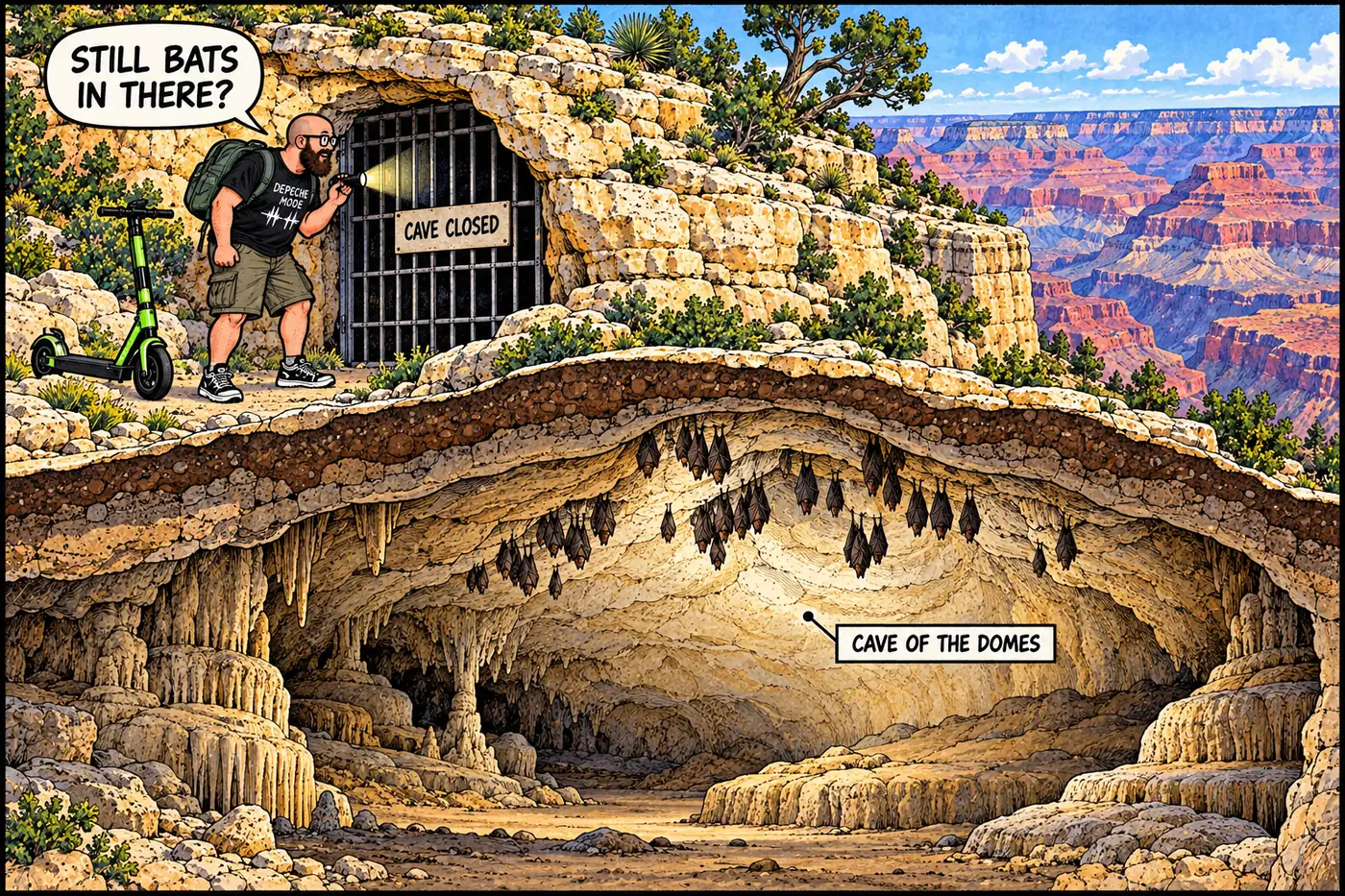
For most of the last century, Cave of the Domes was the one hole in the ground at Grand Canyon you could walk into without asking anyone's permission. It survived a copper bust, a hantavirus scare, and decades of mule-tour tourism. Bats are what finally closed it.
The short version
- Cave of the Domes sits at the end of the Grandview Trail on Horseshoe Mesa, next to the old Last Chance copper mine that first brought tourists down there in the 1890s.
- It was, for decades, the single named exception to Grand Canyon’s blanket cave-permit rule — the only cave in the park you could enter without written NPS authorization.
- In March 2016 it was briefly closed over a hantavirus scare tied to rodent activity, then reopened two months later once NPS ruled it out as the exposure source.
- As late as December 2019, NPS was still describing it as “the one cave in Grand Canyon National Park open to the public.”
- Sometime after that — the exact date isn’t nailed down in what NPS currently publishes — the open-access exception ended. The current Superintendent’s Compendium closes it outright, citing bat protection.
- The reason is white-nose syndrome: a fungal disease that has wiped out bat colonies across the country, and that human foot traffic and gear can carry from cave to cave.
A copper mine’s tourist trail
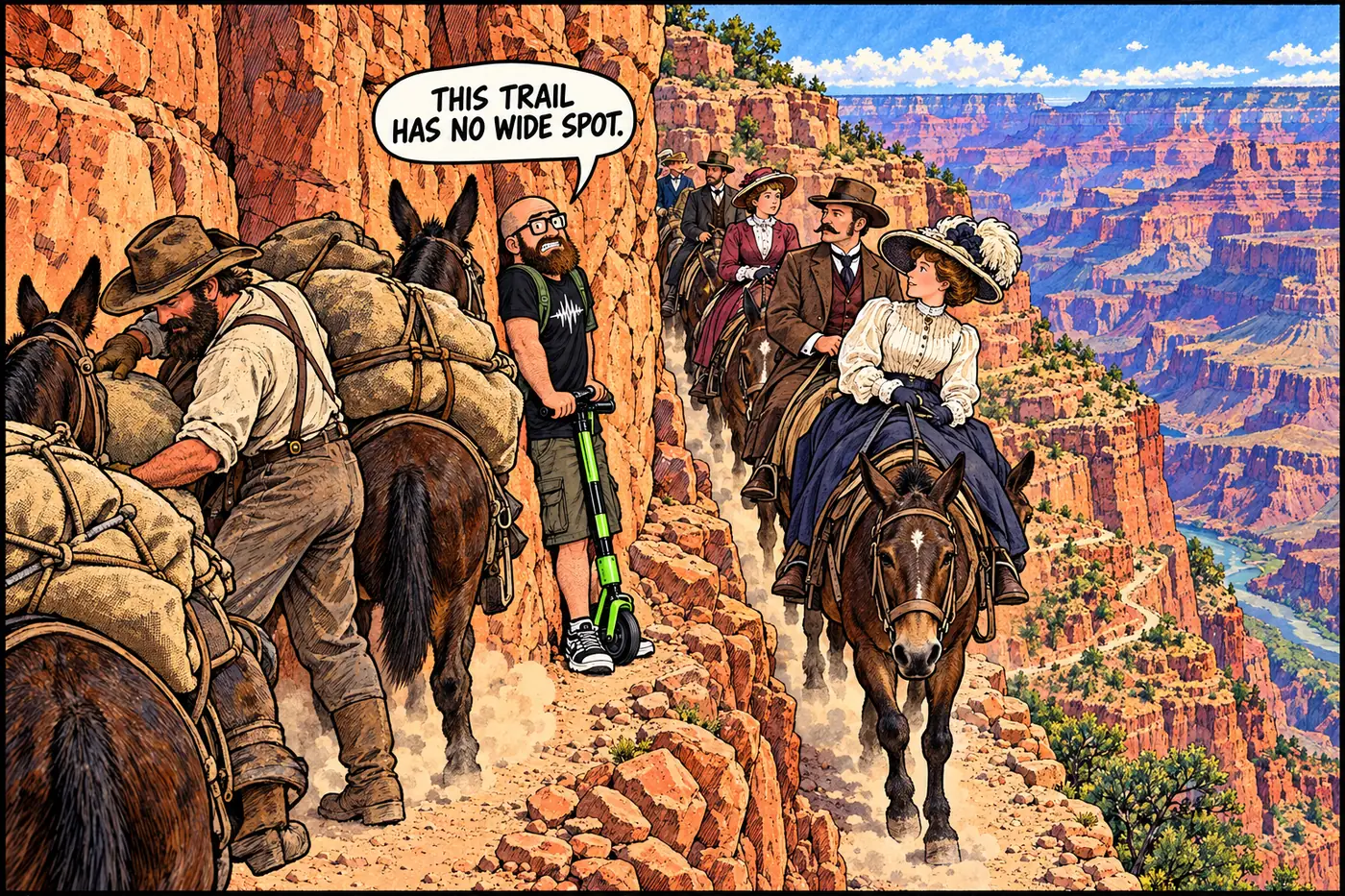
Cave of the Domes doesn’t have its own origin story in the record — it shares one with Horseshoe Mesa. In 1893, Pete Berry and partners Niles Cameron, Ralph Cameron, and Ed Gale staked the Last Chance copper claim on the mesa, at the end of what’s now the Grandview Trail. The ore was good enough to win a purity prize at Chicago’s 1893 World’s Fair, and the operation ran for fourteen years, with mule trains hauling roughly 200 pounds of ore up the trail per animal per trip and carrying food and supplies back down — enough copper, over the mine’s life, to fill 140 railroad cars.
Berry didn’t just mine the mesa; he sold it. He personally led tourist excursions down the Grandview Trail to Horseshoe Mesa, sometimes all the way to the Colorado River, well before Grand Canyon was even a national park. That’s the same access route, and roughly the same era, that put Cave of the Domes on the map as a walk-in attraction rather than a technical caving destination. Copper prices collapsed in 1907 and the mine shut down, but the trail — and the cave at the end of it — kept drawing visitors long after the miners left.
The one cave you didn’t need a permit for
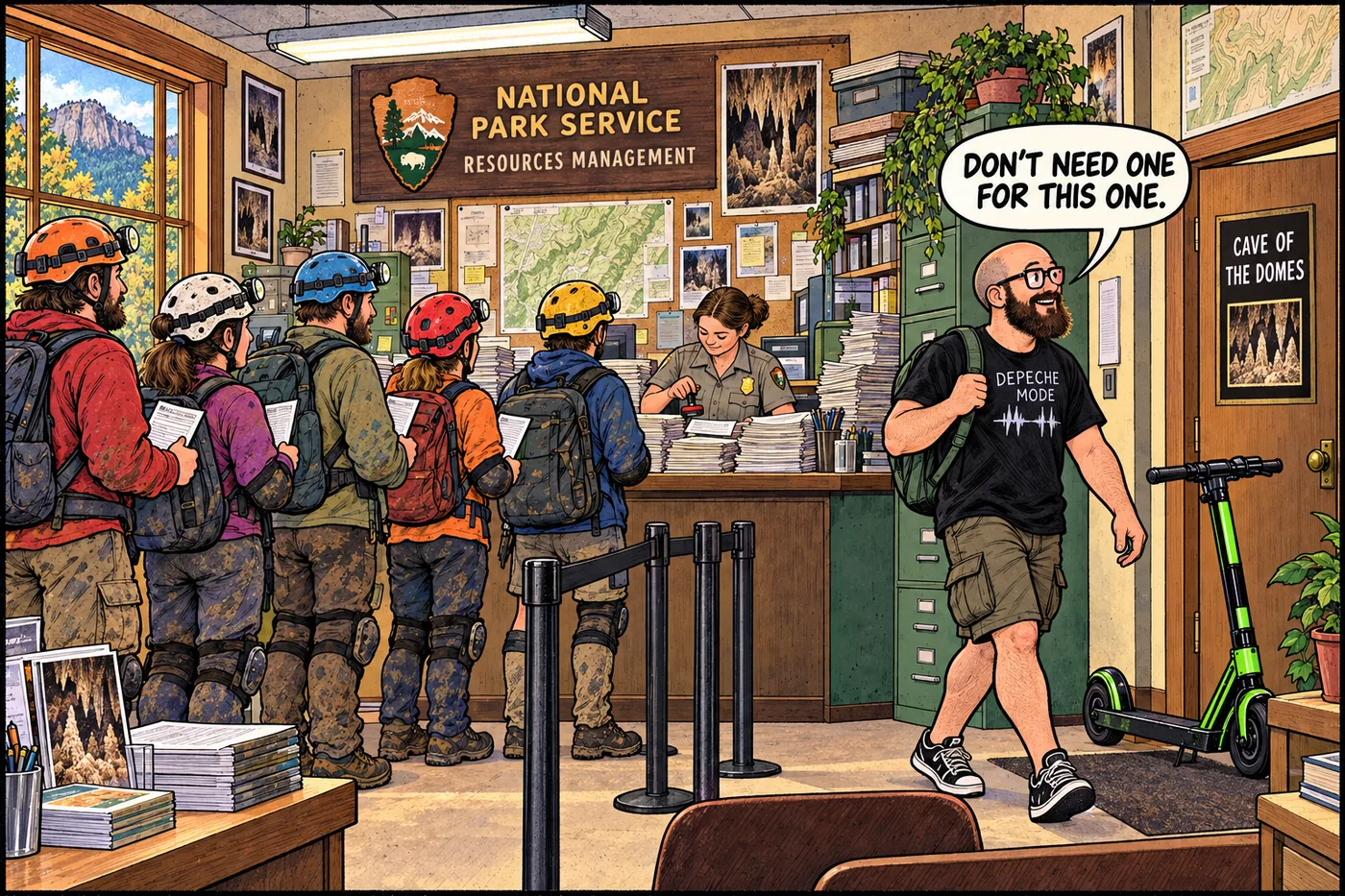
Grand Canyon has treated caves as off-limits by default for a very long time. The park’s 1988 Backcountry Management Plan states it plainly: “Cave use and management is guided by the park’s Cave Management Plan. All caving activity (day use or overnight), except for access to Cave-of-the-Domes on Horseshoe Mesa, must be approved in advance through the Resources Management and Planning Division.” That sentence held for decades. A 2016 Williams-Grand Canyon News report on the cave repeats the same structure almost word for word: “Cave of the Domes… is the only cave open to the public in [Grand Canyon National Park]. Old mines located near Horseshoe Mesa and throughout the park are also closed. With the exception of Cave of the Domes, permits are required to enter caves in [the park] because of the extremely sensitive nature of cultural and natural resources inside.”
Every other cave in the park — and there are thousands of candidate openings in the Redwall and Muav limestone alone — required a written permit. Cave of the Domes didn’t. You hiked the 3-mile Grandview Trail down to Horseshoe Mesa and walked in.
A hantavirus scare, then a longer closure
The first real interruption to that open-door policy came in March 2016, and it wasn’t about caving at all. Coconino County had logged two cases of Hantavirus Pulmonary Syndrome (HPS) that year, a rare but serious disease people can catch from rodent droppings, urine, or saliva. NPS temporarily closed Cave of the Domes “because of rodent activity and the potential for exposure to HPS,” effective March 23, 2016, “until further notice.” Two months later, NPS’s Office of Public Health cleared the cave — determined it wasn’t the exposure source — and reopened it.
That episode is well documented because it made local news twice, coming and going. What happened next is harder to pin down. As of December 2019, National Parks Traveler was still quoting Grand Canyon’s own materials describing Cave of the Domes as “the one cave in Grand Canyon National Park open to the public” — in an article about a different threat entirely: a possible detection of the fungus behind white-nose syndrome on a single bat. At some point after that, the open-access status ended. NPS’s current cave-resources page states flatly that “under the current park policy, all caves are currently closed to visitation, except for research purposes” — with no exception named for Cave of the Domes, and no date attached to when that changed. The two NPS news pages that would presumably document the transition — one titled as a closure notice, one as a status update — both return “page not found” as of this writing. Whatever the exact date, the record is consistent on the reason.
Why bats ended it
Grand Canyon is home to 22 bat species, and 12 of them hibernate — which makes them the ones at risk from white-nose syndrome, a disease caused by the fungus Pseudogymnoascus destructans. First identified in a New York cave in 2006, it has since been confirmed in 28 U.S. states and 5 Canadian provinces, and it kills by rousing hibernating bats more often than normal, burning through the fat reserves they need to survive winter. It doesn’t infect people; it spreads bat-to-bat and on contaminated gear, boots, and clothing carried between caves by cavers, researchers, and tourists.
Grand Canyon runs an active surveillance program to catch it early: eleven acoustic-monitoring stations spanning rim to river, seasonal mist-net captures, and roost surveys. In April 2019, park biologists got an inconclusive trace of the fungus on a single fringed myotis — not a confirmed detection, and not signs of the disease itself, but enough to sharpen the park’s caution. Grand Canyon Wildlife Biologist Brandon Holton put the stakes simply at the time: “Collecting samples in winter and spring increases the likelihood of detecting Pd and WNS, as bats are infected during hibernation over winter and shed the fungus shortly after emergence in the spring.” NPS’s general playbook for protecting bats — laid out on its cave-resources page — includes visitor education, screening people and gear before they enter sensitive caves, disinfection protocols, and, “when necessary, closure of caves used by bats.” Cave of the Domes was, eventually, one of those closures.
What’s actually off-limits (and why)
The current Grand Canyon Superintendent’s Compendium (effective June 16, 2026) is unambiguous: “Cave of The Domes is closed to public presence, use, and access except with prior written permission from the park’s superintendent,” under 36 CFR § 1.5(a)(2). The park’s own stated reason is bat protection on two fronts — “stopping human disturbance of roosting and hibernating bats that reside within the cave” and “stopping human transmission of Pseudogymnoascus destructans, the causative fungal agent of White Nose Syndrome, to bats within the cave.”
That closure sits inside a broader park-wide rule: under compendium item 54, public presence, use, and access in all caves in Grand Canyon — as defined by the Federal Cave Resources Protection Act — is prohibited without a superintendent-authorized permit, “necessary to protect the many unrecorded features, archaeological resources, and various life that may reside in the thousands of Grand Canyon caves.” Cave of the Domes used to be the single carve-out from that rule. It no longer is. The trail to Horseshoe Mesa is still open to hikers; the cave at the end of it, for now, isn’t.
Pete Berry and partners stake the Last Chance copper claim on Horseshoe Mesa, opening the Grandview Trail that later leads tourists — and cavers — to the cave.
Berry personally guides visitors down the same trail to Horseshoe Mesa and beyond, alongside active copper mining, until falling copper prices end the operation in 1907.
Grand Canyon's Backcountry Management Plan names Cave of the Domes as the sole exception to the park's blanket caving-permit requirement.
NPS closes the cave March 23 over rodent-borne hantavirus risk; its Office of Public Health clears it and reopens it about two months later.
NPS materials in December 2019 still describe Cave of the Domes as the park's only cave open to the public, even as white-nose-syndrome surveillance ramps up.
The current Superintendent's Compendium closes Cave of the Domes to the public except by written superintendent permission, citing bat protection and white-nose syndrome.
Sources
- Grand Canyon National Park Superintendent's Compendium, effective June 16, 2026 — National Park Service
- Backcountry Management Plan, September 1988 — Grand Canyon National Park, National Park Service
- Cave / Karst Systems — Grand Canyon National Park, National Park Service
- Current Bat Research — Grand Canyon National Park, National Park Service
- Fungus That Causes White-Nose Syndrome Possibly Detected At Grand Canyon National Park — National Parks Traveler
- Grand Canyon's Cave of the Domes closed for potential Hantavirus exposure — Williams-Grand Canyon News
- Cave of the Domes Reopens in Grand Canyon — Williams-Grand Canyon News
- Grand Canyon park officials close popular cave over hantavirus concerns — Fox News
- Last Chance Mine — Nature, Culture and History at the Grand Canyon (Grand Canyon Historical Society)