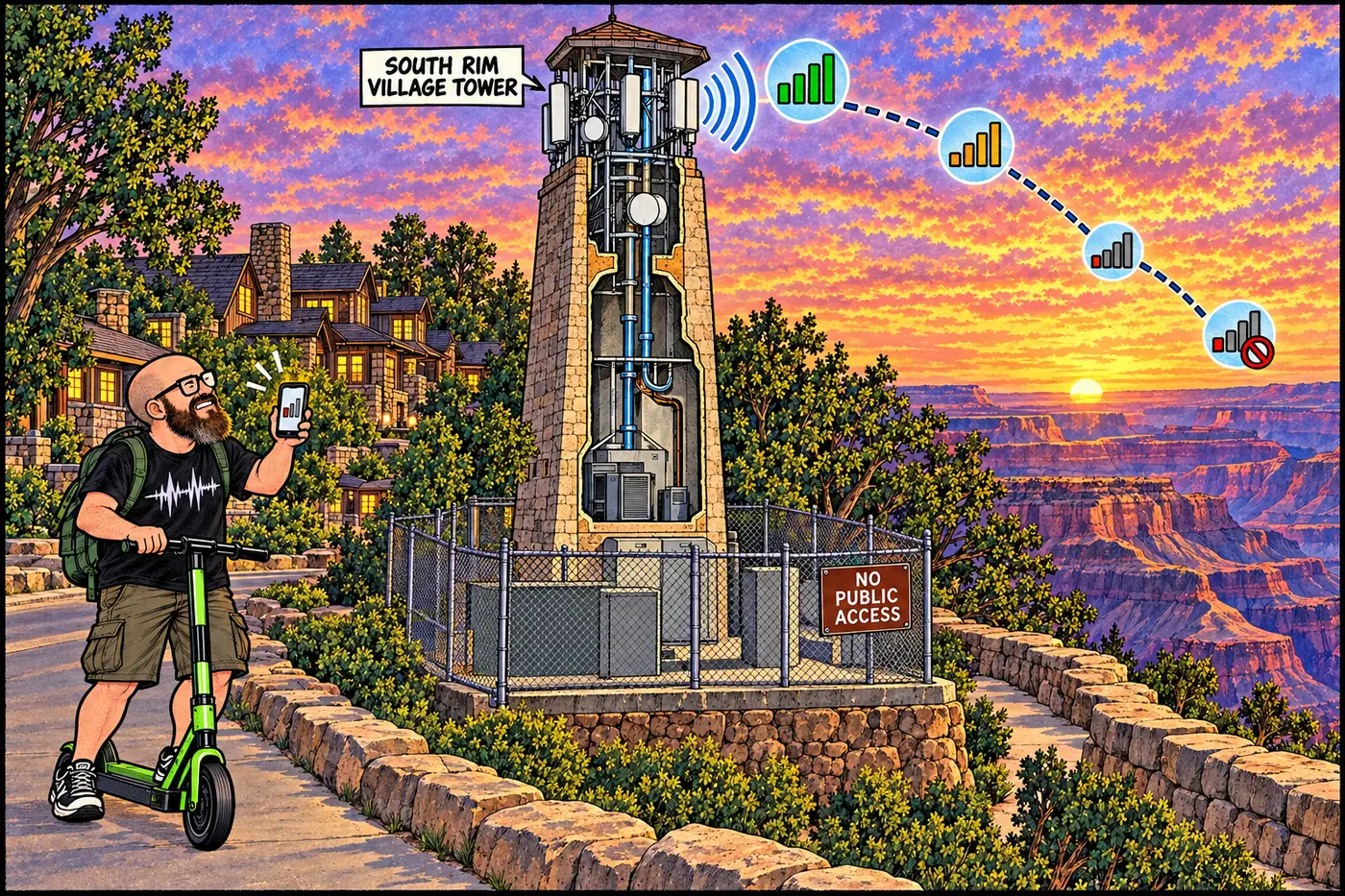
Grand Canyon National Park pulls in 6 million-plus visitors a year and, as of the Park Service's own numbers, offered the whole park a data pipe smaller than a lot of home internet plans — provided by exactly one cell carrier that actually worked. The plan to fix that has been public since 2019, approved since 2020, and is still being built out permit by permit.
The short version
- As of the Park Service’s own 2019 planning documents, cellular service inside Grand Canyon came from only one national carrier and one wholesale partner — everyone else’s phone simply didn’t work.
- The entire park shared roughly 850 megabits per second of total bandwidth for every visitor, resident, and operation combined — NPS itself used less than 4% of it, because there wasn’t more to use.
- Five commercial towers, one relocated tower, and small-cell antenna panels in high-traffic areas got the green light in a November 2020 federal decision — but the Park Service isn’t building any of it itself.
- No commercial tower is allowed below the canyon rim, full stop.
- A tower built on nearby Forest Service land in 2017 already helped, and coverage along Highway 64 near Desert View is still described by NPS as “poor and spotty, if not non-existent.”
- Cell signal already leaks into the backcountry by accident, and NPS has said flatly there’s no way to stop that with current technology — even though expanding backcountry coverage isn’t the goal.
One carrier, one dish, six million visitors
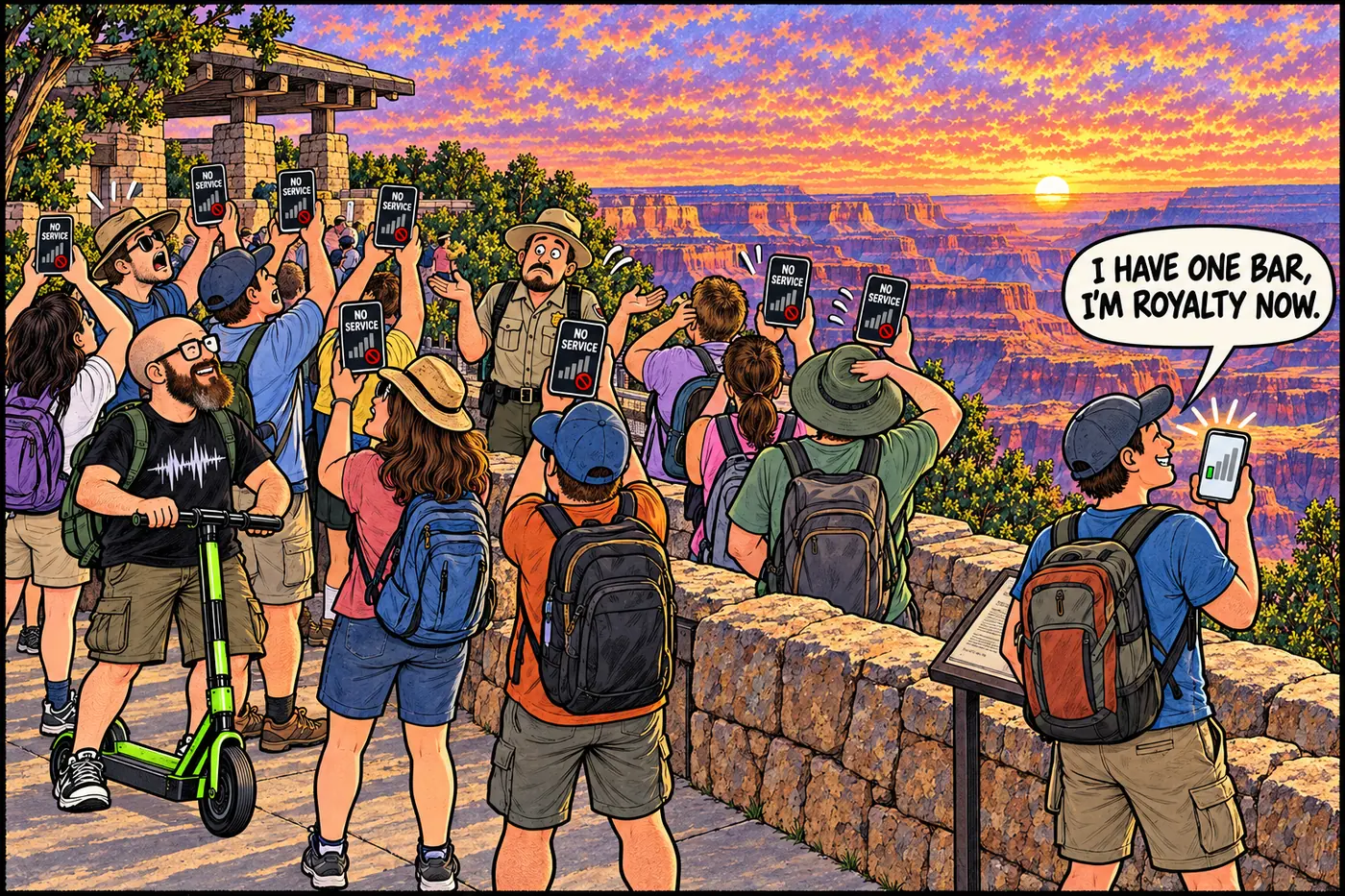
Start with the numbers nobody advertises. Grand Canyon’s 2019 Telecommunications Plan and Environmental Assessment — the Park Service’s own diagnostic of its wireless problem — put it plainly: cellular service was “generally available within Grand Canyon Village on the South Rim and represents the best service within the park,” but “it is provided by only one proprietary national commercial carrier and one wholesaler carrier.” Translation: if your phone wasn’t on that one company’s network or a partner riding on it, you had no service anywhere in the park, best case included.
The infrastructure behind that thin coverage was equally lean. Five NPS-owned two-way radio towers exist inside the park — near Hopi Fire Lookout, at Station One in Grand Canyon Village, at Desert View, at CC Hill, and at Mt. Emma — built for ranger, fire, and medical radio traffic, not public cell service. Desert View’s NPS tower does carry commercial cellular antennas, and a separate, privately-owned South Rim Village Tower (107 feet tall, standing about 800 feet from the rim, built under a right-of-way permit) supplies phone, data, and public cellular service along part of the South Rim. That’s essentially the whole system. Total data bandwidth for every telecommunications use in the entire park — cellular, Wi-Fi, NPS radio backhaul, everything — topped out around 850 Mbps. NPS operations alone used less than 4% of that; the rest went to a park that, that same year, was pulling in close to 6.4 million visitors along with concession companies, nonprofits, tribes, a public school, a medical clinic, a utility company, and law enforcement agencies who all needed a working signal too.
Five possible towers, zero below the rim
The fix NPS proposed and ultimately approved is deliberately modest in shape, if not in paperwork. The 2019 Plan studied adding up to five new commercial telecommunications towers, one each near Hopi Fire Lookout, in or near Grand Canyon Village, near Desert View, and at CC Hill and Lindberg Hill on the North Rim — plus the possible removal or relocation of the existing South Rim Village Tower. Proposed heights run from 80 feet (Hopi Fire Lookout, Desert View) up to 180 feet (Grand Canyon Village’s taller option, CC Hill), each sited close to an existing tower of similar height wherever possible to avoid scattering new structures across the landscape. Small-cell antenna panels — the same short-range technology cities use on streetlights, good for roughly a mile and a half versus several miles for a full tower — were approved for the Grand Canyon Visitor Center, Grand Canyon Village, Market Plaza, and the area around Grand Canyon Lodge on the North Rim.
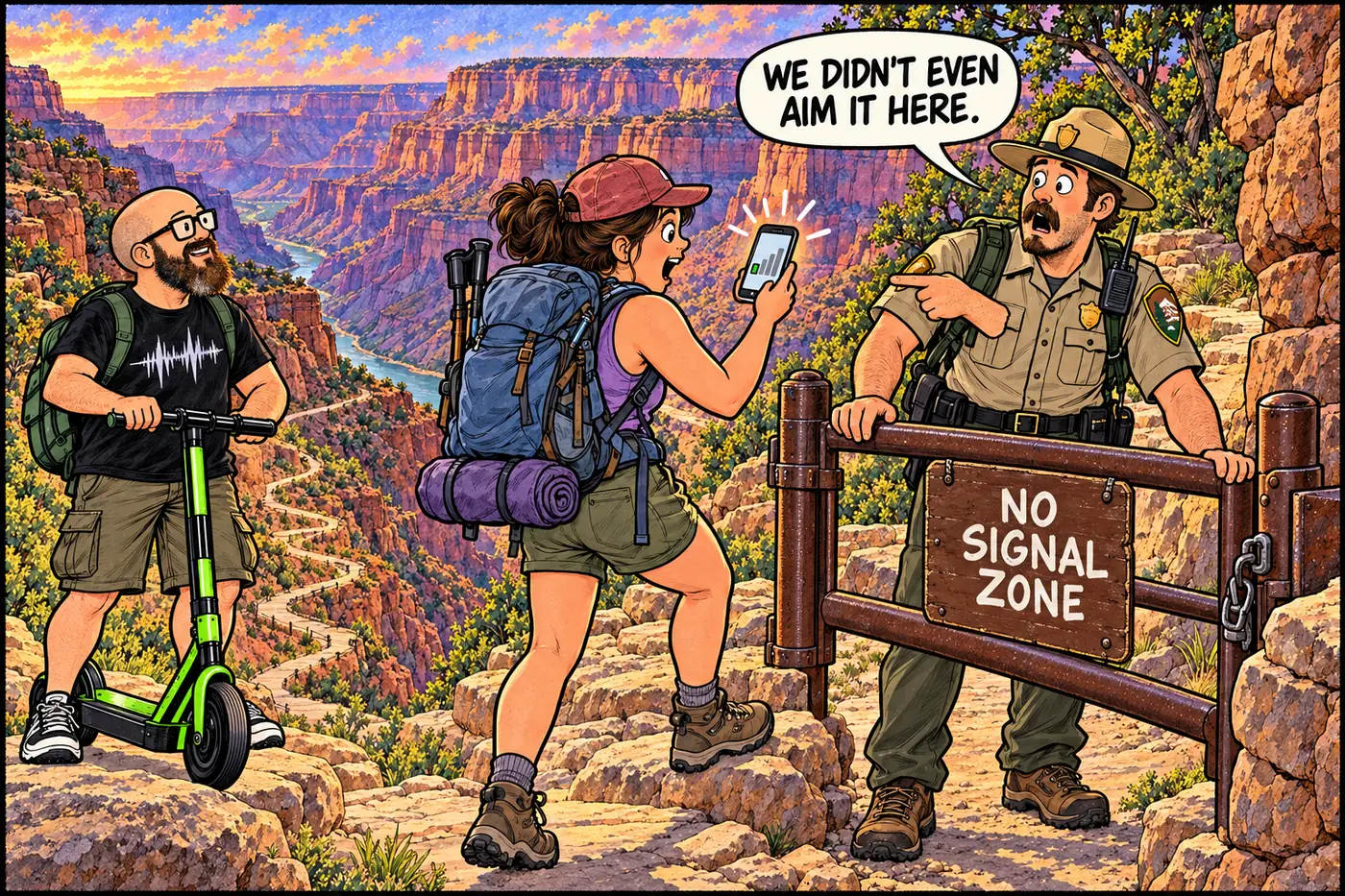
One rule holds no matter what gets built: no commercial telecommunications tower is permitted below the canyon rim. The plan is emphatic that this is about developed areas only.
The Park Service made a point of ruling out the easy version of this fix. An earlier proposal — simply bolting commercial cellular gear onto the existing NPS radio towers — got rejected outright, because commercial equipment previously sharing NPS towers had already caused technical interference with NPS radio frequencies and raised physical-security concerns about the towers themselves. NPS also considered, and rejected, a “no additional cellular service” alternative some commenters wanted, on the grounds that cell signal already spills over into the backcountry from developed-area infrastructure by accident, and current technology can’t fully prevent that leakage even when it isn’t the intent.
None of the new infrastructure would be built by the Park Service directly. Private telecom companies apply for right-of-way permits, pay fair-market value for the use of federal land, and build and maintain anything that gets approved — with every individual tower or small-cell site still needing its own site-specific environmental and historic review before a shovel goes in the ground. NPS’s Finding of No Significant Impact, signed November 19, 2020, describes the whole rollout happening “over the next five to ten years and beyond,” permit by permit, rather than all at once.
A commercial tower built on nearby U.S. Forest Service land expands cellular service toward Desert View — but Highway 64 coverage stays patchy.
NPS opens 30 days of public scoping on a comprehensive Telecommunications Plan; 61 responses come in.
The full Plan/EA goes out for 36 days of public review; 97 more responses arrive, plus two tribal-government responses.
NPS signs a Finding of No Significant Impact selecting the five-tower, small-cell, fiber-and-microwave plan as its preferred approach.
Implementation proceeds through individual right-of-way permit applications, expected to unfold over five to ten years or more.
What’s actually off-limits (and why)
The Telecommunications Plan itself doesn’t create any new closed areas — it’s a permitting framework, not a construction project. But the ground rule inside it is absolute: commercial cellular towers cannot be built below the canyon rim under any version of the plan, protecting the inner canyon’s undeveloped character regardless of how coverage above the rim eventually fills in. And several of the towers under discussion sit at or near sites that are already restricted for unrelated reasons — CC Hill and the area near Hopi Fire Lookout, for instance, sit close to existing NPS radio infrastructure that the public can’t approach regardless of what commercial equipment eventually gets added nearby.
Sources
- Grand Canyon National Park Telecommunications Plan and Environmental Assessment, 2019 — National Park Service
- Frequently Asked Questions, Telecommunications Plan / Environmental Assessment — National Park Service
- Grand Canyon National Park Telecommunications Plan Finding of No Significant Impact, signed Nov. 19, 2020 — National Park Service
- News Release: Telecommunications Plan FONSI Signed — National Park Service, Grand Canyon National Park
- Park Service Finds 'No Significant Impact' For Grand Canyon Telecommunications Plan — KNAU Arizona Public Radio