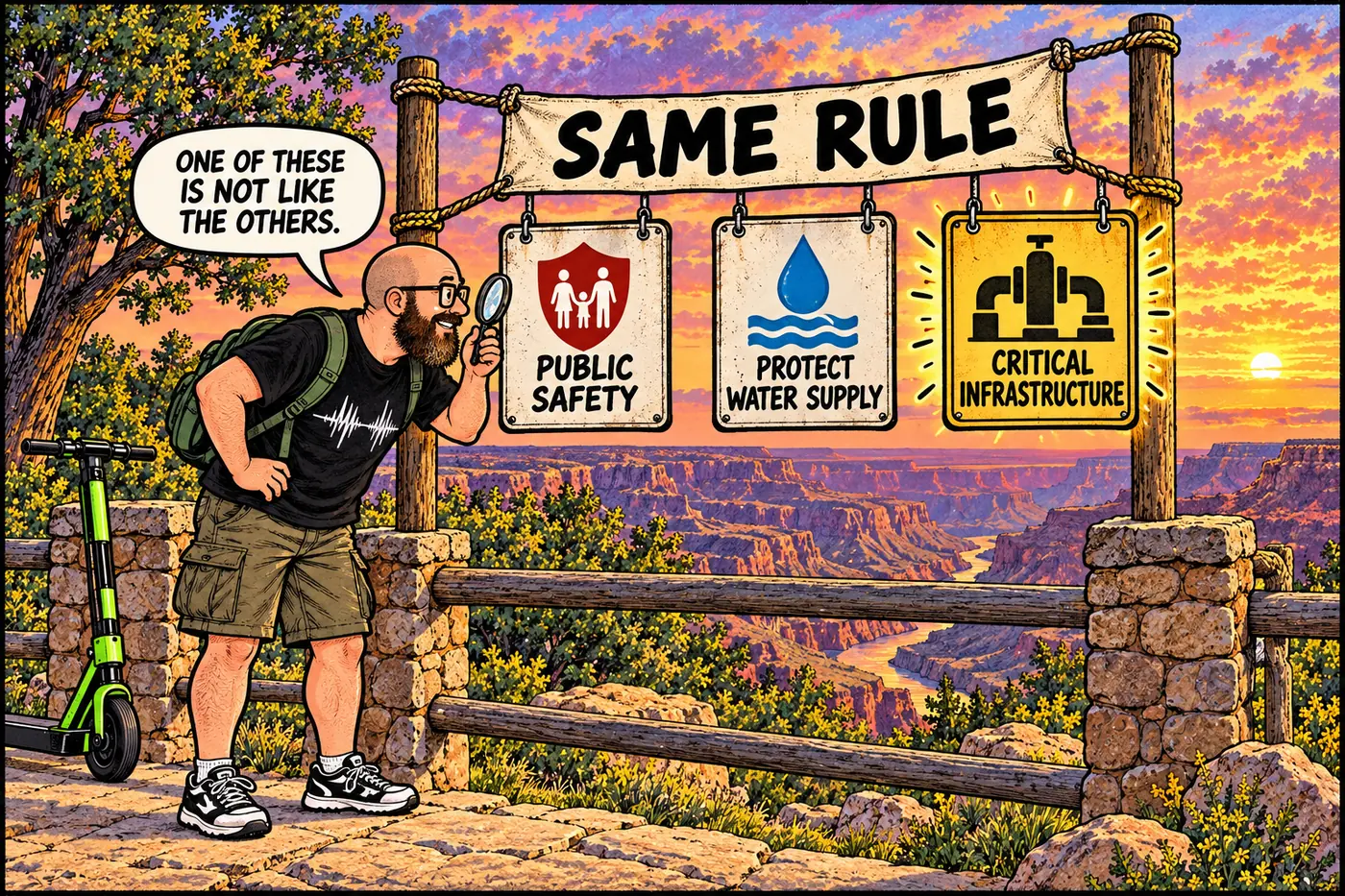
The words "critical infrastructure" get thrown around a lot when people talk about the pipes, radios, and pump stations tucked around Grand Canyon National Park. The park's own rulebook uses that exact phrase exactly once — for one pumphouse. Everything else runs on a much more ordinary legal lever.
The short version
- Grand Canyon’s Superintendent’s Compendium — the park’s official closure rulebook — uses the phrase “critical park infrastructure” exactly once, to justify closing the Roaring Springs Pumphouse.
- Every other infrastructure closure in the same document — water tanks, wastewater plants, the Hopi Point repeater, government buildings — is justified with different, more ordinary language: public safety, protection of government property, protection of a public water supply.
- All of it, “critical infrastructure” language or not, runs on the same legal authority: 36 CFR § 1.5(a), which lets the superintendent close areas or restrict activities for public safety and resource-protection reasons.
- At the federal level, Grand Canyon sits inside a “National Monuments and Icons” subsector of the Government Facilities critical-infrastructure sector — a structural, department-wide designation, not a Grand-Canyon-specific one.
- Two Government Accountability Office reports, in 2005 and 2009, examined national-park and federal-icon security practices broadly; neither singles out Grand Canyon by name in the public summary material.
- This page reports history, legal authority, and public-record facts only — no equipment, no security measures, no vulnerabilities.
One phrase, one closure
Read through the entire current Superintendent’s Compendium looking for the words “critical infrastructure,” and it turns up exactly once. It’s attached to the Roaring Springs Pumphouse — the facility and helistop tied to the park’s primary water source, which the Transcanyon Waterline carries to both rims. The compendium closes the pumphouse, the helistop, and the surrounding water-source infrastructure to public entry, and requires the public to stay 100 feet from all water infrastructure there. Its stated reason: “This restriction is necessary to protect critical park infrastructure and to protect the public from hazards.”
That’s it. No other closure in the document borrows that specific phrase — not the closures covering water tanks, wastewater treatment facilities, the Hopi Point repeater site, or administrative and storage buildings. Those closures exist too, and they’re just as real, but the compendium justifies each one differently: a water tank closure cites protecting a public water supply, wastewater facility closures cite public-safety hazards, a communications-equipment closure cites the need to protect “the integrity of operational communications equipment,” and a storage/administrative site closure cites protecting government property and employee safety. One site gets the “critical infrastructure” label in writing. The rest get closed just as firmly, under the exact same regulation, without that specific phrase ever appearing.
The federal architecture behind the term
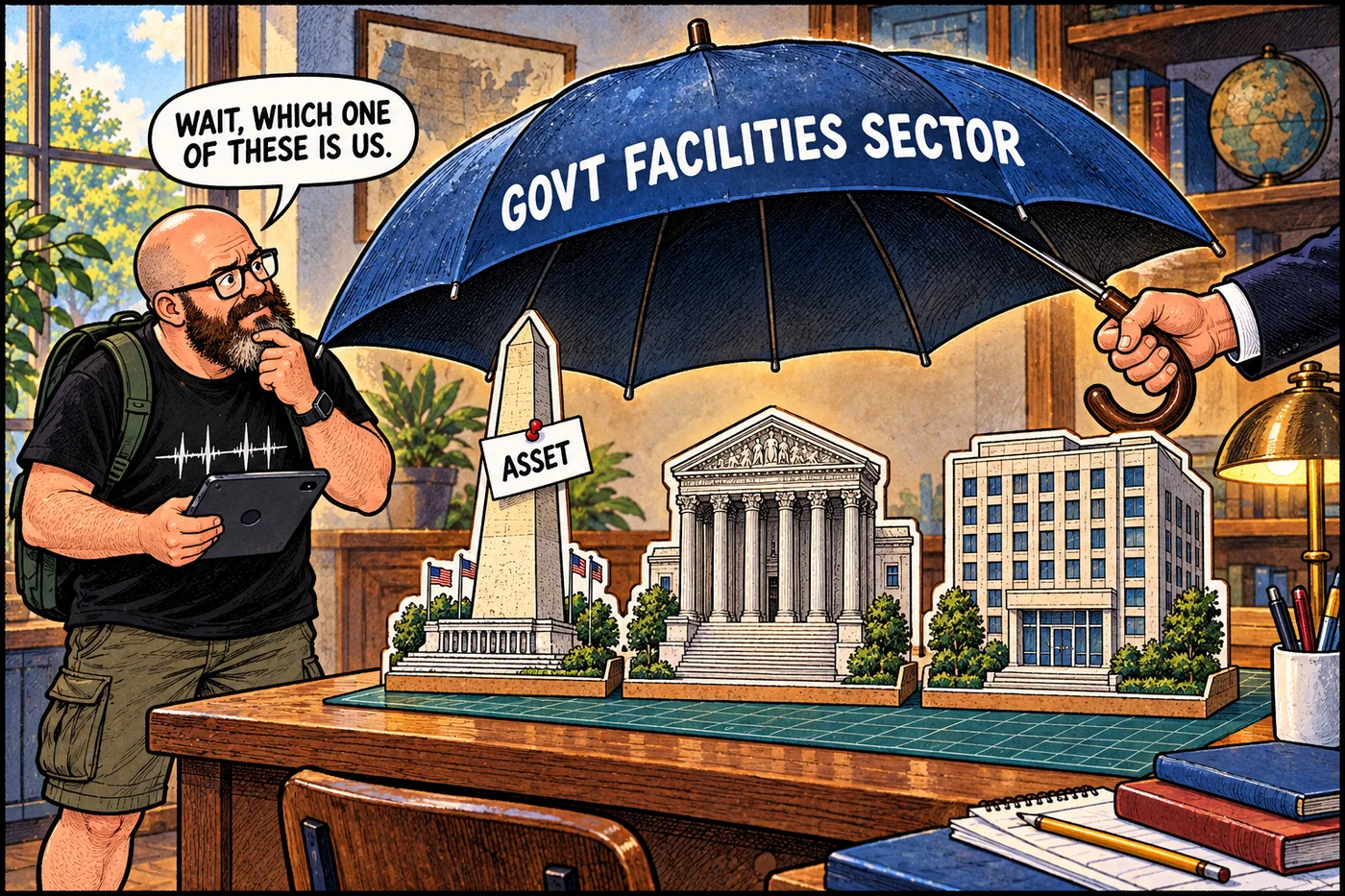
“Critical infrastructure” isn’t a phrase NPS invented — it’s a term of art from national homeland-security policy. Presidential Policy Directive 21 organizes the country’s infrastructure into sixteen designated critical-infrastructure sectors. One of them, the Government Facilities Sector, contains a subsector specifically for “National Monuments and Icons” (NMI) — federally owned or managed landmark properties — with the Department of the Interior designated as the federal Sector-Specific Agency responsible for that subsector.
CISA’s Government Facilities Sector-Specific Plan describes the NMI subsector as encompassing “a diverse array of assets located throughout the United States,” many of them listed on the National Register of Historic Places or as National Historic Landmarks, spanning both government-owned and privately owned properties. What that planning document does not do, anywhere in its text, is name Grand Canyon National Park specifically. A full-text search of the document turns up zero mentions of “Grand Canyon,” “National Park Service,” or “NPS.” The connection between Grand Canyon and federal critical-infrastructure policy is structural — Interior is the NMI subsector’s Sector-Specific Agency, and the National Park Service is an Interior bureau that happens to run Grand Canyon among roughly 400 other park units — not a specific listing that names this park or any of its individual facilities.
What two GAO audits looked at (and didn’t say)
The Government Accountability Office has weighed in on this general subject twice, at the national level. In June 2005, GAO published Homeland Security: Actions Needed to Better Protect National Icons and Federal Office Buildings from Terrorism (GAO-05-790), examining how the Department of the Interior and the General Services Administration each handled terrorism-related security threats to their properties. In August 2009, GAO followed up with Homeland Security: Actions Needed to Improve Security Practices at National Icons and Parks (GAO-09-983), which evaluated whether the National Park Service was implementing key protective practices — across nearly 400 park units nationwide, not any single park.
Both reports are public record and both are relevant background for understanding how federal security oversight of national parks works. Neither one, in the summary-level material available, calls out Grand Canyon specifically. That’s consistent with their scope: these are system-wide reviews of park-security practices in general, not site-specific assessments of any one park’s facilities. This page deliberately doesn’t go further than that — no specific findings, security measures, or vulnerabilities from either report are reproduced here, in keeping with how sensitive infrastructure topics get handled on this site generally.
The legal lever behind every closure
Whatever language a given compendium entry uses, the authority behind it is uniform. Every infrastructure closure at Grand Canyon — the Roaring Springs Pumphouse included — traces back to 36 CFR § 1.5(a), the regulation that lets a park superintendent close areas, set use limits, or restrict specific activities. The regulation itself doesn’t use the words “critical infrastructure” anywhere; it authorizes closures and restrictions when necessary for public health and safety, environmental or resource protection, cultural-resource preservation, scientific research, management responsibilities, equitable allocation of facilities, or avoiding conflicts among visitor uses. A companion provision requires the superintendent to prepare a written determination justifying any restriction before it’s put in place or lifted.
The compendium itself is a living document — NPS states it’s reviewed and updated annually or as needed “to ensure adequate protection of the park’s resources, provide for public safety and enjoyment and to address changes in public use patterns.” None of its closures apply to NPS’s own official or administrative use of these sites; they’re aimed at the visiting public. The version in effect as of this writing took effect June 16, 2026, recommended by Chief Ranger Justin Cully and approved by Superintendent Edward T. Keable.
| Compendium item | What’s closed | Stated justification |
|---|---|---|
| 31 | Roaring Springs Pumphouse & water-source infrastructure | “protect critical park infrastructure” and public hazards |
| 16 | Water tank/reservoir infrastructure | protection of a public water supply |
| 18 / 24 | Wastewater treatment facilities | public-safety hazard |
| 19 | A government facility | “protection of the government property” |
| 20 | Hopi Point repeater site | integrity of operational communications equipment |
| 23 | A storage/administrative site | protect government property and files, enhance employee safety |
What’s actually off-limits (and why)
Every site in that table is closed to public entry under the same regulation, 36 CFR § 1.5(a)(2), regardless of which justification language the compendium uses for it. In practice, that means the “critical infrastructure” label attached to Roaring Springs doesn’t buy that one pumphouse any special legal status the other closed sites lack — it’s descriptive language in the compendium’s own explanatory note, not a different tier of protection. Visitors are kept out of all of these sites the same way: posted closures backed by the superintendent’s authority, enforceable as a federal regulatory violation regardless of which sentence explains the “why.” For the fuller list of what’s closed park-wide and the general legal basis behind it, see what’s actually off-limits across Grand Canyon.
Sources
- Grand Canyon National Park Superintendent's Compendium, effective June 16, 2026 — National Park Service
- 36 CFR § 1.5 — Closures and public use limits — Cornell Law School Legal Information Institute
- Government Facilities Sector-Specific Plan (2016), an annex to the National Infrastructure Protection Plan — Cybersecurity and Infrastructure Security Agency
- Homeland Security: Actions Needed to Better Protect National Icons and Federal Office Buildings from Terrorism (GAO-05-790) — U.S. Government Accountability Office
- Homeland Security: Actions Needed to Improve Security Practices at National Icons and Parks (GAO-09-983) — U.S. Government Accountability Office