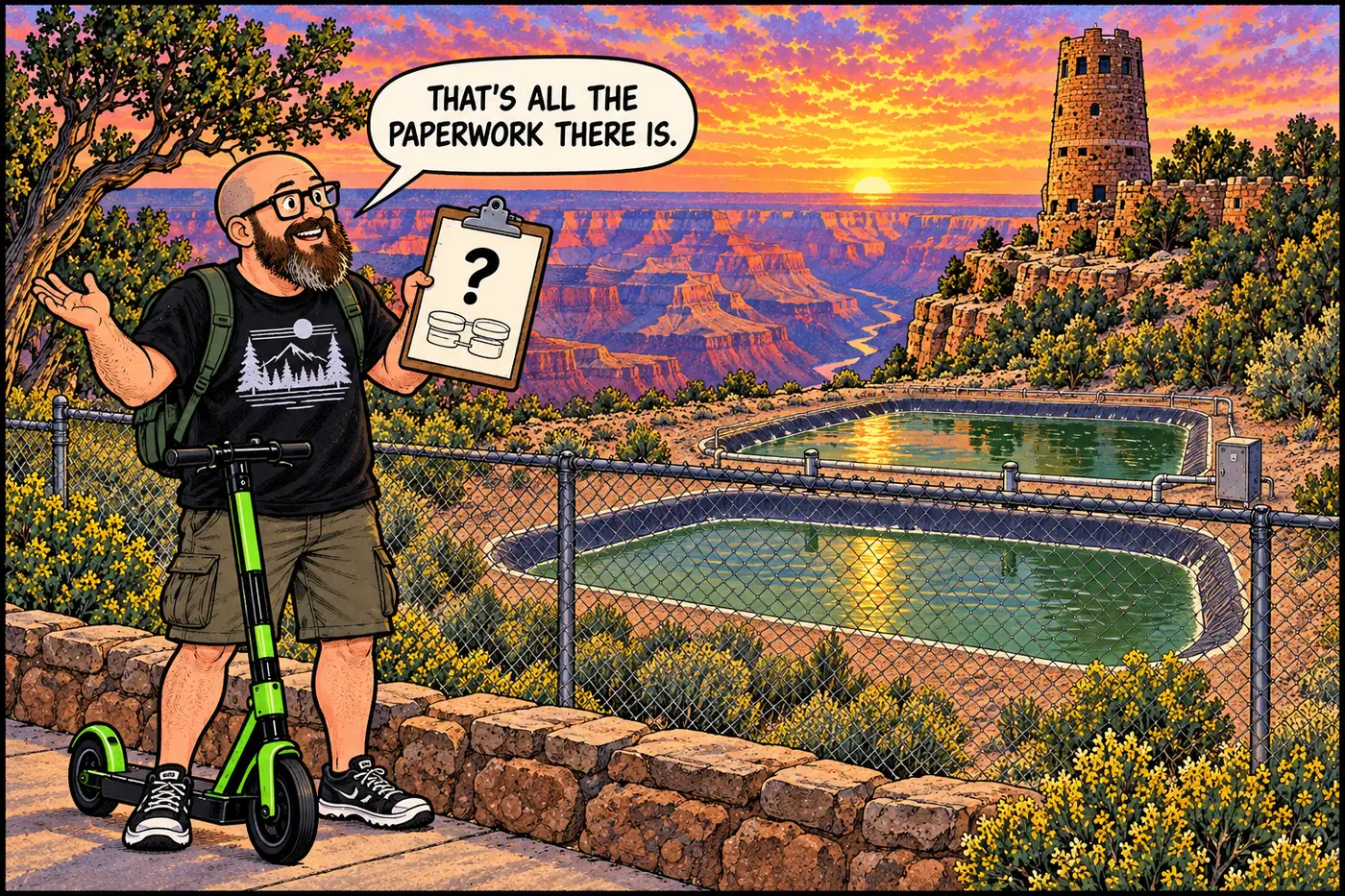
Twenty-three miles east of the crowds at Grand Canyon Village, Desert View has a gas station, a Watchtower, a trading post — and a fenced wastewater plant that barely exists in the public record. This is a short page because that's an honest reflection of what's actually documented.
The short version
- Desert View’s wastewater treatment plant and its lagoons sit off Cedar Mountain Road, about half a mile east of Highway 64, behind a chain-link fence.
- Unlike the South Rim, North Rim, or Phantom Ranch wastewater systems, no NPS news release, construction contract, or ADEQ violation history for the Desert View plant specifically turned up in a genuine search effort this session.
- What is documented: the site’s closure itself, under the park’s Superintendent’s Compendium, citing hazards flagged by the Arizona Department of Environmental Quality — the same boilerplate that covers every wastewater site in the park.
- Desert View itself dates to 1931-1932 (East Rim Drive, then Mary Colter’s Watchtower and the Trading Post), with its campground and a stone restroom building added by the Civilian Conservation Corps in the 1930s.
- A current NPS planning effort — the Desert View Inter-tribal Cultural Heritage Site Plan, developed with seven tribal nations — is reshaping the site’s future, but its public project pages don’t discuss the existing wastewater system’s age, capacity, or condition.

What’s actually documented
Start with what the record does say, because it’s short. The current Superintendent’s Compendium — the park’s official closure list — names the Desert View Wastewater Treatment Plant, its lagoons, and its access road as a single closed unit: located east of Highway 64, half a mile east on Cedar Mountain Road, enclosed by a chain-link fence, closed to public entry under 36 CFR § 1.5(a)(2). The stated reason is identical to every other wastewater closure in the park — protecting the public from hazards “associated with wastewater treatment per the Arizona Department of Environmental Quality.” The word “lagoons” is doing real work in that closure text: it tells you the plant uses open treatment ponds rather than an enclosed mechanical system like the one that was rebuilt at Phantom Ranch. Beyond that, the Compendium is the whole technical description available.
That’s a genuine gap, not an oversight on this page’s part. No NPS news release announces a Desert View wastewater project. No ADEQ violation record like the one that forced years of shower bans at Phantom Ranch turned up. No construction contract, no capacity figure in gallons per day, no build date, no lagoon count. The South Rim’s wastewater system has a documented history running back to a pioneering 1926 reclamation plant; Desert View’s equivalent facility simply doesn’t have that kind of public paper trail.
Desert View itself: well-documented, separately from its sewage plant
The site around the plant is much better recorded than the plant itself. The East Rim Drive connecting Desert View to Grand Canyon Village opened in 1931. Architect Mary Colter’s Desert View Watchtower and the adjacent Trading Post, both built for the Fred Harvey Company, followed in 1932. The Civilian Conservation Corps built the campground and a stone restroom building near the Watchtower sometime during its 1933-1942 run at the park, alongside road maintenance, trail and fence work, and landscaping along East Rim Drive. Today’s Desert View Campground — 50 sites, open roughly mid-April through mid-October — still has no water, sewer, or power hookups at individual sites; visitors use shared restrooms instead.
None of that history says anything definitive about when the current wastewater plant was built or what replaced whatever the CCC-era campground originally used. It’s a reasonable guess that a facility serving a gas station, a market, a trading post, and a seasonal campground needed real sewage treatment well before now — but a guess is all it would be, so this page doesn’t offer one as fact.
A site in transition, infrastructure unmentioned
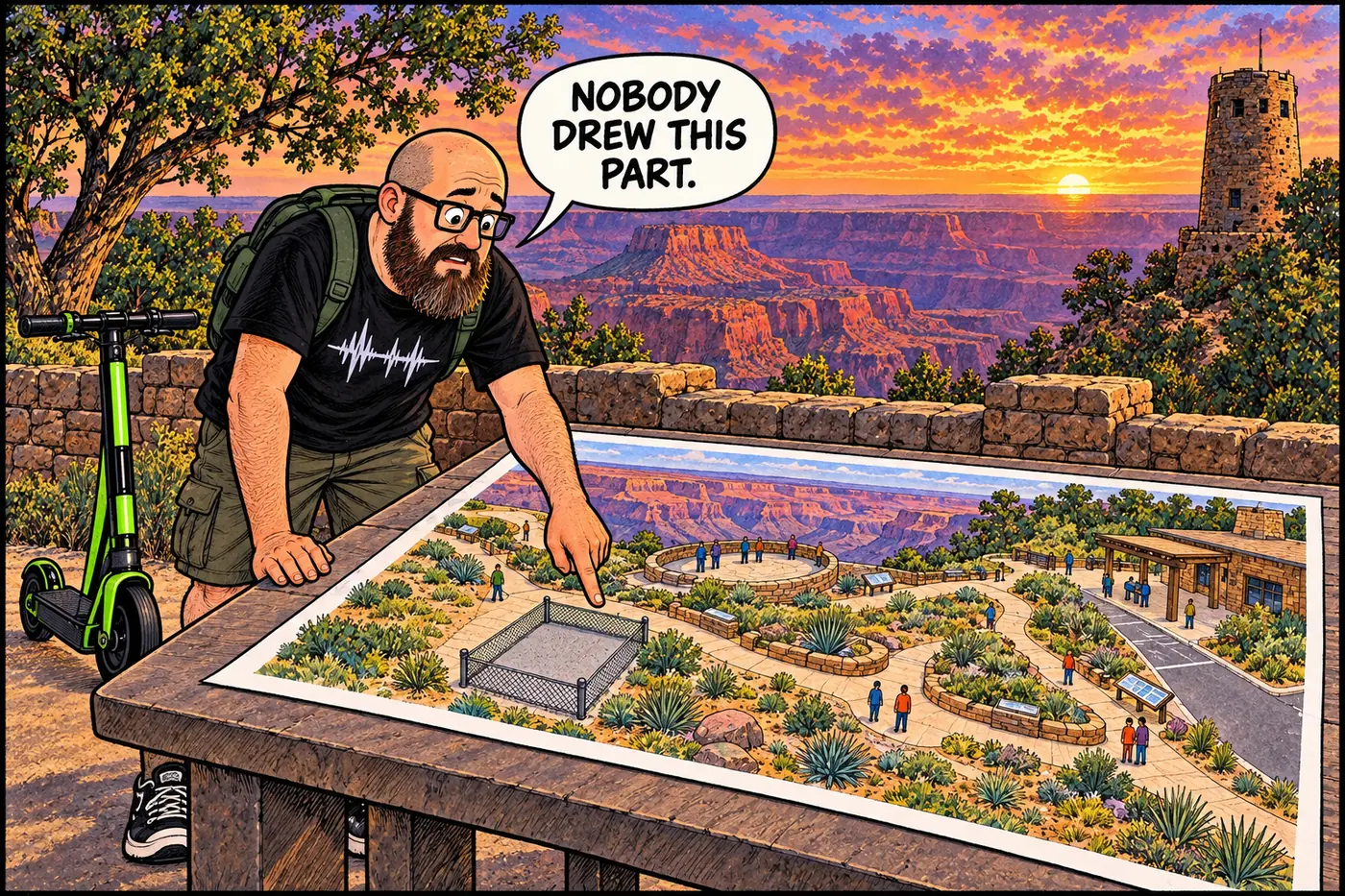
NPS is currently developing the Desert View Inter-tribal Cultural Heritage Site Plan and Environmental Assessment, working with seven tribal nations — the Kaibab Band of Paiute Indians, Havasupai, Hopi, Hualapai, Navajo, Zuni, and Yavapai-Apache — to reshape Desert View from a standard scenic overlook and concession area into what the project describes as an Inter-tribal Cultural Heritage Site. That’s a meaningful shift in how the site will be used and presented. What the publicly browsable project pages don’t do, as of this writing, is discuss the wastewater plant behind the fence: its age, its remaining capacity, or whether the cultural heritage plan will require expanding it. If that changes, it’ll be in a future environmental assessment document this page doesn’t have access to yet.
| What’s documented | What isn’t |
|---|---|
| Plant location (off Cedar Mountain Road, chain-link fenced) | Build date |
| Treatment method uses lagoons (open ponds) | Number of lagoons, capacity |
| Closure authority (36 CFR § 1.5(a)(2), ADEQ hazard citation) | ADEQ compliance/violation history |
| Desert View site history (1931-32 buildings, CCC-era campground) | When sewage service was first installed or last rebuilt |
| An active tribal cultural-heritage planning process for the site | Whether that plan touches the wastewater system |
What’s actually off-limits (and why)
The Desert View Wastewater Treatment Plant, its lagoons, and the access road serving them are closed to public entry — not just the treatment building itself, but the road to it. The stated justification is standard for every wastewater facility in the park: protecting visitors from hazards the Arizona Department of Environmental Quality associates with treatment operations. It’s the same regulatory language covering the South Rim and North Rim wastewater plants and Phantom Ranch’s — a standing, non-emergency closure rather than anything tied to a specific incident.
Sources
- Grand Canyon National Park Superintendent's Compendium, effective June 16, 2026 — National Park Service
- Desert View Watchtower — Nature, Culture and History at the Grand Canyon (Grand Canyon Historical Society)
- Desert View Trading Post — GrandCanyon.com
- Human History: Civilian Conservation Corps at Grand Canyon — Hit the Trail
- Desert View — National Park Service
- Desert View Campground — National Park Service
- Desert View Inter-tribal Cultural Heritage Site Plan / Environmental Assessment — NPS PEPC