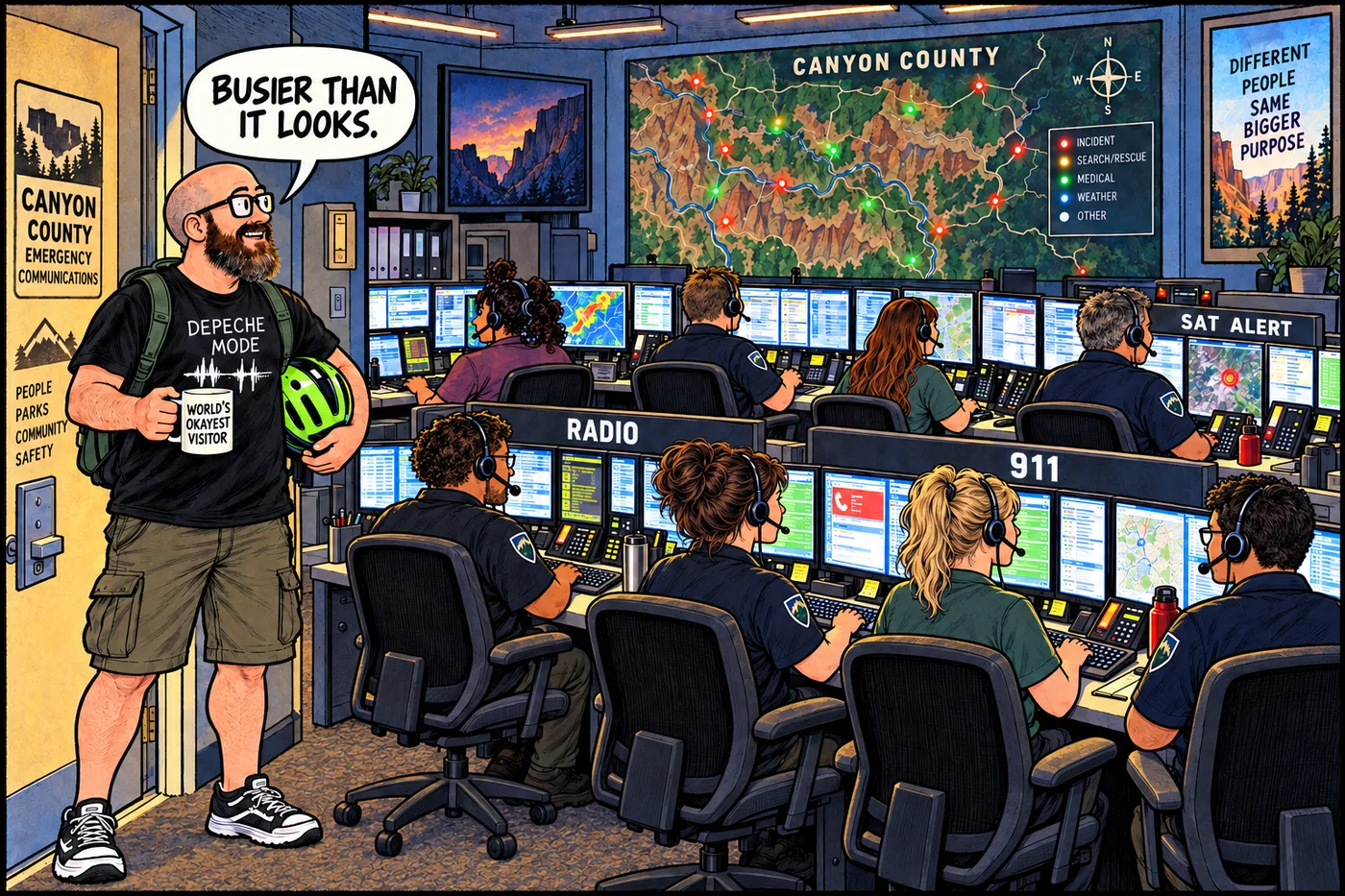
Eight dispatchers keep a park roughly the size of Rhode Island on the line, 24 hours a day, for a landscape that specializes in breaking whatever system you built to watch it. On August 29, 2026, the specific system built to watch for flash floods broke mid-flood — and the fallback that saved the day was rangers picking up 911 calls the old-fashioned way.
The short version
- The Grand Canyon Regional Communications Center runs 24/7/365 with eight dispatchers and one manager, and as of 2022 handled roughly 9,000 calls for service, 50,000 phone calls, and 600,000-plus radio transmissions a year — not just for Grand Canyon, but for five other NPS units across Arizona and New Mexico.
- A catastrophic 1996 season (five heat deaths, 482 search-and-rescue calls) led directly to the 1997 creation of Preventive Search and Rescue (PSAR), a program built to stop emergencies before dispatch ever gets the call.
- PSAR rangers are cross-trained as EMTs or paramedics, technical rescue specialists, and helicopter medevac personnel — because the same person who talks a hiker out of a bad decision at Mile-and-a-Half Resthouse may be the one who flies out to get them later.
- A 1992 court ruling found search-and-rescue is legally a “discretionary function” of national parks — the Park Service isn’t obligated to rescue anyone, which is part of why prevention got built out as hard as response.
- On August 29, 2026, a post-wildfire streamgauge network installed to watch Bright Angel Creek for flooding went offline mid-flood; with it down, the park’s real-time flood picture came from 911 calls reaching dispatch and a year-old satellite text-alert system, not from the sensors built for the job.
- NPS and Arizona DPS flew dozens of helicopter missions in the flood’s first 36 hours, moving at least 62 people to a Red Cross-staffed evacuation point on the South Rim.
The dispatch center behind the badge
Every 911 call, every radio transmission, every dispatched ranger at Grand Canyon runs through one room: the Grand Canyon Regional Communications Center (GCRCC). As of a 2022 profile published for National Public Safety Telecommunicators Week, it ran around the clock with eight dispatchers and one center manager, handling close to 9,000 documented “calls for service” a year, roughly 50,000 total phone calls, and monitoring or responding to more than 600,000 radio calls annually. A “call for service,” in the center’s own definition, is any event that needs a dispatcher to document it and possibly trigger a response from rangers, EMS, fire, search and rescue, or other park staff — everything from a wildlife jam on Desert View Drive to a cardiac arrest at Phantom Ranch.
GCRCC’s job is bigger than Grand Canyon alone. It’s also the primary 911 answering point for the Town of Tusayan and Tusayan Fire Department, parts of Coconino County, and dispatch service for five other National Park Service units scattered across the region — Montezuma Castle, Tuzigoot, Montezuma’s Well, Tonto National Monument, and Pecos National Historical Park. One room on the South Rim is, in effect, the emergency phone line for a chunk of the Southwest’s federal land.
Field response at Grand Canyon doesn’t follow a standard fire-department shift pattern, either. Rangers here are primarily law enforcement officers who are also trained EMTs and structural firefighters, covering the district on two nine-hour shifts for 18 hours of daily coverage rather than the 24-, 48-, or 72-hour rotations typical of a municipal department. That’s a deliberate trade-off for a park whose emergency load swings hard with the season — peak summer months can bring four to six search-and-rescue missions a day, while the off-season sees one or fewer.
From a brutal summer to a prevention program
The reason Grand Canyon built a dedicated prevention arm, rather than just adding more rescuers, traces to one specific season. Search-and-rescue calls at the park had roughly doubled between 1983 and 1996, and that summer broke every record that mattered: five heat-related deaths, around 300 heat-related SAR calls, and 482 total search-and-rescue operations — a record that has stood since. A 10-ranger planning group, commissioned by park leadership in the crisis’s aftermath, stood up Preventive Search and Rescue in 1997, starting with four rangers patrolling the Bright Angel and South Kaibab Trails.
It worked. SAR numbers declined steadily after PSAR launched, dropping to roughly 275 by 2014 even as visitation kept climbing. The dollar case is just as blunt: pre-PSAR rescue costs ran about $1 million a year; NPS was, as of the same reporting, spending roughly $5 million a year on rescues across the whole park system — meaning stopping an emergency at Grand Canyon before it starts is cheap by comparison. Retired SAR branch chief Ken Phillips described what the job had been like before PSAR existed: “In the summer months…we were totally in a reactionary mode…if you have a couple of those calls a day, you start burning people out. The cumulative fatigue factor was insane.”
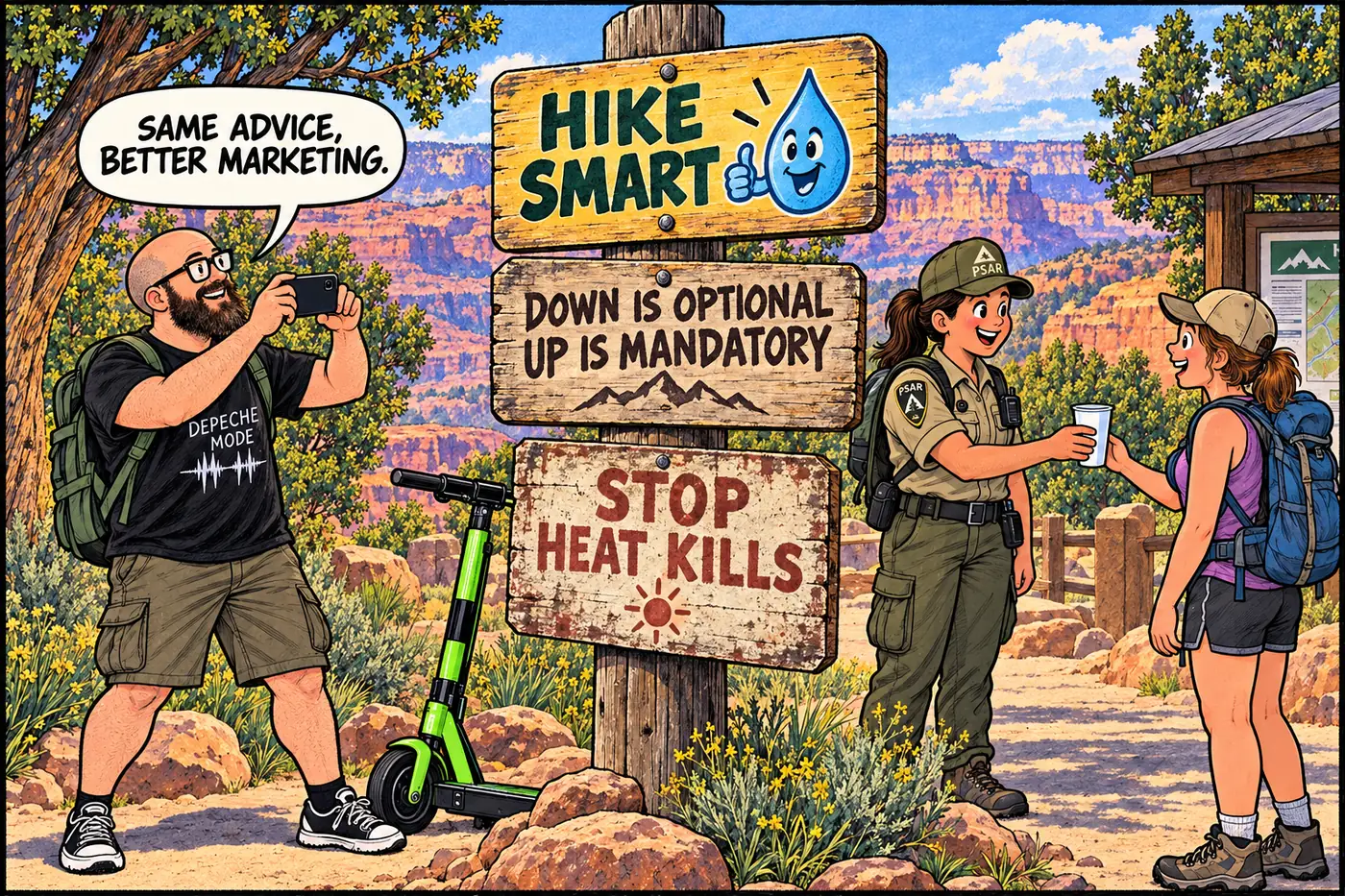
The prevention message itself has gone through three eras. The 1990s pitch was blunt — “STOP, Heat Kills.” The 2000s version, “Down is optional, up is mandatory,” tried to reframe the hike itself as the risk. The current campaign, “Hike Smart,” is built on actual research: a 2011-2013 study found 95°F as a hard inflection point, where heat-related assists per 1,000 hiker contacts jump 71 percent once temperatures cross that line. 1996, for what it’s worth, had 65 days above 95°F — the most of any year in the 25-year dataset researchers pulled from.
By 2025, PSAR — now leaning heavily on trained volunteers backed by Grand Canyon Conservancy funding for training, gear, and trailside snacks — logged 18,400 preventive actions, 444 hiker assists, 2,583 patrol hours, and 140,362 visitor contacts across the Bright Angel, South Kaibab, North Kaibab, and Hermit Trails. The model has spread past Grand Canyon, too: a PSAR symposium hosted at the park in April 2023 drew staff and volunteers from 31 different NPS sites.
The legal floor under all of it
None of this rescue infrastructure exists because the Park Service is required to build it. A 1992 federal court ruling, Johnson v. U.S. Department of the Interior, established that search-and-rescue is a “discretionary function” of national parks — legally, the government isn’t obligated to come get you, and the court found that backcountry dangers are “patently obvious” enough that safety is fundamentally the visitor’s own responsibility. That ruling is a big part of why Grand Canyon invested as hard in PSAR’s education side as its SAR response side: talking someone out of a bad decision at a resthouse is a better bet than counting on a legal or operational guarantee of rescue that doesn’t actually exist. Modern PSAR rangers are certified as EMTs or paramedics, backcountry emergency responders, technical rescue specialists, and helicopter medevac personnel — the same staff who hand out water and advice on the trail are the ones who show up when advice wasn’t enough. (The radio network they call in on — its channel structure and coverage history — is covered separately in Grand Canyon’s public-safety radio system and the park’s radio communications history.)
When the system got tested: August 2026
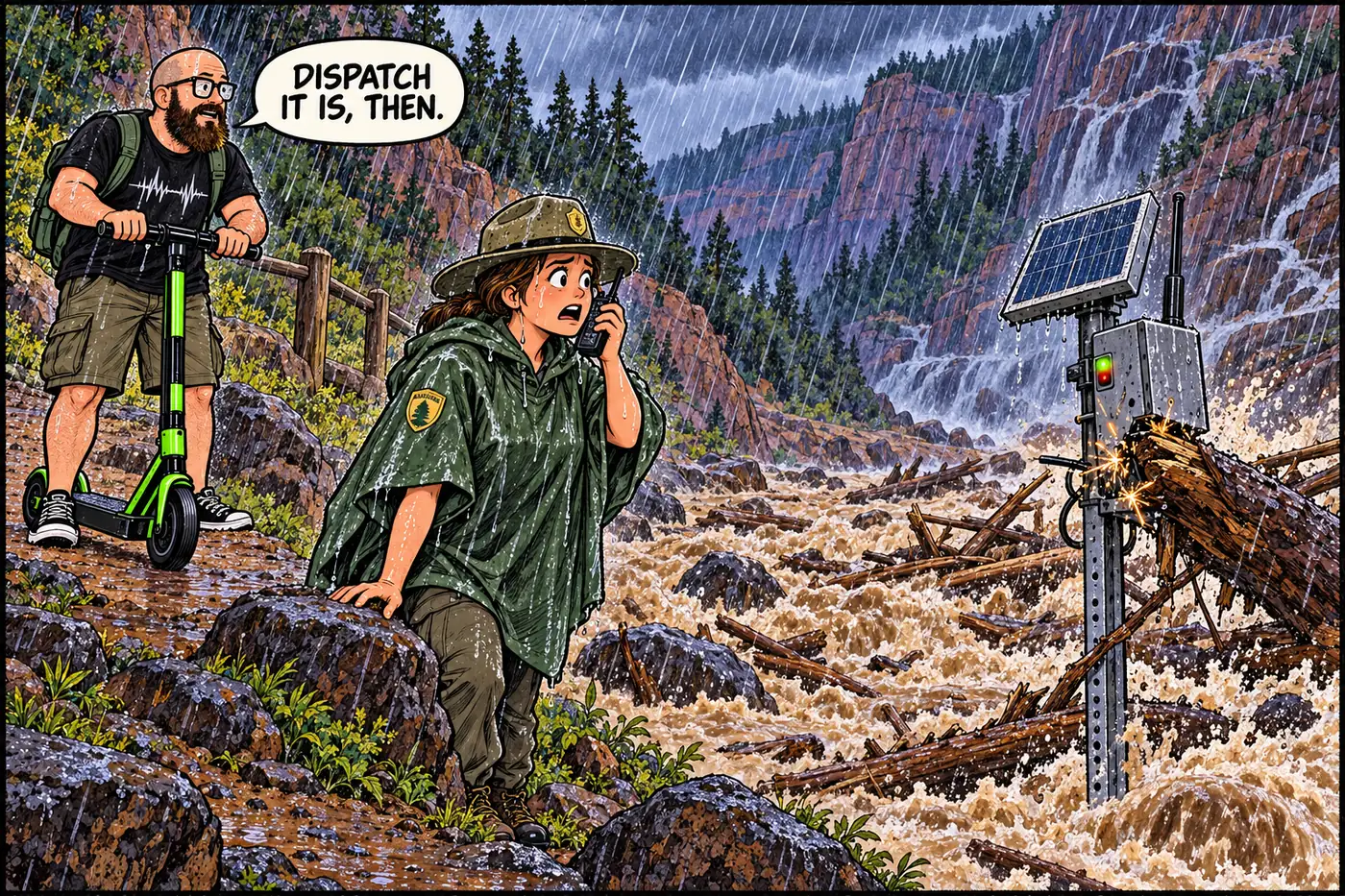
Every piece of this — dispatch, PSAR, the legal framework, the radio network — got stress-tested at once on August 29, 2026, when a flash flood tore through Bright Angel Canyon starting around 2:30 p.m.
The park wasn’t flying blind going in. After the 145,000-acre Dragon Bravo Fire burned the North Rim in 2025, the federal government installed water-level gauges along Bright Angel Creek specifically to give early warning of exactly this kind of post-fire flood risk. The system worked, briefly — then it didn’t. “That system started to alert us of rising waters,” Deputy Superintendent Brian Drapeaux said afterward. “And then shortly after that system went offline.” Officials suspected flood debris had physically knocked out the sensors and planned to investigate.
That left a gap between a sophisticated, purpose-built warning system and the people in the canyon who needed the warning. Two backups filled it. First, the National Weather Service’s own alerts weren’t tied to the local gauge network and kept functioning independently; Coconino County Emergency Management pushed six messages through the Grand Canyon River Alert System — the satellite-text warning network that had launched barely a year earlier, on June 17, 2025 — starting shortly after noon, at the park and NWS’s request. Second, and more strikingly, the oldest channel in the building did the heaviest lifting. “The only way we really knew was as the reports started to come in to either 911 through dispatch,” Drapeaux said — meaning GCRCC, the eight-dispatcher room described above, became the park’s primary real-time flood intelligence source once the purpose-built sensors failed.
What followed was PSAR and SAR infrastructure running at full capacity simultaneously: NPS and Arizona Department of Public Safety flew helicopter missions through the following day, evacuating 62 people from Phantom Ranch and the lower North Kaibab Trail by the morning of August 30 alone, funneling them to a Red Cross-staffed evacuation center at the Maswik Lodge Cafeteria on the South Rim. River operations rangers used the same alert system to redirect river parties already on the water. Nearly every footbridge across Bright Angel Creek was destroyed, and the flood damaged the Transcanyon Waterline badly enough that water restoration became its own weeks-long recovery operation. As of a September 8 NPS update, search operations continued for one person still unaccounted for, and a second flash flood on September 17 set back the emergency water-infrastructure work already underway — a reminder that in a canyon built to funnel water fast, the warning system and the people answering the phone when it fails are doing the same job from two different directions.
Johnson v. U.S. Department of the Interior rules that park search-and-rescue is a discretionary function — not a guarantee.
Five heat deaths and 482 search-and-rescue calls — a record that still stands — force the park to rethink rescue from the ground up.
Four rangers begin patrolling the Bright Angel and South Kaibab Trails with a new mandate: stop the emergency before it happens.
Annual SAR calls fall to about 275, down from a peak near 480, even as visitation keeps climbing.
Post-fire streamgauges go in along Bright Angel Creek; the Grand Canyon River Alert System launches June 17 as a satellite-text backup for zero-signal terrain.
On August 29, the gauge network fails mid-flood. Dispatch, satellite alerts, and helicopter crews carry the response instead.
Sources
- Recognizing Grand Canyon Regional Communication Center for National Public Safety Telecommunicators Week — Williams-Grand Canyon News
- An inside look at the Emergency Services team handling emergencies at the Grand Canyon National Park — FireRescue1
- Preventive success! Grand Canyon's response to search-and-rescue overload — Park Science, National Park Service
- Preventive Search and Rescue (PSAR) — Grand Canyon Conservancy
- Grand Canyon National Park's flood warning system failed during deadly deluge — KNAU
- New backcountry alert system warns Grand Canyon visitors about flash floods — U.S. Geological Survey
- Significant Flash Flooding Closes Phantom Ranch and North Kaibab Trail — Grand Canyon National Park, National Park Service
- Grand Canyon National Park Announces Recovery and Repair Plan Following Flash Flood — Grand Canyon National Park, National Park Service