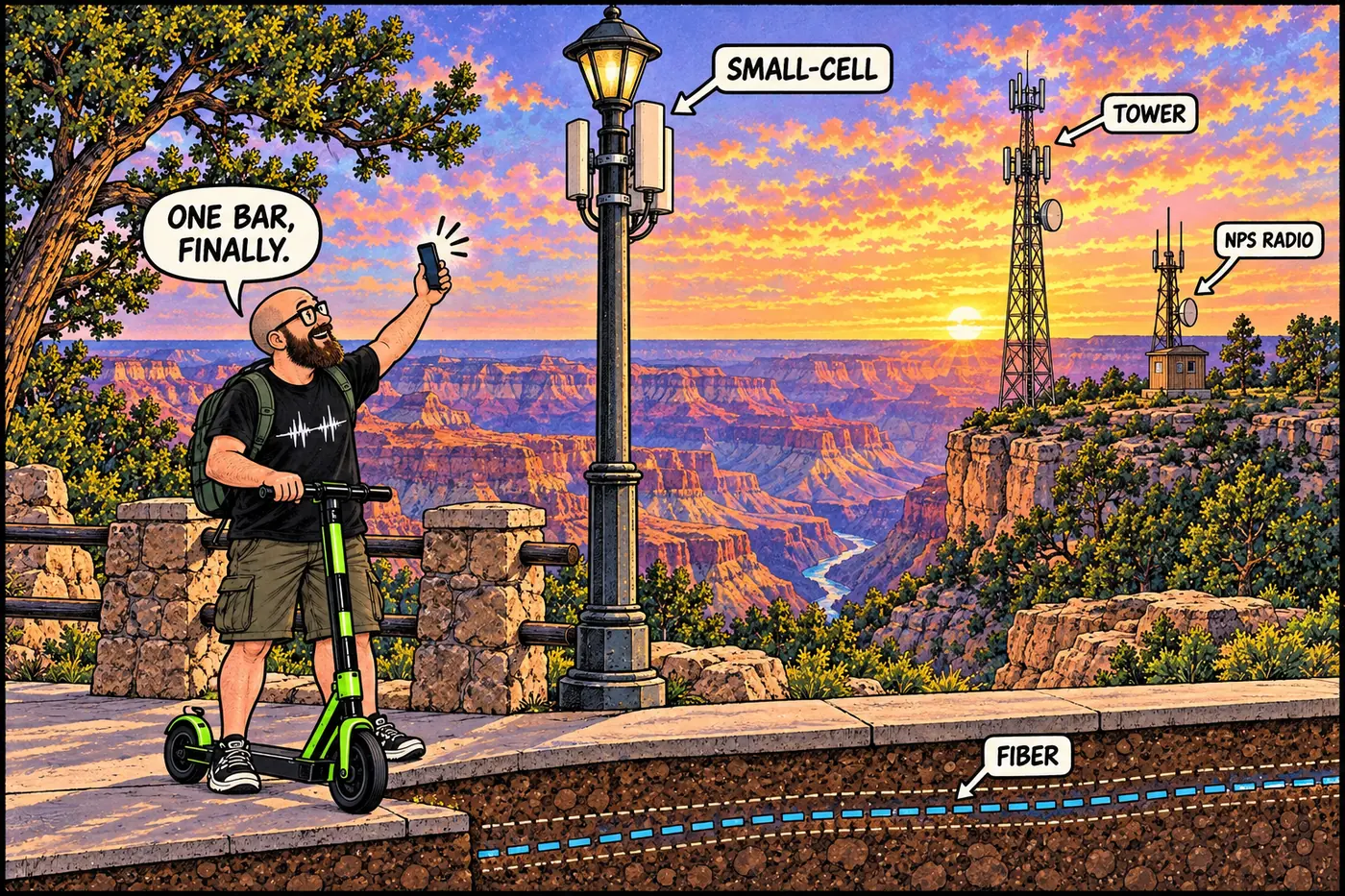
Six million people a year show up at a park where, by the Park Service's own admission, the wireless service is "slow, sometimes non-existent." The fix on paper is towers, small-cell nodes bolted to light poles, and fiber optic cable strung along roads that already exist. The fix in practice, five years after federal approval, is still mostly on paper.
The short version
- A 2019-2020 NPS environmental review found existing wireless coverage and data capacity in Grand Canyon’s developed areas insufficient for the park’s own operations, its partners, and more than six million annual visitors.
- The approved Telecommunications Plan is a framework, not a construction order: it lets private companies apply for permits to build up to five new towers, small-cell nodes, and fiber cable — NPS doesn’t build or pay for any of it.
- New towers would run 80 to 180 feet depending on location, hold up to four carriers each, and mostly sit next to towers the Park Service’s own radio network already uses.
- The Regional Director and Grand Canyon’s superintendent signed off on the plan on November 19, 2020; no evidence turned up this session that any of the five towers have actually gone up since.
- Coverage today is carrier-dependent and rim-only: Verizon works best in the South Rim’s developed areas, AT&T is hit-or-miss, T-Mobile barely works past Grand Canyon Village, and nothing works once you’re half a mile below the rim on any carrier.
- The newest layer of “connectivity” at Grand Canyon isn’t cellular at all — it’s a satellite text-alert network built for hikers and boaters with no signal, which had its first real-world test during the August 2026 Bright Angel Canyon flood.
Why the canyon needed a plan
By 2018, Grand Canyon was pulling in close to 6.4 million visitors a year, and the park’s wireless infrastructure hadn’t kept pace. NPS’s own framing, from the December 2019 notice opening public comment, doesn’t hedge: “Existing wireless coverage and data network capacity within developed areas of Grand Canyon National Park are insufficient to support the operations of the NPS and its in-park partners” — a list that runs to concession companies, nonprofits, tribes, a public school and medical clinic, a utility company, other law enforcement agencies, and residents living year-round on both rims.
That’s a lot of institutional weight riding on a weak signal. Elly Boerke, an NPS environmental protection specialist, put the balancing act plainly to Arizona public radio in mid-2019: “We know we have a pretty valuable scenic resource here at Grand Canyon. That is the main reason why people are here. And so, we are trying to be really sensitive to that as we develop the proposed action.” The park scoped the problem that July and August, then opened formal public comment on a Telecommunications Plan and Environmental Assessment from December 2, 2019 through January 6, 2020.
What the plan actually authorizes
The Telecommunications Plan isn’t NPS building a network — it’s NPS deciding, in advance, where it will say yes if a telecom company asks. The plan evaluates “the combined use of microwave antennas and fiber optic communications cable to provide the necessary links between the park and the broader wireless network,” plus small-cell nodes and up to five new towers. If a company gets a right-of-way (ROW) permit, the company pays to build and maintain the equipment and pays the government fair market value for using the land — NPS’s role is reviewing the application, not writing the check.
The specifics, laid out in the plan’s own FAQ, are unusually precise for a document mostly about zoning:
| Element | Detail |
|---|---|
| New towers | Up to 5, sized for up to 4 carriers each |
| Tower height | 80 ft max near Desert View/Hopi Fire Lookout, up to 180 ft on the North Rim |
| Co-location | 4 of the 5 new towers sited near an existing NPS radio tower |
| South Rim tower areas | Grand Canyon Village (outside historic districts), south of Hopi Point, near Desert View |
| North Rim tower areas | “CC” and Lindbergh Hill |
| Small-cell locations | Grand Canyon Visitor Center, Grand Canyon Village, Market Plaza (South Rim); near Grand Canyon Lodge (North Rim) |
| Small-cell range | Up to ~1.5 miles, vs. several miles for a full tower |
That last point matters for what the canyon actually looks like afterward: a typical small-cell antenna panel is three to four feet tall and about six inches wide, mounted two to four at a time on things that already exist — a light pole, mostly — rather than a new structure poking up over the rim. One existing tower inside Grand Canyon Village, currently sitting in a national historic landmark district, is slated for possible relocation outside it.

The sign-off, and what happened after it
On November 19, 2020, NPS Regional Director Michael T. Reynolds and Grand Canyon Superintendent Ed Keable signed a Finding of No Significant Impact — the federal government’s way of saying the environmental review is done and the framework can move forward — after a 30-day comment period that included input from traditionally associated tribes. The park announced it publicly on January 14, 2021, framing the payoff as infrastructure that would “support an average of 6 million visitors per year” along with NPS operations and partners.
That FONSI approved a process, not a project. Grand Canyon still had to “identify and develop procedures for processing telecommunications right-of-way applications” before any company could actually apply to build. A search of public records this session found no evidence that any of the five towers authorized under the framework have been built in the five years since — current coverage maps show an existing Verizon presence and 5G at some South Rim viewpoints, but nothing distinguishes that from infrastructure that predates the 2020 approval. If new towers have gone up under this plan, it hasn’t made the public record in a form this research turned up.
Mountain States Telephone builds the South Rim's first central switching station, tying together what had been separate NPS, Fred Harvey, and railway phone systems.
A Mountain Bell microwave transmitter at Phantom Ranch starts relaying inner-canyon calls to the South Rim switch instead of running copper the whole distance.
NPS proposes a framework for up to five new towers, small-cell nodes, and fiber cable to fix "insufficient" coverage for 6+ million annual visitors.
NPS regional leadership and the superintendent approve the plan's environmental review on November 19; the park still has to build a permit process before any tower gets built.
Verizon coverage data shows 5G service at Mather Point and other major South Rim overlooks; carrier coverage below the rim remains effectively zero.
The Grand Canyon River Alert System launches June 17 — a free satellite-text warning network built for the exact dead zones cell towers can't reach.

What’s actually online today
Cell service at Grand Canyon is a rim-and-carrier lottery. Verizon is consistently reported as the strongest option in the South Rim’s developed areas, with service reaching major overlooks; AT&T is described as moderate and inconsistent; T-Mobile users report coverage barely extending past Grand Canyon Village itself, with little to nothing at the North Rim. All of that evaporates fast once you leave the rim: coverage on inner-canyon trails, including the Bright Angel and South Kaibab, is “very limited or nonexistent” within roughly half a mile of the top.
Lodging doesn’t fill the gap. Xanterra, which runs the Historic District hotels (Bright Angel Lodge, El Tovar, Kachina, Thunderbird, Maswik), says so on its own website: “the internet speeds that we are able to provide are capable of checking an email here or there but little else” — no video streaming, and photo uploads that may need to wait until checkout. Delaware North runs Yavapai Lodge and Trailer Village near the Visitor Center under similar constraints. The North Rim Lodge has no WiFi at all; the campground general store has limited service.
The one genuinely new piece of infrastructure that reaches where cell towers can’t is satellite-based, and it isn’t trying to stream video — it’s built to deliver a handful of words when it matters. The Grand Canyon River Alert System, launched June 17, 2025 by USGS, Coconino County, the National Weather Service, and NPS, pushes flash-flood and hazard warnings to satellite messengers like Garmin and SPOT devices, and to cell phones where signal exists. NWS Flagstaff meteorologist Megan Taylor summed up why it exists: “We have never been able to reach people in Grand Canyon with flash flood warnings before.” How that system performed under real pressure — and where it fell short — is its own story, covered in emergency communications and dispatch.
Sources
- National Park Service Requests Public Input on a Telecommunications Plan and Environmental Assessment at Grand Canyon National Park — News Release, Dec. 2, 2019, National Park Service
- Frequently Asked Questions, Telecommunications Plan / Environmental Assessment — National Park Service
- Finding of No Significant Impact Signed for Telecommunications Plan at Grand Canyon National Park — National Park Service (Wayback Machine capture)
- NPS Wants To Enhance Telecommunications Services At Grand Canyon — KJZZ
- WiFi Info — Grand Canyon Lodges (Xanterra Travel Collection)
- Grand Canyon National Park Cell Phone Coverage Map & 5G Coverage Reviews — DeadCellZones.com
- New backcountry alert system warns Grand Canyon visitors about flash floods — U.S. Geological Survey