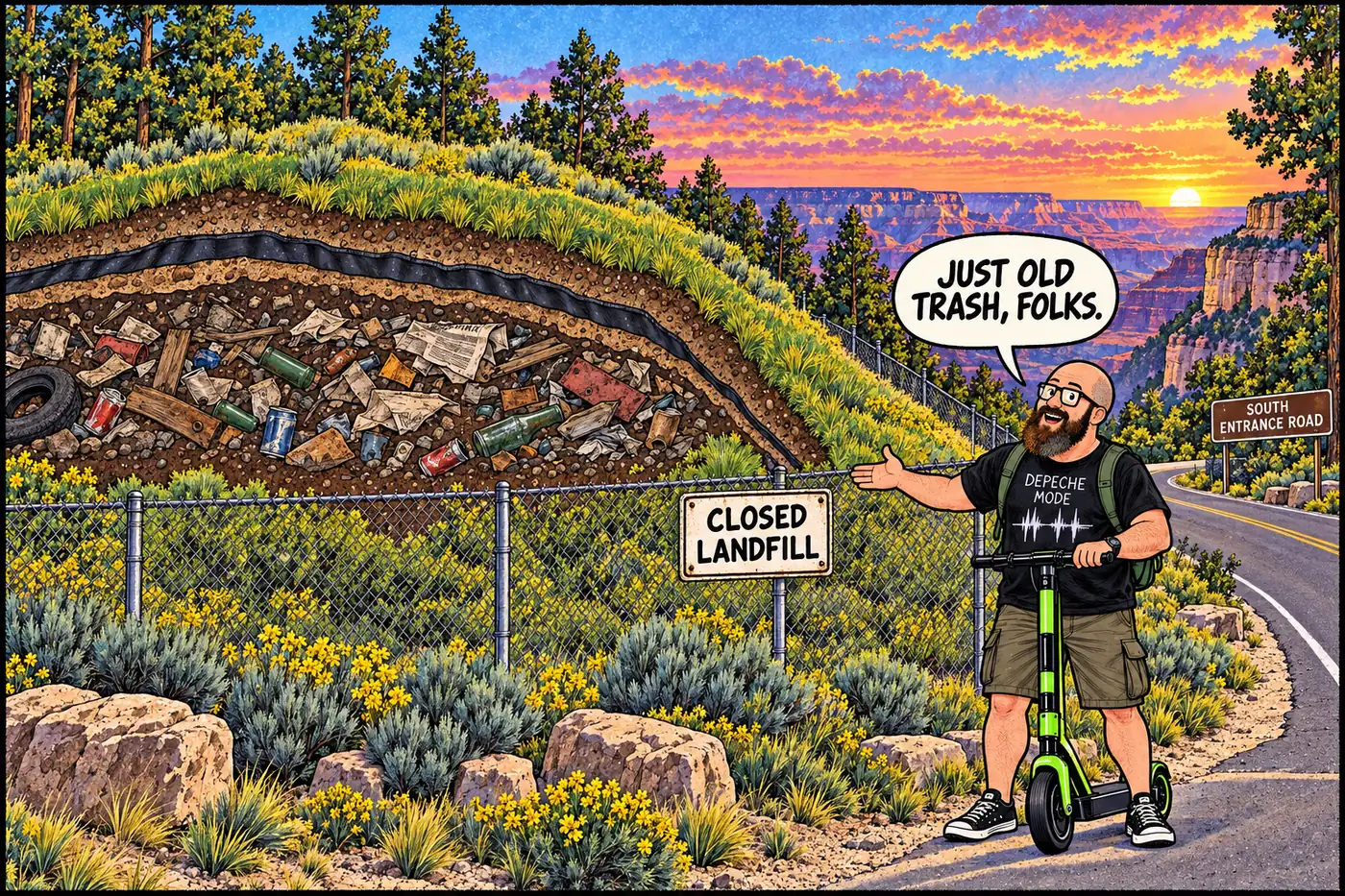
Three-quarters of a mile west of the South Entrance Road sits a fenced patch of ground the park calls, simply, the Former South Rim Landfill. There's no uranium here, no headframe, no dramatic Cold War backstory — just a century of a national park figuring out where to put its garbage, one increasingly regulated hole in the ground at a time.
The short version
- Before there was a landfill, there wasn’t much of anything: 1920s Grand Canyon Village ran on a dozen informal open dumps, some of them set on fire to reduce the pile.
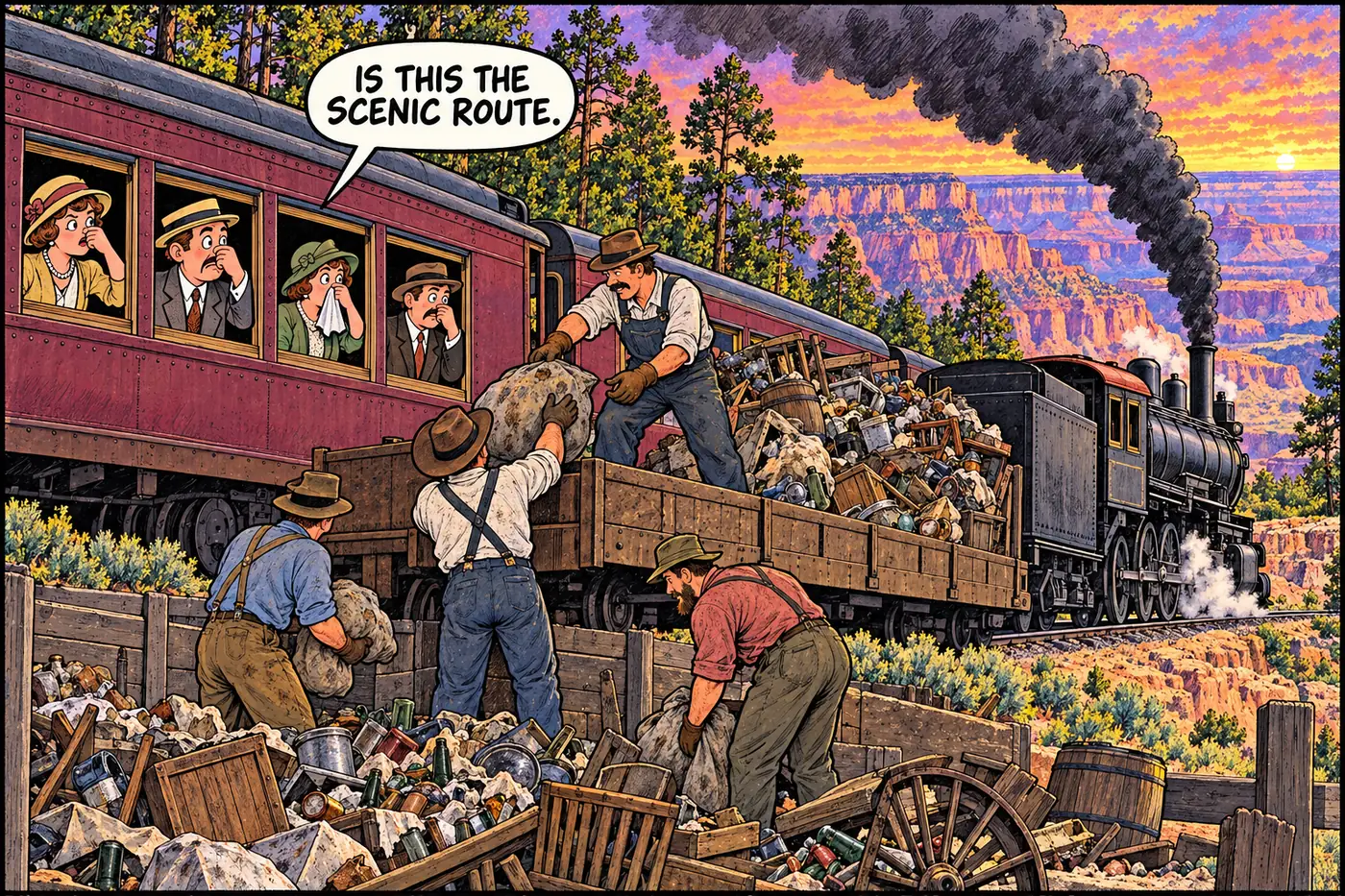
- Through the early 1920s the railroad simply loaded trash onto flatcars and hauled it outside the park to dump along the tracks — a habit that annoyed the Forest Service and tourists alike.
- The Santa Fe Railroad paid for and built a real incinerator in 1926, complete with a can-crushing machine, served by a short spur road off Rowe Well Road.
- By 2002, records show the South Rim’s landfill was still operating, with plans to close it by the end of September 2001 and switch to a transfer station instead.
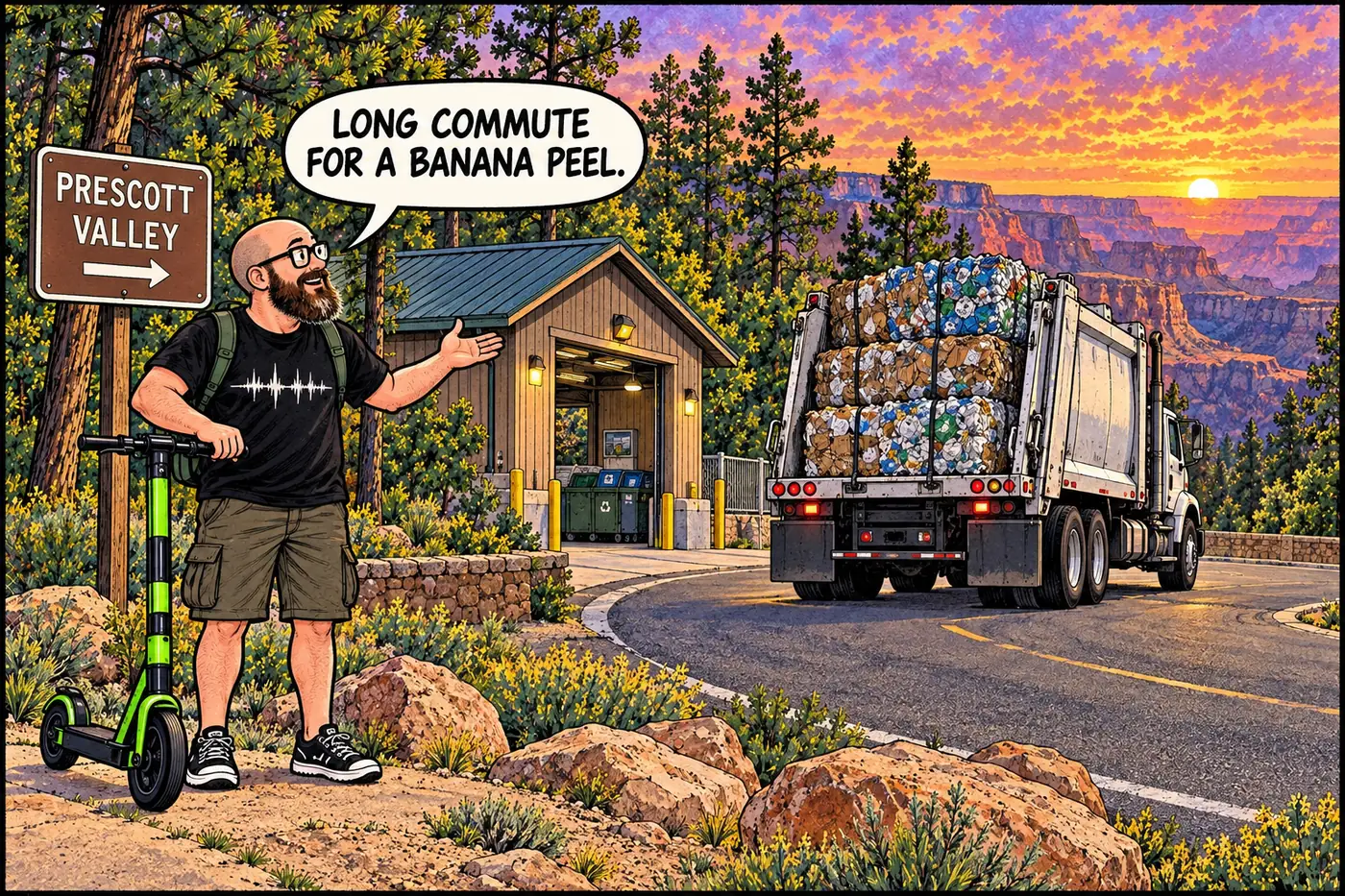
- Today the site is closed to public entry under the Superintendent’s Compendium, and the park’s actual current trash goes through a transfer station on Shuttle Bus Road, then to a sorting facility in Prescott Valley.
- There’s no evidence this was ever a federal Superfund or state WQARF site — it’s a closed municipal-style landfill managed as a public-safety hazard, not a contamination emergency.
From open dumps to an incinerator on Rowe Well Road
Before the National Park Service ever ran anything at the Grand Canyon, Grand Canyon Village was, environmentally speaking, a mess. The Santa Fe Railroad and Fred Harvey Company built hotels and drew crowds, but nobody built a sanitation system to match. Residents and concessioners maintained roughly a dozen informal open-air dumps scattered around the village and the surrounding forest, occasionally setting the piles on fire just to keep them from growing any bigger.
Through the early 1920s the fix was almost worse than the problem: railroad crews and NPS staff loaded the accumulated garbage onto flatcars and hauled it out of the park, dumping it along the tracks on national forest land. Forest Service officials didn’t love finding someone else’s trash on their land, and neither did train passengers riding toward a national park past piles of somebody’s refuse.
The real turning point came in 1925, when planning began for a proper community incinerator. The Santa Fe Railroad paid for the whole thing, and it went into service in August 1926. It wasn’t just a burn barrel — the facility included a “can-smashing” and baling machine that crushed the tens of thousands of tin cans discarded every year down to 8 percent of their original volume, which sped up rusting and effectively boosted the incinerator’s usable capacity by half. By 1927 it was processing 100 tons of garbage a month during the summer tourist season, and a second, similar unit came online by 1930.
To serve that incinerator (and the sewage plant built alongside it), road crews cut a 3,800-foot spur off Rowe Well Road, southwest of the village near the South Entrance — one of only a handful of roads built west of Grand Canyon Village during the entire 1920s. Whether that 1920s incinerator-and-sewage-plant footprint is literally the same ground the compendium later designated the “Former South Rim Landfill” isn’t something any source nails down; what’s clear is that this general area, west of the entrance road, was the park’s working trash-and-sewage corner for the better part of a century.
The South Rim landfill era, and its 2001 closure
By the time solid-waste regulation caught up with national parks in the late 20th century — new federal landfill standards under RCRA Subtitle D, plus Arizona’s own permitting requirements — Grand Canyon, like a lot of small Arizona communities, faced a choice: upgrade the landfill to modern standards, or close it and haul waste somewhere else. A 2002 regional water-quality planning document from the Northern Arizona Council of Governments (NACOG) captured the park mid-decision: as of that report, the South Rim landfill was still active, but the park had a plan to officially close it by the end of September 2001 and switch to using a transfer station in nearby Tusayan for municipal solid waste instead.
That’s consistent with where things stand today. The Superintendent’s Compendium — the park’s current, official closure rulebook — lists the “Former South Rim Landfill Site,” 0.75 mile west of the South Entrance Road, as closed to public entry under 36 CFR § 1.5(a)(2). The stated reason isn’t mystery or intrigue; it’s the same plain public-safety language NPS uses for its other old industrial sites: access has to be denied “to protect the public from a potentially hazardous site and materials,” per the Arizona Department of Environmental Quality. Old landfills, even closed and capped ones, aren’t places you want the public wandering — settling ground, buried debris, and whatever leachate a few decades of pre-regulation trash generates are reason enough.
Where the trash goes now
Grand Canyon’s actual, current municipal solid waste doesn’t go into a hole in the ground at all anymore. ADEQ’s statewide transfer-station directory lists an active “Grand Canyon National Park Waste Transfer Station,” run by the National Park Service, at 1575 Shuttle Bus Road inside the park. From there, waste gets trucked out — since 2016, according to the park’s concession operator, everything collected inside the park has gone to a sorting center in Prescott Valley, where conveyor belts, magnets, and people separate out paper, plastic, and metal for recycling before anything reaches an actual landfill (a different one, run by Yavapai County’s contracted operator, nowhere near the canyon).
The concessioner reports real progress from that switch: roughly 1.9 million pounds of solid waste, about half of what the park generated, got diverted from landfill disposal in the first full year after the 2016 change. By 2019 that diversion rate had climbed to about 65 percent, including 1.3 million pounds of comingled recycling. A food-waste composting program started the same year, processing 75,000 pounds in its first twelve months — compost that gets sold on to nurseries and farmers rather than buried.
None of that is independently audited by a government source; it’s the concessioner’s own reporting. But it’s a genuinely different model than the trash-by-flatcar-and-burn-barrel era a century earlier, and it explains why the “Former South Rim Landfill” is former: the park doesn’t need a hole in the ground on-site anymore, just a transfer station and a truck route.
What’s actually off-limits (and why)
The closure itself is narrow and unglamorous. It’s the old landfill footprint, 0.75 mile west of the South Entrance Road, fenced and marked closed under the compendium — not a broader zone, not the road itself, not anything a visitor would stumble into by accident on a normal trip through the South Entrance. Nobody has turned up any evidence that this site ever qualified for the EPA’s National Priorities List or Arizona’s WQARF registry, the state-level equivalent of Superfund; it isn’t being treated as a contamination emergency, just as an old dump that isn’t safe to walk around on. That’s a much less dramatic story than Orphan Mine’s radioactive tailings and open shafts a few miles away, but it’s the same basic pattern: a working park generates industrial-grade problems, and cleanup lags the closure by years or decades.
Grand Canyon Village runs on informal open-air trash piles, some periodically burned; excess garbage gets flatcar-hauled outside the park and dumped along the tracks.
Santa Fe Railroad funds a community incinerator with a can-crushing/baling machine, served by a new spur off Rowe Well Road; it's processing 100 tons of garbage a month by 1927.
A 2002 regional water-quality plan documents the park's intent to close the South Rim landfill by end of September 2001 and shift to a Tusayan transfer station.
Concession operator Xanterra reports the park switches to hauling all solid waste to a sorting center in Prescott Valley; food-waste composting starts the same year.
The Superintendent's Compendium (effective June 16, 2026) still lists the Former South Rim Landfill as closed to public entry; ADEQ's current directory lists an active NPS transfer station on Shuttle Bus Road.
Sources
- Grand Canyon National Park Superintendent's Compendium, effective June 16, 2026 — National Park Service
- Polishing the Jewel: An Administrative History of Grand Canyon National Park — Michael F. Anderson / National Park Service (npshistory.com)
- An Environmental History of Grand Canyon National Park — Journal of Arizona History, 2019 (npshistory.com)
- Section 208 Water Quality Management Plan — Northern Arizona Council of Governments, June 2002
- Waste Transfer Stations List — Arizona Department of Environmental Quality
- How the Waste Was Won — Grand Canyon Lodges / Xanterra Travel Collection