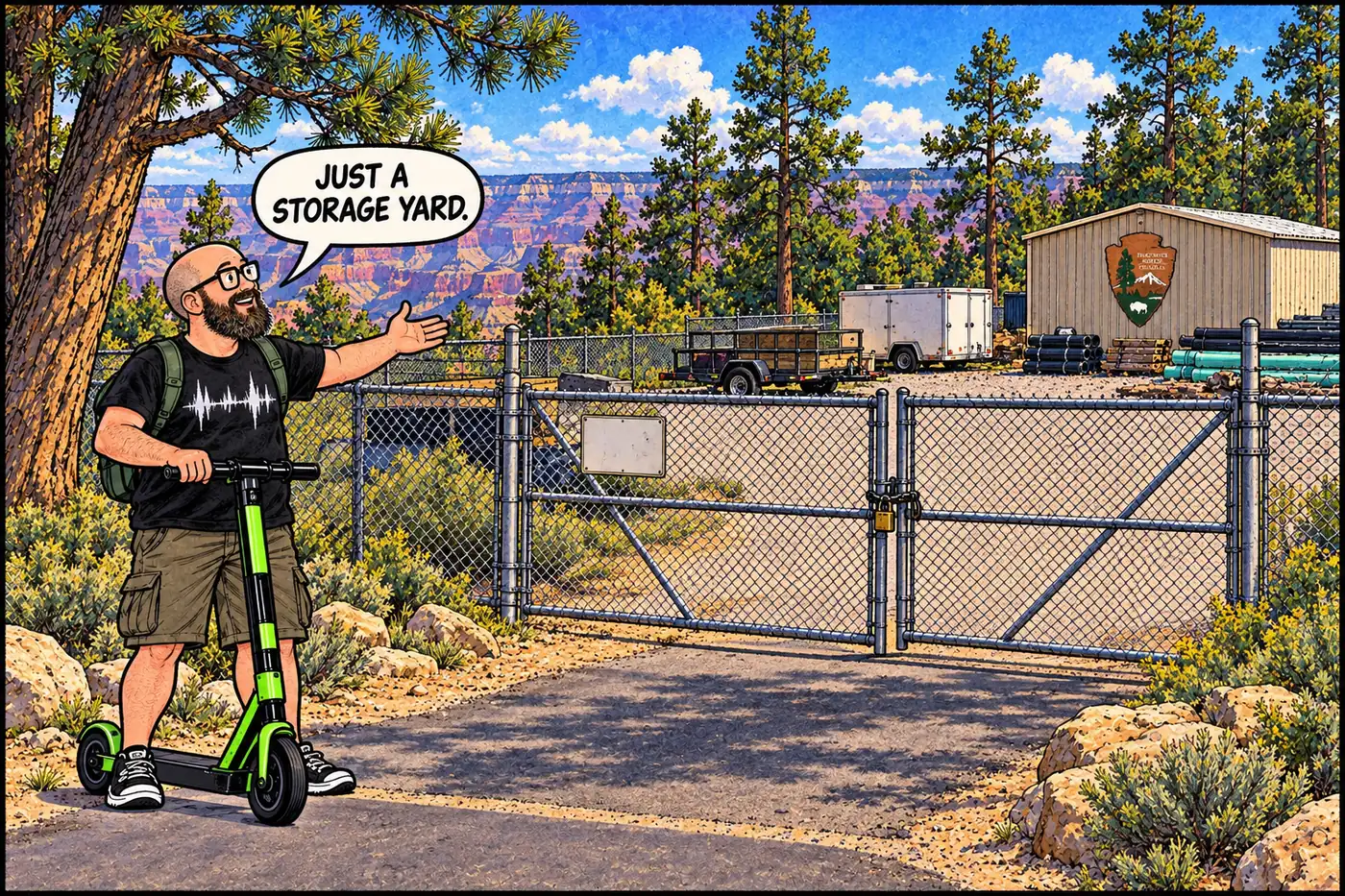
Search Grand Canyon's official closure list for "storage area" and you get exactly one hit: a fenced yard off South Gate Road that the park won't let you walk into. No secret warehouse network, no hidden bunker complex — just one road, one gate, and a straightforward reason for keeping the public out.
The short version
- The Superintendent’s Compendium — the park’s official closure list — names exactly one general-purpose “government storage area”: the South Gate Storage Site.
- It’s labeled a “Maintenance and Protection storage area,” meaning it supports NPS’s facilities-maintenance division and its ranger/law-enforcement division, called Protection.
- The stated reason for closing it is as plain as federal paperwork gets: protecting government property.
- A separate, nearby closure — a remediated leaking fuel-tank site inside the old maintenance yard — gets confused with “storage” but is really an environmental-cleanup closure, not an active storage facility.
- Public record doesn’t say what’s inside the fence, when it was built, or how big it is. That’s not a cover-up; it’s just not the kind of thing NPS publishes about a working equipment yard.
What the compendium actually closes
Grand Canyon’s Superintendent’s Compendium is the document that turns the park superintendent’s general legal authority into a specific, public list of closures. As the compendium itself puts it, its job is “to provide the public and park employees with a document that lists the special designations, closures, public use limits, permit requirements and other restrictions imposed under the discretionary authority of the superintendent,” using the authority found in “Title 36, Code of Federal Regulations (CFR), § 1.5(a).”
Item 19 in the current version, effective June 16, 2026, reads: “South Gate Storage Site (Maintenance and Protection storage area) - Closed to Public / Restricted Area: The South Gate Road and storage area, as defined by the road closure gate and posted signs, is closed to public use, access and presence.” The justification is one sentence: “Public access of this area needs to be restricted for the protection of the government property.”
That’s the entire public record on this specific site. No square footage, no inventory, no construction date. The parenthetical — “Maintenance and Protection storage area” — is the only clue to what it’s for: it backs up two of the park’s operating divisions, the crews who keep roads, buildings and utilities running (Maintenance) and the rangers who handle law enforcement and resource protection (Protection).
The tank site next door — a different kind of closure
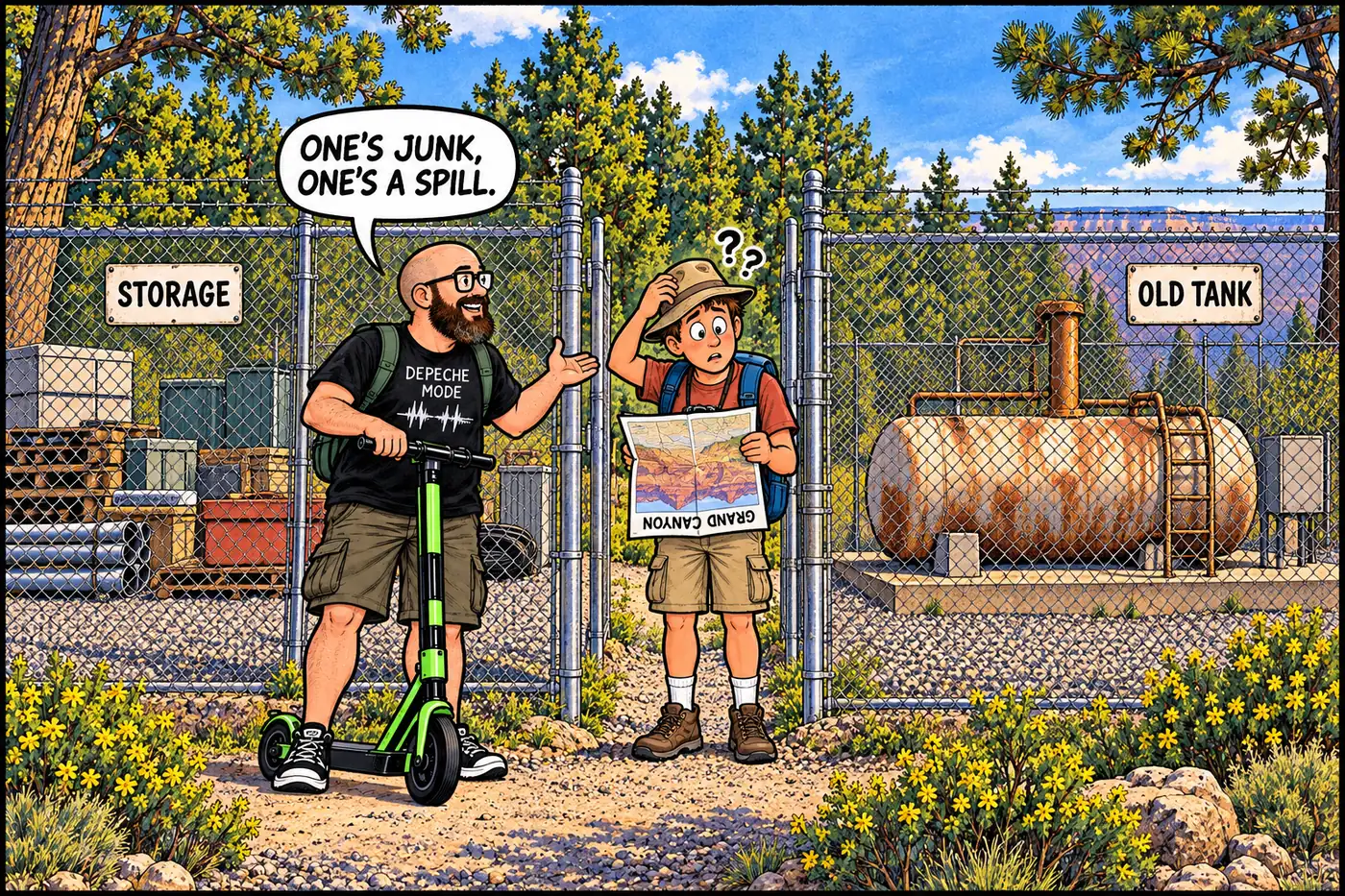
A second, unrelated South Rim closure sits inside “the former National Park Service maintenance yard” and sometimes gets lumped in with “storage” because it involves a tank. It isn’t a storage area at all — it’s a cleanup site. The compendium closes construction “between NPS building #1536 and the above ground fuel tanks (an area of 75’ east to west and 35’ north to south)” because “this is the former site of a 20,000-gallon tank that experienced a leak resulting in an unknown amount of fuel loss into the surrounding soils.” The restriction exists “to meet Arizona Department of Environmental Quality regulations regarding public safety at environmentally impacted sites” — the same regulatory logic that closes the park’s former landfills and old wastewater sites, not the “protect the equipment” logic that closes South Gate.
| Site | Compendium item | What it actually is | Why it’s closed |
|---|---|---|---|
| South Gate Storage Site | (19) | Maintenance and Protection storage area, off South Gate Road | Protection of government property |
| South Rim Remediated Leaking Underground Storage Tank | (21) | Former 20,000-gallon fuel tank site in the old maintenance yard | Soil contamination / ADEQ environmental-safety rule |
What’s actually off-limits (and why)
Both closures work the same way procedurally, and the same way every closure in this compendium works: a road-closure gate and posted signs mark the boundary, the underlying authority is 36 CFR § 1.5(a)(2), and the superintendent “retains the right to grant special or routine access to park staff and/or administrative users for park management and/or research interests” even inside a closed area. There’s no ambiguity about the legal basis — it’s published, current, and cited by section number on the sign and in the compendium itself.
What’s genuinely off-limits is narrow: the fenced South Gate storage yard and its access road, and the small footprint around the old fuel-tank site. The rest of the South Gate area, and the general vicinity of the historic maintenance yard, isn’t covered by either closure. If you’re looking for a wider “restricted government storage network” at Grand Canyon, the compendium doesn’t describe one — just this single, unremarkable yard doing exactly what its name says.
For the bigger fenced compound nearby — shops, fuel, fire base, and shuttle operations — see Restricted maintenance compounds. For the legal machinery behind every closure on this list, including the handful that specifically invoke “critical infrastructure” language, see Critical infrastructure protection inside Grand Canyon and What is actually off-limits at the Grand Canyon, and why?