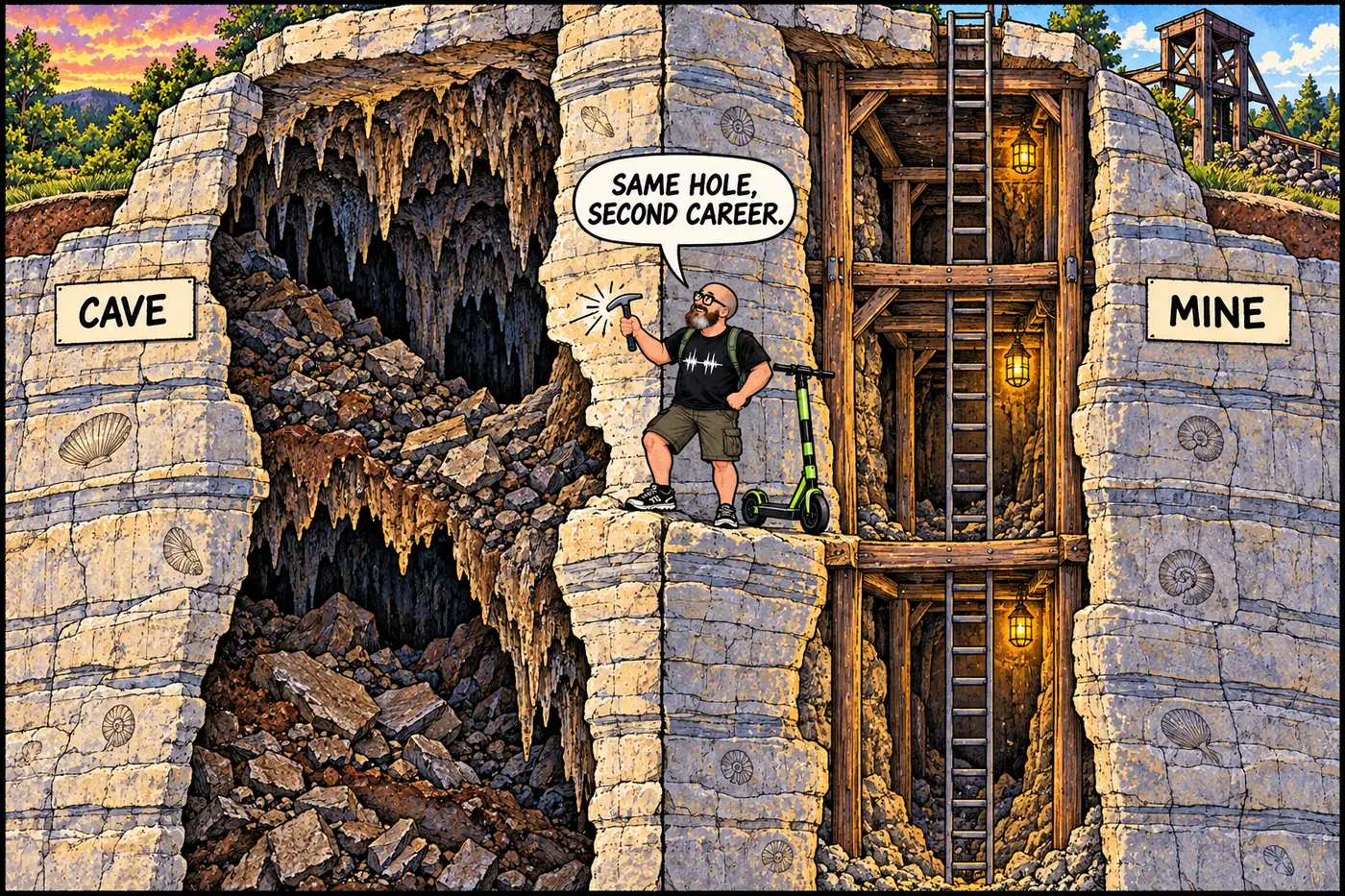
Ninety-seven percent of Grand Canyon National Park sits on karst — rock that dissolves into caves. Some of those caves, over millions of years, collapsed and filled with ore, and people spent a century digging the ore back out. Caves and mines aren't two unrelated stories at Grand Canyon. Often they're the same hole, at two different points in its life.
The short version
- Almost all of Grand Canyon’s bedrock is karst, and the Redwall Limestone that hosts most of its caves is the same formation that hosts its uranium deposits — the two aren’t a coincidence of geography, they’re a shared origin.
- “Breccia pipes,” the vertical ore columns miners chased for a century, form when ancient caverns in that limestone collapse and later fill with metal-bearing groundwater. A uranium mine and a fossil cave can be the same feature at different points in its history.
- NPS estimates the park holds as many as 2,500 natural caves (several hundred formally documented, a more recent inventory puts it past 660) and, on the mining side, has counted 38 abandoned-mine sites with 75 individual features.
- Federal and park rules treat “cave” and “mine” as legally separate categories with separate closure justifications — but the same bats often live in both, which is where the rulebook and the biology reconnect.
- The park’s single most-studied cave system, found in 2008, has been mapped past 40 miles of passage and holds thousands of naturally mummified bats up to 50,000 years old — a scientific trove that has nothing to do with either mining or white-nose syndrome.
The shared geology nobody mentions on the rim trail
Start with the rock. Almost the entire park — 97% — sits on karst terrain, limestone and related rock riddled with the voids that water carves out over geologic time; another 3% is pseudokarst, similar-looking terrain formed by other processes. Only Everglades National Park has more karst area than Grand Canyon among all National Park Service units, and here it’s concentrated in one formation: the Redwall Limestone, the reddish-gray band about a third of the way down the canyon wall that hosts the majority of the park’s caves.
That same limestone is also where the canyon’s mining history comes from. “Breccia pipes” — the vertical, cylindrical ore bodies that produced nearly every uranium mine in and around the canyon — form when caverns inside the Redwall Limestone collapse under the weight of overlying rock, leaving a rubble-filled chimney that groundwater later saturates with dissolved metals, chiefly uranium and copper. It’s an unusual geologic mechanism, common in this part of northern Arizona and southern Utah and rare almost everywhere else; it’s also generous enough to have produced at least one mineral, grandviewite, found nowhere on Earth outside Grand Canyon. Put plainly: a breccia-pipe uranium mine isn’t built near an old cave. Structurally, it’s built inside one — a cave that collapsed, filled with ore, and got excavated a second time by people instead of water. The Orphan Mine, which pulled roughly 495,000 tons of ore and 4.26 million pounds of uranium oxide out of the South Rim between 1956 and 1969, is the best-documented example of this exact process.
Two different ways of counting holes
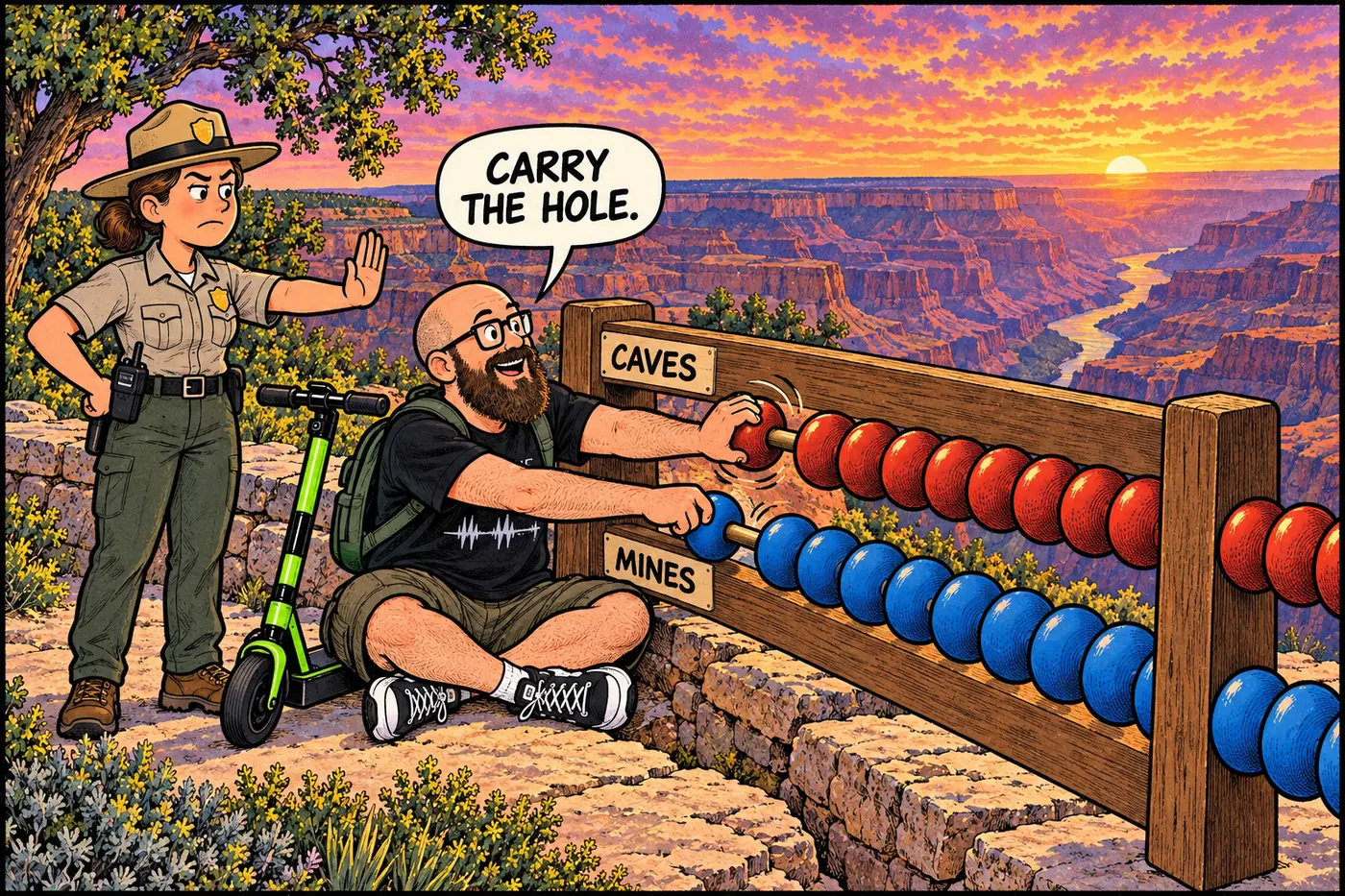
Ask NPS how many caves are in the park and you get an estimate with real uncertainty attached: as many as 2,500, with several hundred formally documented by the park’s Geodiversity Atlas, and a more recent, narrower figure from ongoing NPS-permitted survey work putting the documented count past 660. Ask about mines and you get something closer to an actual tally: 38 documented Abandoned Mineral Lands sites containing 75 individual features — adits, shafts, pits, tunnels, prospects, and tailings piles — with 12 of those 38 sites flagged as needing active mitigation. Those hazards run the range you’d expect from a century of hand-dug and machine-bored excavation: high radon, radioactive soils, asbestos, unstable debris, slope failure, and subsidence.
The two counts aren’t measuring the same thing the same way, and shouldn’t be added together. Caves are counted by exploration — someone has to physically find and survey a passage before it’s “documented,” and most of the park’s caves sit on cliff faces nobody has reason to visit. Mines are counted by federal environmental-liability inventory, a very different and more systematic process, because the government is legally obligated to track hazards on its own land. That gap in methodology is itself a small piece of the underground story: nature’s inventory is still being written by cavers with headlamps; industry’s inventory was closed out by federal accountants. For the full breakdown of what those 75 mine features are and where the money to close them has gone, see the mine inventory.
Water dissolves passages through the Redwall Limestone; some later collapse into rubble-filled breccia pipes that groundwater saturates with uranium and copper ore.
Prospectors start working breccia-pipe deposits across the canyon for copper, asbestos, and other minerals.
NPS and Smithsonian researchers document one of North America's largest Shasta ground sloth dung deposits in a natural cave — unrelated to mining, a pure paleontological find.
A breccia-pipe deposit on the South Rim yields roughly 495,000 tons of ore, run through a shaft sunk into what was structurally a collapsed cave system.
Congress legally separates "cave" from "mine" for the first time, excluding manmade excavations from the cave definition nationwide.
Caver Jason Ballensky locates a system that will eventually be mapped past 40 miles of passage — a natural cave with no mining history at all.
Same rock, different rulebook
Legally, the two categories don’t overlap at all. The Federal Cave Resource Protection Act of 1988 defines “cave” as a naturally occurring void and explicitly excludes “any vug, mine, tunnel, aqueduct, or other manmade excavation.” Grand Canyon’s current Superintendent’s Compendium, effective June 16, 2026, sharpens that further for management purposes — a natural opening only counts as a cave if it’s at least 50 feet long with an entrance no wider than it is deep — while defining “mine,” on the other side, as broadly as possible: any anthropogenic feature dug for mineral extraction, from a single 1890s prospect pit to a 1,500-foot uranium shaft. Both categories end up closed to the public by nearly parallel rules — mines need written superintendent permission for research or administrative work, caves need a valid entry permit — but for different stated reasons. Mine closures lead with safety. Cave closures lead with safety plus archaeology plus biology. For the full legal mechanics of that split, including why Redwall Cavern (a genuinely enormous natural feature on the river) technically fails the park’s own cave definition, see mines versus natural caves.
Where the rulebook’s clean split breaks down is biology. Nationally, 29 of the 45 bat species native to the U.S. rely on abandoned mines for some part of their life cycle — summer roosts, hibernation, nurseries — and Grand Canyon’s own mines are no exception; NPS says plainly that its abandoned copper, gold, and uranium workings “now make excellent habitat for many bat species.” That means a mine sealed for public safety and a cave sealed under Cave of the Domes’s bat-specific closure can be protecting the exact same colony, just under two different sections of the compendium. White-nose syndrome, the fungal disease that has killed millions of bats nationally since 2006 and was confirmed in Arizona for the first time in February 2025 — including trace detections in Coconino County, where the park itself sits — is the reason both categories now share the same decontamination protocol for anyone doing closure work near a roost.
The one cave nobody needed a mining company to find
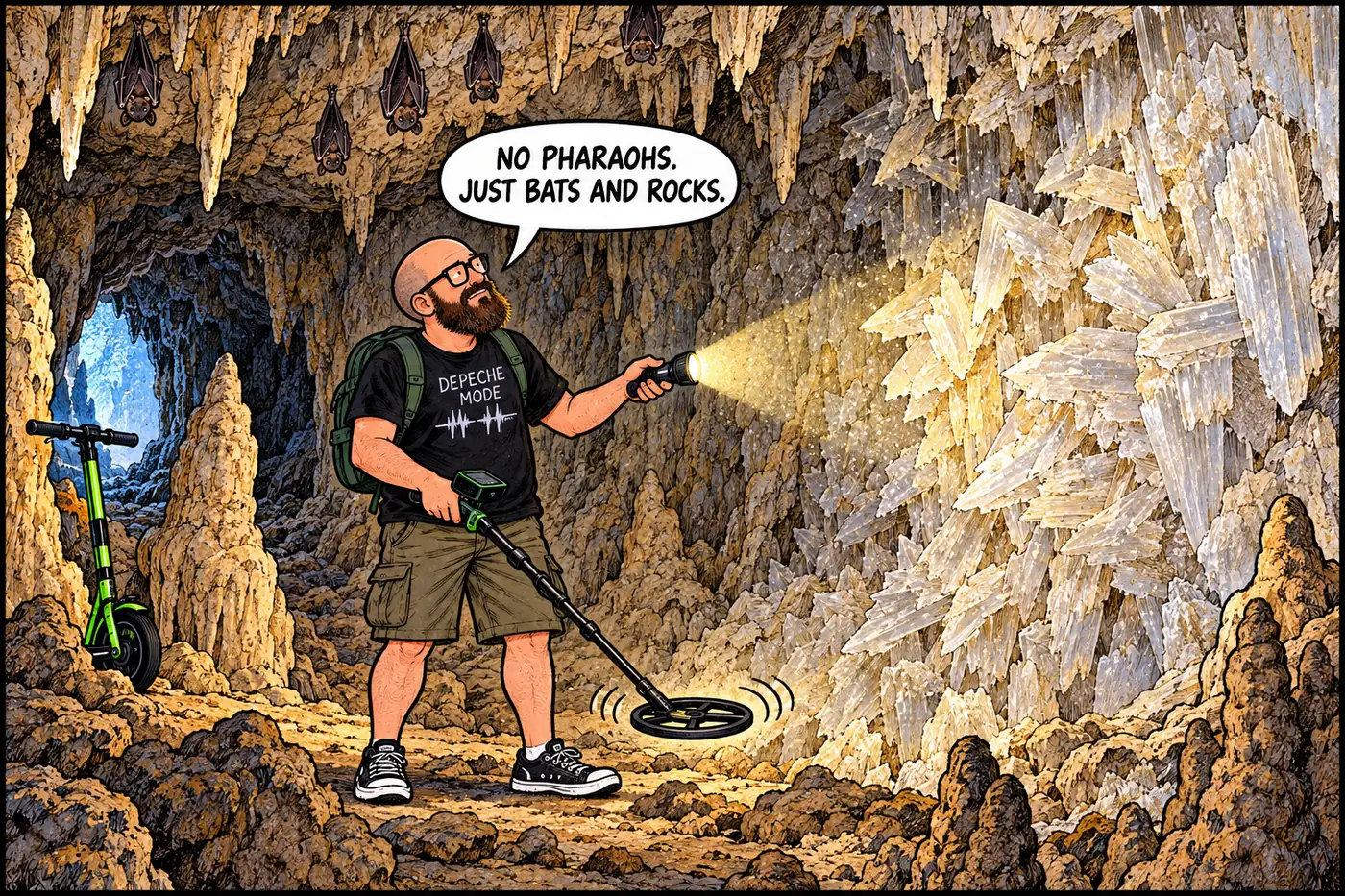
Not every hole in this canyon has an industrial backstory, and the park’s best example proves it. In 2007-2008, caver Jason Ballensky located a cave system with no mining connection whatsoever — a purely natural discovery that has since been mapped past 40 miles of interconnected passage, ranking it among the longest known caves in the world, and it’s still not fully explored. Its location is kept undisclosed by NPS, and for good reason: the cave preserves hundreds, possibly thousands, of naturally mummified bats spanning at least 11 species, radiocarbon-dated from roughly 3,700 years old to beyond the ~50,000-year limit of the dating method itself, alongside preserved ringtails, foxes, raccoons, and rare gypsum-flower mineral formations. It’s a paleontological deposit, not a modern die-off — unrelated to white-nose syndrome — and it’s arguably the single best argument that this canyon’s underground is worth protecting on its own terms, independent of whatever was once mined out of it.
It’s also worth saying what this canyon’s underground definitely isn’t: there’s no lost Egyptian city, no hidden ancient civilization’s tunnel network, whatever a century-old newspaper hoax might still claim. See the Kincaid/Egyptian cave myth for how that story got started and why the geography it describes doesn’t hold up.
What’s actually off-limits (and why)
Every documented cave and every documented mine in Grand Canyon National Park is closed to casual public entry — full stop — under the compendium’s general rules, with individually named sites (Orphan Mine, Cave of the Domes, Bat Cave, Rampart Cave) carrying their own specific closure language on top. Cave management and permitted access are their own detailed topic; so is the park’s broader catalog of known, researched cave systems. For the general framework behind every closure in the park, not just underground ones, see what’s actually off-limits at the Grand Canyon, and why.
Sources
- NPS Geodiversity Atlas — Grand Canyon National Park, Arizona — National Park Service
- Inside the Grand Canyon's Longest Known Cave — Grand Canyon Trust
- Grand Canyon National Park Superintendent's Compendium, effective June 16, 2026 — National Park Service
- Science for Decision Making on Uranium Mining in Arizona: Orphan Mine — U.S. Geological Survey
- Bats test positive for possible deadly fungus — Arizona Game & Fish Department
- Mines as Habitat — Abandoned Mineral Lands, National Park Service
- To the Batcave — Arizona Highways