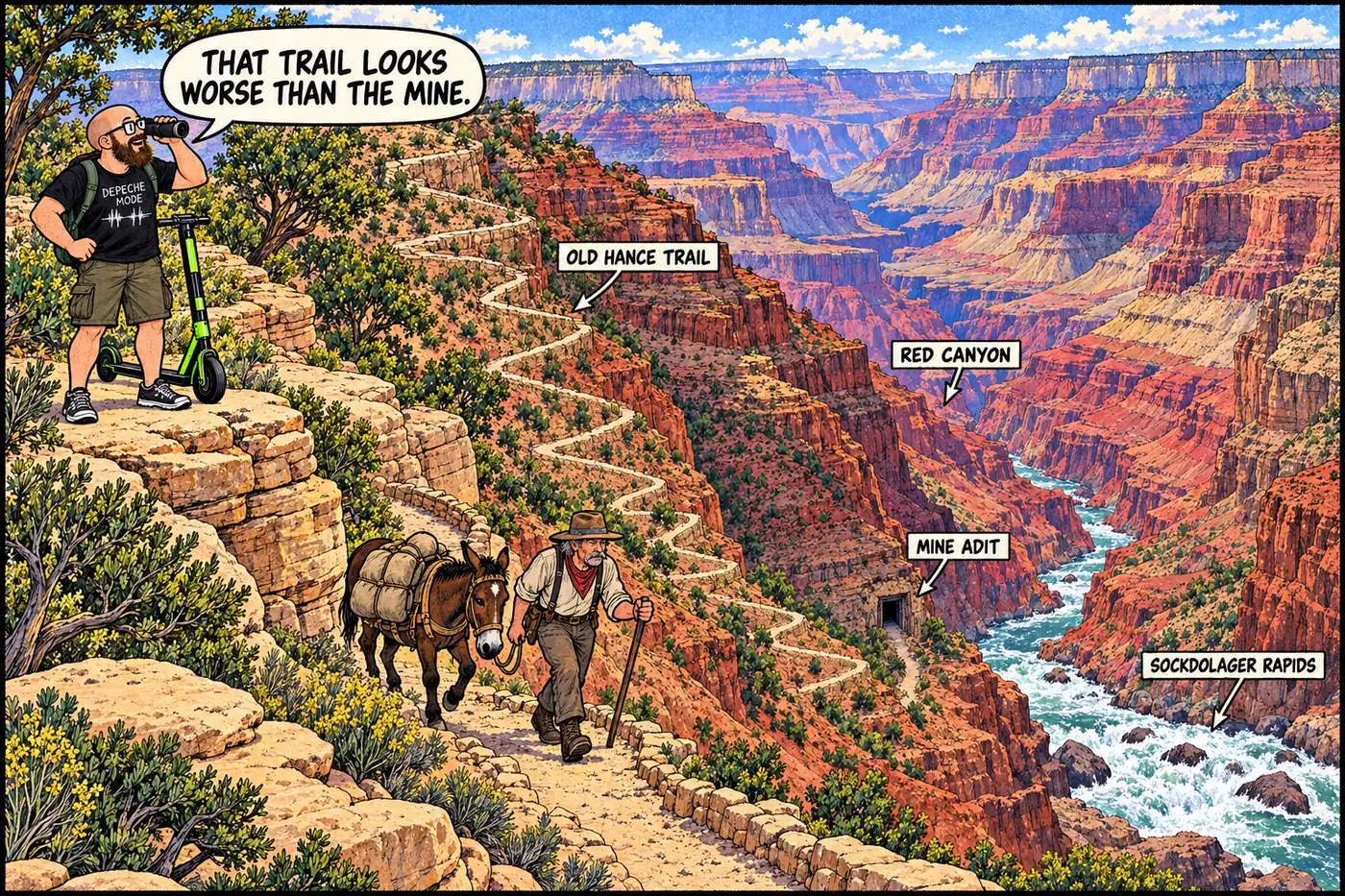
John Hance told a lot of tall tales — about grizzly fights, about his own age, about how the canyon got carved. The one thing he didn't exaggerate was how little money his asbestos claims actually made him. Hance ended up more famous as the canyon's first tour guide than as a miner, and the mine that bears his name is now a hard closure on the river, not a tourist stop.
The short version
- John Hance’s mining claims trace to Bill Ashurst’s discovery of the “Wool Claim” near the Colorado River, which became known as the Hance asbestos mine.
- By 1886 Hance had built a trail to those claims at the mouth of Red Canyon, near Sockdolager Rapids — the route that later became the Old Hance Trail.
- The mine itself made him little money; his real income came from selling the asbestos claims outright to Massachusetts investors in 1901 for $6,250.
- Hance is remembered today mainly as the Grand Canyon’s first Anglo tour guide, having led the first documented tour down his own trail in 1884.
- No EPA Superfund site profile for Hance Mine could be found this session, unlike Bass Asbestos Mine and Orphan Mine, which both carry EPA site records.
- The current park rulebook closes the river corridor from Mile 77.5 through the mine itself at Mile 78.6 to all visitation, citing the asbestos hazard.

A miner who became a storyteller
Hance’s own biography is harder to pin down than his trail work. He was born in Tennessee, but sources disagree on the year — a guest-book entry from 1898 implies 1850, while voting records where he listed his own age point closer to 1845-1846. His Civil War service is similarly contested: a contemporary Prescott newspaper claimed he served the Confederacy and was imprisoned by Union forces, but his own niece disputed the story, noting that her father — Hance’s brother George — was an abolitionist. After the war, records place him as a dispatch rider out of Fort Leavenworth in 1865 and later as a “mule skinner” hauling military supplies for a wagon train run by Lorenzo Butler Hickok, Wild Bill Hickok’s brother.
Hance arrived in Prescott, Arizona Territory with his brother George in November 1868. Both settled at Camp Verde, where George ran the sutler’s store and John handled wood and hay contracts for the military post, along with co-owned freight teams. Sometime between 1883 and 1886, Hance relocated to the Grand Canyon’s South Rim and started prospecting alongside other early canyon miners, including William “Bill” Ashurst and Pete Berry.
The asbestos claim and the trail to it
Hance’s mining ventures were never financially successful on their own — the record on that point is consistent. What made his corner of the canyon notable was a claim Ashurst located, the “Wool Claim,” which became known simply as the Hance asbestos mine. By 1886, Hance had completed a trail down to those claims at the mouth of Red Canyon, near Sockdolager Rapids on the Colorado River — a genuinely difficult piece of trail-building through some of the steepest terrain on the South Rim.
That original route, now remembered as the Old Hance Trail, didn’t last. Washouts and rockslides had damaged it badly by the mid-1890s, bad enough that Hance abandoned it outright. Around 1894 he built a replacement — the New Hance Trail, also called the Red Canyon Trail, possibly with help from other miners working the same district. The new route kept moving both ore and tourists: Hance hauled copper and asbestos from his Red Canyon claims over it while continuing to run his guiding business on the side.
A Christmas 1902 photograph shows a line of workers at what’s described as “the Hance asbestos claims on the north side of the Colorado River” — a period snapshot of an operation that, by most accounts, never scaled much beyond that. The real payday came from selling out: in 1901, Hance sold his asbestos claims along the Colorado River to a group of Massachusetts investors for $6,250. That’s a modest sum next to William Bass’s later $25,000 sale of his own claims a quarter-century afterward, but it’s roughly in line with how most Grand Canyon mining actually paid off in this era — not through ore production, but through selling claims to investors who thought they’d be worth more later.
The guide outlasted the miner
Hance and his partners built the earliest wagon road connecting the South Rim to Flagstaff in 1885 — a route that, after a 1960 rebuild and realignment, became today’s Arizona Highway 180. That road-building instinct paid off in a different way than mining ever did. When the railroad reached the South Rim in 1901, Hance moved into Grand Canyon Village, and the Fred Harvey Company put him up with board and lodging in exchange for entertaining tourists with his stories. That arrangement lasted until 1914, when he and the company parted ways. He’d patented his original homestead claim in 1907, and by most tellings he’s remembered today as the canyon’s first tour guide — having led the first documented tour group down his own trail back in 1884, before Grand Canyon was a national monument, let alone a park.
Hance died in 1919. Sources agree on the year; they split slightly on the exact location, with some accounts placing his death in Flagstaff and others simply noting he was near Grand Canyon Village at the end. He’s buried in the Pioneer Cemetery in Grand Canyon Village on the South Rim, not far from the trail he cut through Red Canyon almost four decades earlier.
Hance and his brother George arrive in Prescott, later settling at Camp Verde on military supply contracts.
Hance relocates to the Grand Canyon and starts prospecting with Bill Ashurst and Pete Berry.
A trail reaches Hance's asbestos claims at the mouth of Red Canyon, near Sockdolager Rapids.
Washouts force Hance to abandon the original route; he builds a replacement to keep moving ore and tourists.
Hance sells his asbestos claims along the Colorado River to Massachusetts investors for $6,250; the same year, the railroad reaches the rim and he moves to Grand Canyon Village.
John Hance dies, remembered by then more as the canyon's first tour guide than as a miner.
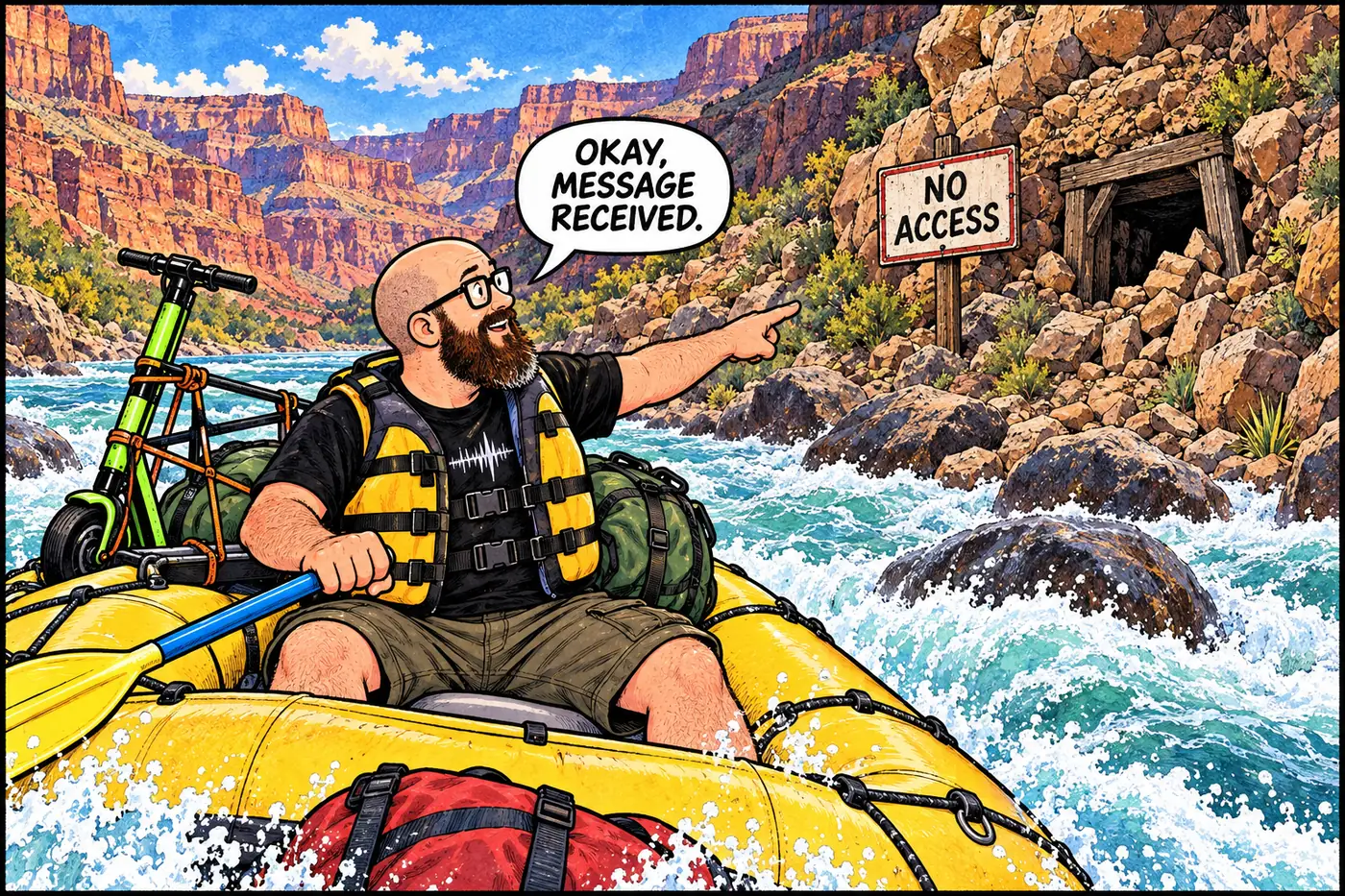
The current Superintendent's Compendium closes river right from Mile 77.5 through the Hance Mine (Mile 78.6) to all visitation, citing the asbestos hazard.
What’s actually off-limits (and why)
The current Grand Canyon National Park Superintendent’s Compendium closes the river corridor around Hance Mine outright: river right from Mile 77.5 through the mine itself at Mile 78.6 is closed to all visitation, because of the asbestos hazard. That’s a blunter rule than the buffer-zone approach used at the Bass Asbestos Mine, which allows entry with special written permission — the Hance Mine closure has no permission clause in the river regulations section.
The mine also falls under the park’s blanket rule covering every mine within its boundaries, which defines “mine” broadly enough to include adits, shafts, pits, tunnels, prospects, and tailings piles, and bars public presence, use, or access in all of them without special written permission from the superintendent — the same rule that protects Bass Asbestos Mine and Orphan Mine.
What’s missing from the public record, at least as far as this search went, is any EPA Superfund site profile for Hance Mine. Bass Asbestos Mine and Orphan Mine both carry EPA CERCLIS site records (both non-NPL, both archived with no further federal action planned). No comparable EPA record for Hance Mine turned up this session. That doesn’t mean the site is cleaner — asbestos hazard is exactly why the river corridor is closed — it just means the applicable protection here is the NPS compendium’s closure, not a federal Superfund designation. See the park’s general rundown of what’s closed and why for how that compares across sites.
Sources
- John Hance biographical chapter — Arizona Highways
- Hance — Sublimity & Spectacle, Grand Canyon 100 exhibit, Northern Arizona University Cline Library
- New Hance Trail — Grand Canyon Historical Society
- Mining — Nature, Culture and History at the Grand Canyon (Grand Canyon Historical Society)
- John Hance: From Miner to Mythmaker — Hatch River Expeditions
- Mile by Mile: Hance Rapid — Western River Expeditions
- Grand Canyon National Park Superintendent's Compendium, effective June 16, 2026 — National Park Service