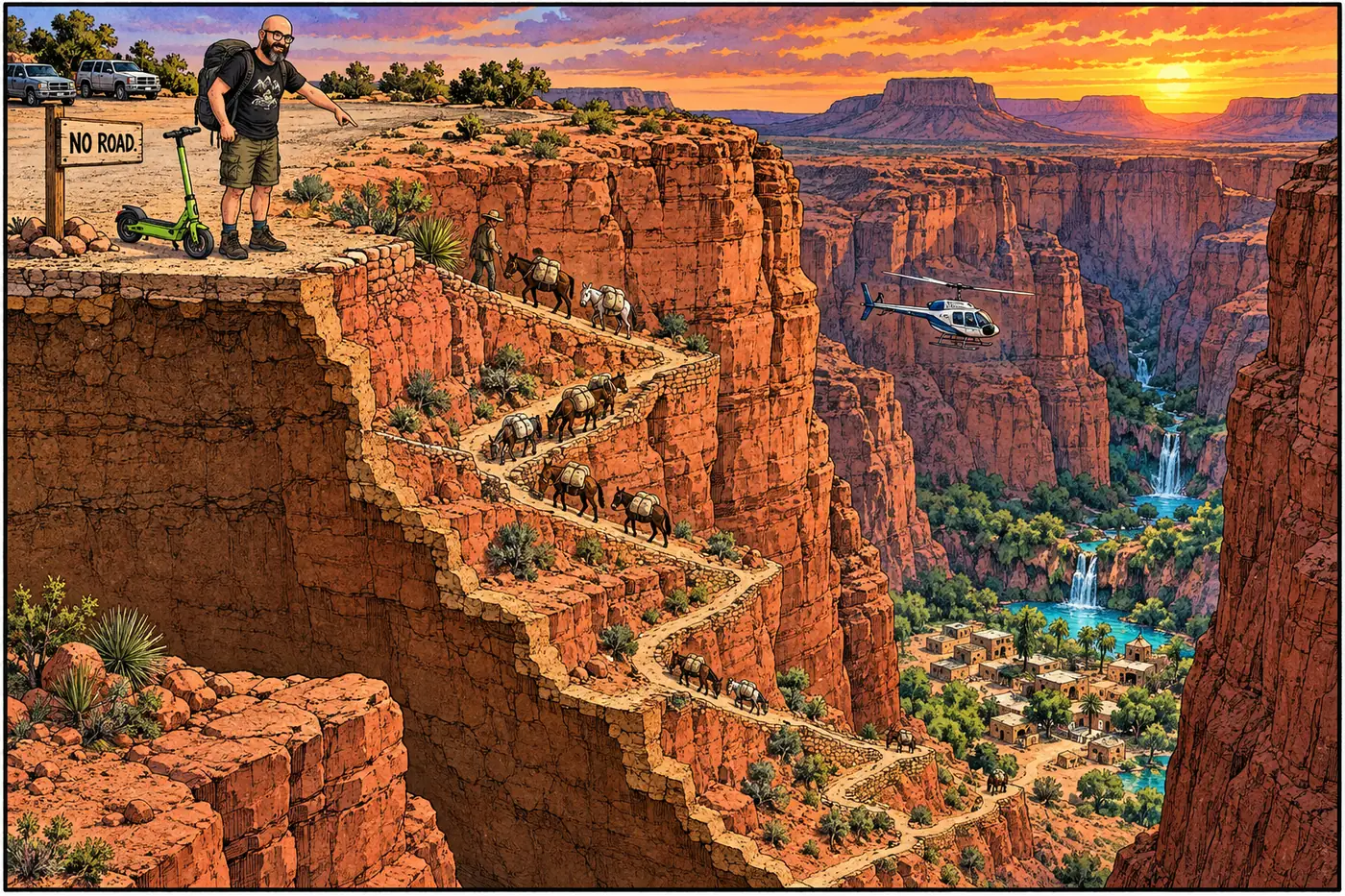
Eight miles down a trail with no road at the bottom of it sits the only place in the country where the mail still travels by mule train. Supai village isn't part of Grand Canyon National Park at all — it's the capital of the Havasupai Tribe's own sovereign nation, and everything about how you get in, what you're allowed to do, and who's in charge runs through them, not the Park Service.
The short version
- Supai village and the blue-green waterfalls around it (Havasu, Mooney, Beaver Falls) sit on the Havasupai Indian Reservation — tribal land, governed by the Havasupai Tribe, not Grand Canyon National Park.
- The reservation was reduced to about 519 acres on the canyon floor in 1882; the Grand Canyon National Park Enlargement Act of 1975 returned 185,000 acres of plateau land outright and granted the tribe exclusive traditional use of another 95,000 acres down to the river.
- Every visitor needs a paid reservation booked directly through the Tribe’s own booking system — there’s no walk-up access, no day hiking without a permit, and permits can’t be resold or transferred.
- There’s no road to Supai. Everything — people, food, building materials, mail — moves by an 8-mile trail, pack mule, or helicopter.
- The U.S. Postal Service still runs mule trains into Supai, the last mule-mail route left in the country.
- The Tribe closed the reservation to outside visitors for nearly three years (March 2020 to February 2023) over COVID-19 and flood damage, and can close it again “at any time for any reason.”
Whose land this actually is
Havasu Canyon has been home to the Havasupai — the Havasu ‘Baaja, “people of the blue-green waters” — for roughly 800 to 1,000 years. President Rutherford B. Hayes established a reservation here in 1880, but an 1882 executive order gutted it to about 519 acres confined to the canyon floor, cutting the tribe off from plateau lands they’d always used for grazing and farming. When Grand Canyon National Park was created in 1919, its boundary grew up around that tiny reservation without absorbing it.
That changed, partially, in 1975. The Grand Canyon National Park Enlargement Act — signed by President Ford and announced by the Bureau of Indian Affairs on January 17, 1975 — returned 185,000 acres of the plateau above the canyon to the tribe outright, and separately granted the Havasupai exclusive traditional use of another 95,000 acres running from near the rim down to the Colorado River. The BIA’s own language at the time called it land “the Havasupais had occupied for about 1,000 years, until it was taken away from them about a century ago.” Commercial logging and mining were written out of the new grant, to keep it compatible with the park next door.
Today the Tribe’s own site puts the total reservation at 188,077 acres of canyon and plateau — its own nation, with its own council and its own rules, not a unit of the National Park System.
No road in
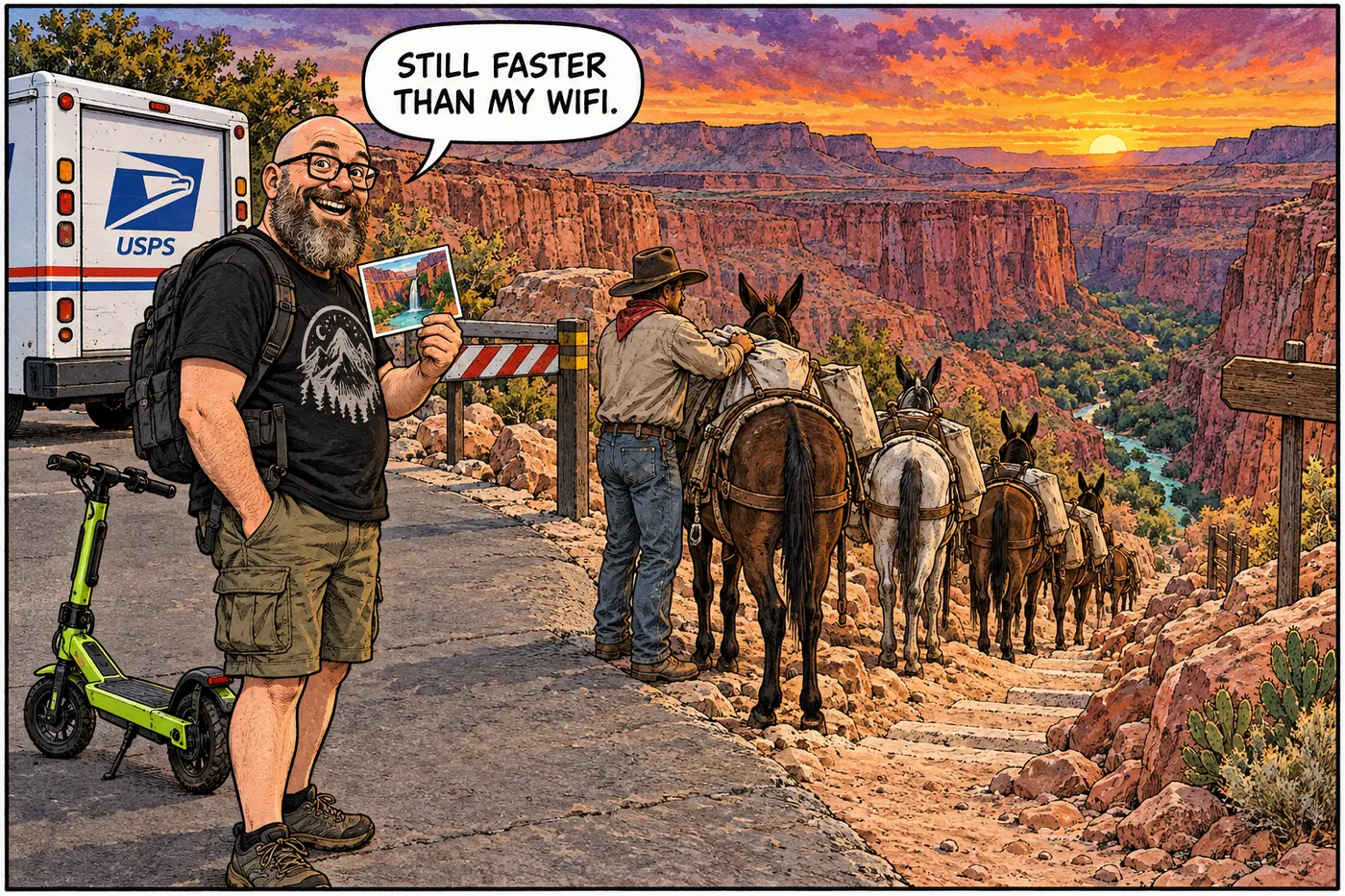
There has never been a road into Supai, and there almost certainly never will be one. The only ways in are an 8-mile trail down from Hualapai Hilltop — foot, horseback, or chartered helicopter — or a helicopter flight direct from the rim. Before 1975, even reaching the trailhead meant driving 63 miles of graveled road to Hualapai Hilltop first.
That roadlessness shapes everything else. The Postal Service has delivered mail, food, and freight to Supai by mule train since the 1930s — the last mule-train mail route left in the country. A wrangler and a string of 10 to 22 mules make the run five days a week, each animal carrying up to 200 pounds. Mail from Supai carries a distinctive “Mule Train” postmark that collectors specifically request.
Electric power tells a similar story. For decades, Supai’s only power came from a single Mohave Electric Cooperative line running more than 80 miles overhead, with extended outages that were brutal to fix in a roadless canyon. Mohave Electric and G&W Electric addressed that with a smart microgrid — new switchgear with automated fault detection, a solar array, a backup diesel generator, and a microwave data link tying a rim control building to the distribution system below. Documented in trade press in March 2019, it now backs power for roughly 40 households plus the café, store, lodge, post office, and school serving about 200 residents and some 20,000 annual visitors.
Internet followed a similar do-it-yourself path: the Tribe partnered with the nonprofit MuralNet and Niles Radio Communications to build a fixed-wireless LTE network using Educational Broadband Service spectrum, after pushing for access to that spectrum to close the homework gap for Supai’s students. It now reaches around 40 homes with broadband that, for years, wasn’t available at any price.
Getting in, on the Tribe’s terms
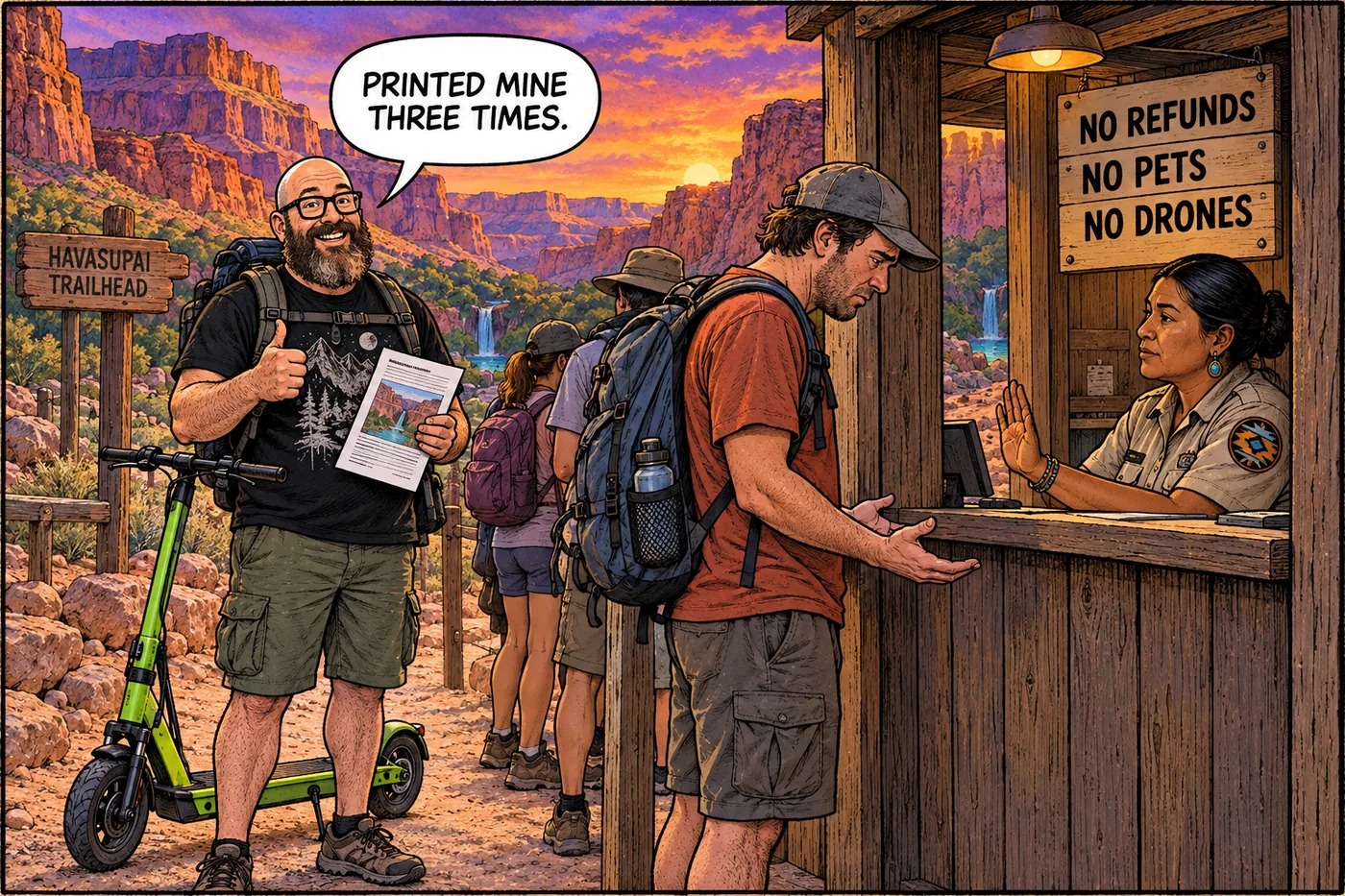
Everyone entering Supai needs a paid reservation, booked through the Tribe’s own system at HavasupaiReservations.com — no walk-up access, no exceptions. Bookings run a fixed 4 days/3 nights. Per the Tribe’s 2026 fee schedule: a campground permit runs $455/person for three nights (groups up to 12), a lodge room runs $2,277 for up to four people, a round-trip pack mule costs $400, and a one-way helicopter seat costs $300 — when one’s available, since the flights run a limited schedule, first-come first-served, locals and cargo ahead of tourists.
The rules are non-negotiable. Cancel 90+ days out and get half your money back; cancel inside 90 days and it’s gone, “NO EXCEPTIONS WILL BE MADE OR ALLOWED” — even for weather or illness. Permits can’t be resold except to two pre-named alternates, checked by photo ID. The reservation is alcohol- and drug-free. Pets, horses, and drones are prohibited, along with unpermitted commercial photography. There’s no hospital or ambulance service in the canyon — evacuation is costly and the visitor’s responsibility.
None of this is Grand Canyon National Park policy. It’s the Havasupai Tribe managing its own land the way any government manages a place with 20,000 visitors a year and no road to handle them.
Closures aren’t rare
The Tribe closed the entire reservation to outside visitors in March 2020, citing limited access to health care during COVID-19. The closure ran almost three years. Flooding in 2022 tore out bridges and trail sections on top of the pandemic closure — bad enough that it was declared a federal disaster — and a separate dispute with the tribe’s former tourism contractor added more delay. The reservation reopened to the public on February 1, 2023, prioritizing visitors whose 2020-2022 bookings had been cancelled.
As of late August 2026, Havasupai was open and operating, trails passable, no closure reported at the falls (distinct from unrelated flood damage elsewhere in the park that August — see the Bright Angel Canyon note below). But the Tribe’s own FAQ page is blunt about how conditional that access is: “The Tribe may close all or part of its Reservation… at any time for any reason.”
President Rutherford B. Hayes sets aside land for the Havasupai along Havasu Creek.
An executive order shrinks the reservation to a small tract confined to the canyon floor, cutting the tribe off from plateau lands used for centuries.
The new park's boundary encircles the tiny Havasupai reservation without absorbing it.
Congress returns 185,000 acres of plateau land outright and grants exclusive traditional use of 95,000 more acres down to the river.
Heavy rain breaches an upstream dam, flooding Supai Village; outside tribal grants help fund recovery.
Mohave Electric and G&W Electric finish a solar-backed smart microgrid, cutting reliance on a single 80-mile overhead line.
COVID-19 and 2022 flood damage keep the reservation closed to outside visitors until it reopens February 1, 2023.
What’s actually off-limits (and why)
There’s no “closure” here in the National Park Service sense — there’s a sovereign tribal government deciding who enters its own land and under what conditions, the same as any nation controls its borders. The Havasupai Tribe requires every visitor to hold a paid, non-transferable reservation; bans alcohol, drones, and unpermitted commercial photography; and can suspend access without notice. None of that is a restriction imposed on the tribe by outside authority — the tribe is the authority. On the NPS side, the current Superintendent’s Compendium simply marks the boundary: the park line with Havasupai land sits at the Havasu Creek/Beaver Creek confluence, and hikers heading upstream past that point are expected to pay the Havasupai Tribe’s own access fee, on the Tribe’s own terms.
Grand Canyon National Park’s inner-canyon corridor took a serious flash flood hit at Bright Angel Canyon and Phantom Ranch on August 29, 2026 — a separate NPS-managed area many miles away, covered elsewhere in this project (see Transcanyon Waterline). Tribal and federal systems here are managed independently; trouble on one side of a jurisdictional line doesn’t automatically mean trouble on the other.
Sources
- Land Near Grand Canyon Restored to Havasupai Indians (Jan. 17, 1975) — Bureau of Indian Affairs
- Havasupai Reservation — Nature, Culture and History at the Grand Canyon (Grand Canyon Historical Society)
- About Supai — Official Havasupai Tribe Website
- FAQs — Havasupai Reservations (official Tribe booking system)
- Mule Train Delivery — U.S. Postal Service Facts
- Havasupai Tribe Will Reopen to Tourism in 2023 After Nearly 3-Year COVID-19 Closure — KNAU Arizona Public Radio
- Bringing Reliable Power to the People of Supai Through Solar PV and a Microgrid — Renewable Energy World
- Grand Canyon National Park Superintendent's Compendium, effective June 16, 2026 — National Park Service