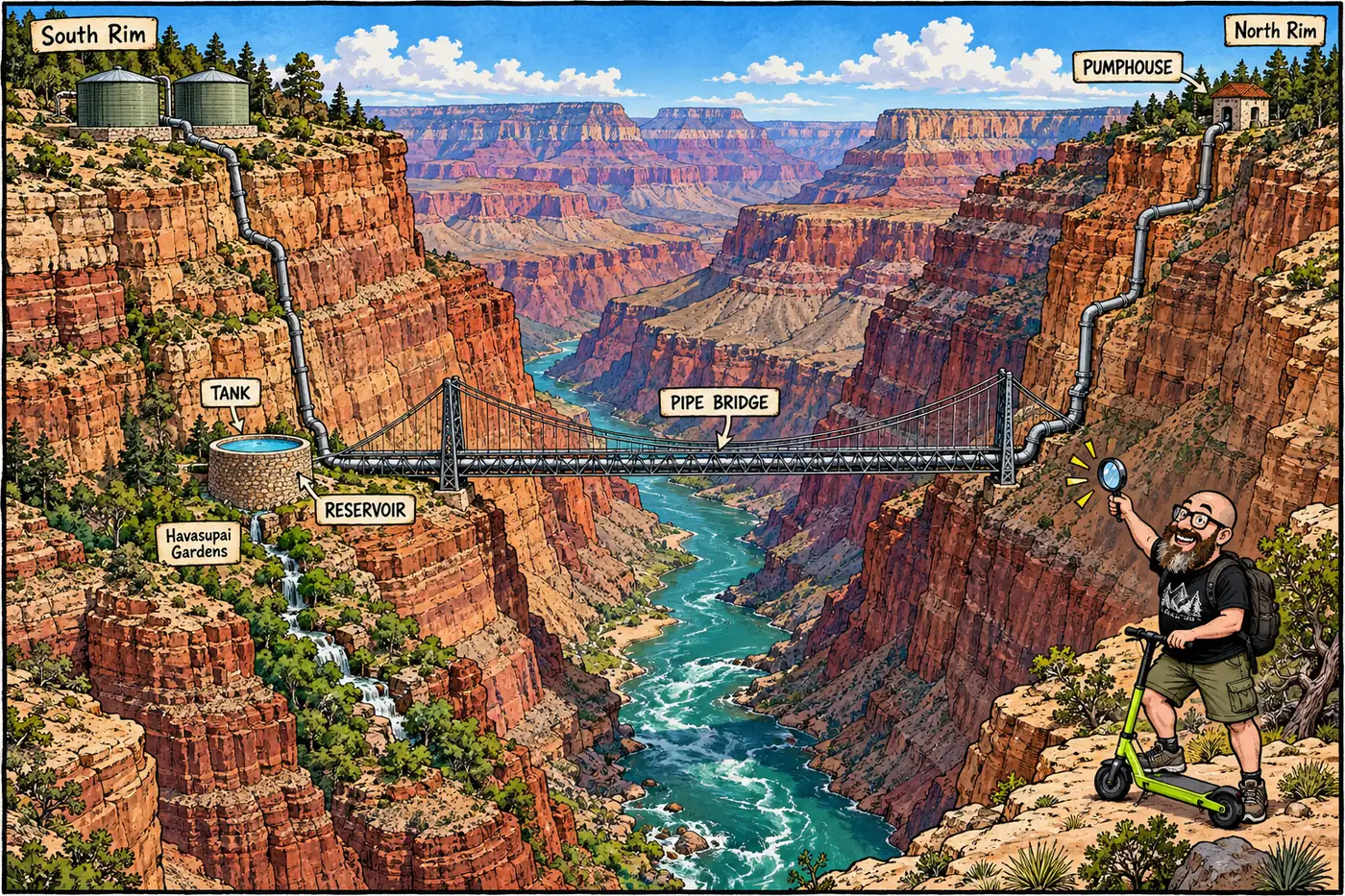
Between the North Rim and the South Rim sits a mile of vertical relief, a river, and — bolted, buried, and slung under bridges the whole way down — a water system built in pieces across nine decades. Pumphouses, a 70,000-gallon tank shaped like a bunker, a bridge that secretly doubles as a pipe rack: this is the hardware, not the headline project.
The short version
- Water doesn’t just flow downhill through the canyon corridor — it’s pumped, stored, and re-pumped at a chain of specific structures: reservoirs and pumphouses at Havasupai Gardens (formerly Indian Garden), a cross-river pipe bridge, and distribution lines feeding Phantom Ranch and the campgrounds.
- The oldest surviving piece, the Havasupai Gardens system, dates to 1931-1932, built by the Santa Fe Railway before the National Park Service even owned the water infrastructure.
- The Silver Bridge over the Colorado River was built specifically to carry the pipeline — the water line runs through its substructure, not just alongside the historic suspension bridge people actually walk across.
- A 1936 CCC-built bridge, destroyed by a 1957 flood, had its surviving stone abutments reused in 1965 for a water-system crossing — flood damage to this network isn’t new in 2026, it has a precedent nearly 70 years old.
- The 2023-2027 Transcanyon Waterline (TCWL) rebuild is replacing much of this network’s aging pipe and pump stations; see the Transcanyon Waterline dossier for that project’s full history and engineering story.
- The August 29, 2026 flash flood tore through part of this exact corridor, destroying a footbridge and about 40% of the old pipeline north of Phantom Ranch — as of September 21, 2026, NPS was targeting mid-to-late November for restoring South Rim water service.
The nodes: what’s actually down there
Havasupai Gardens (called Indian Garden until 2022) is the hub. The Santa Fe Railway built the first real water infrastructure here in 1931-1932, years before the site’s current name or the park’s modern ownership of the system. To get materials into the canyon, the railroad strung a cable tramway from the South Rim down to the Garden, then buried about 2.5 miles of 6-inch pipe. Three structures from that era survive: the Indian Garden Water Reservoir, a round, partly-buried concrete tank 40 feet across holding 70,000 gallons, finished with a stone veneer that makes it look more like a bunker than a tank; the South Pumphouse, a squat 31-by-24-foot concrete-and-stone building that pumped water up to the South Rim starting in 1932; and the Rock Residence — the live-in caretaker’s house, rebuilt in stone in 1942 after the original 1932 frame version burned down, donated to the Park Service by the railroad in 1953, and now used as a meeting space rather than a home.
A second pump building, the North Pumphouse, was added later as part of the Trans-canyon Water System (the historic-district survey that documents this gives two different construction dates in two different places — 1962 in one passage, 1967 in another — a discrepancy nobody seems to have caught). Whichever year it went up, the North Pumphouse eventually took over the job entirely: once it was modified in the mid-1980s, the original South Pumphouse was retired and hasn’t operated since.
The bridge that’s secretly a pipe rack
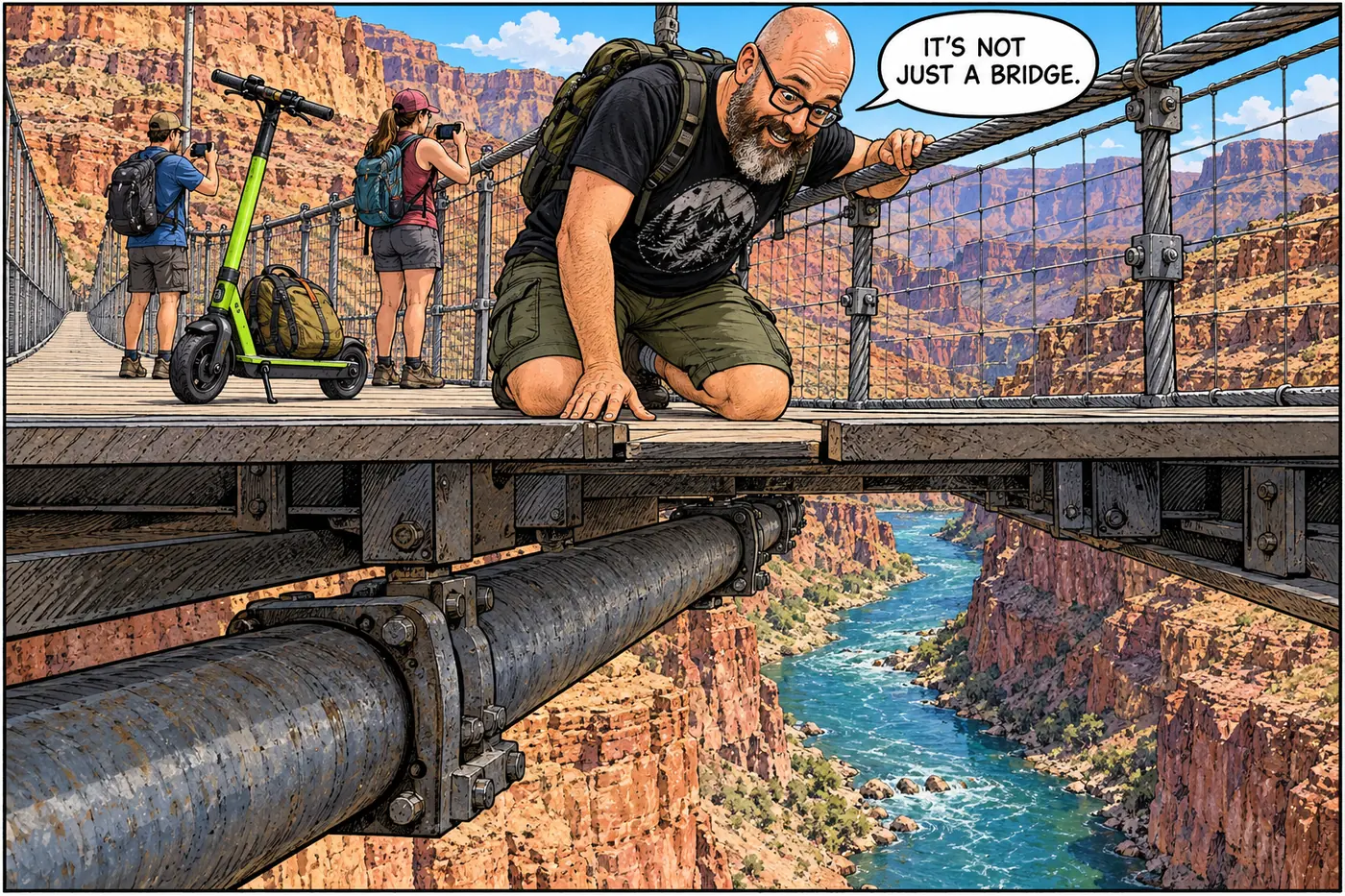
Hikers crossing the Colorado River on the Silver Bridge are usually looking at the water, the exposure, or the swaying cable deck — not at what the bridge is actually built to carry. Built between 1965 and 1970 specifically for the Trans-canyon Water System, the Silver Bridge’s substructure carries the 12.5-mile gravity pipeline itself, running the water line from the Roaring Springs pumphouse across the river toward Havasupai Gardens. It’s a separate structure from the older, more famous 1928 Kaibab Suspension Bridge (“Black Bridge”) nearby, which was built for foot and mule traffic and carries no pipe.
Not every water-system crossing has fared as well as the Silver Bridge. In 1936, the CCC built the Rock House Bridge near a USGS facility at the Bright Angel Creek delta. A flood destroyed it in 1957. Rather than starting from scratch, crews reused the surviving stone-and-masonry abutments in 1965 to support a new aluminum-and-wood-plank bridge as part of the same Trans-canyon Water System construction push that produced the Silver Bridge. It’s a small case study in a pattern that repeats through this system’s history: flood destroys crossing, crews rebuild on what’s left, water system keeps moving. The August 2026 flood, which destroyed a footbridge downstream of Phantom Ranch, is the most recent entry in that same pattern.
Distribution beyond the hub
The campgrounds and rest stops along the corridor were plumbed early and kept simple. Cottonwood Campground, established in 1927 as a mule-party layover along Bright Angel Creek, had piped water from the start, alongside picnic tables and a telephone — modest infrastructure, but infrastructure nonetheless, for a site that’s still an active campground today. By 1934, reporting from the period says the Havasupai Gardens pump was moving roughly 150,000 gallons a day, 3,200 feet up a 6-inch pipe to the South Rim, drawing from Garden Creek — a fraction of what the system handles now, but the same basic engineering problem the current $208 million rebuild is still solving.
That rebuild (contractor: Stronghold Engineering Inc.; design: HDR Inc.) is replacing roughly 3 miles of pipe between Phantom Ranch and Havasupai Gardens with 8-inch flex-steel and steel pipe, building a new intake and pump station on Bright Angel Creek near Phantom Ranch, and adding two new 1-million-gallon raw-water tanks at the South Rim alongside the existing ones. Where the old distribution lines to Havasupai Gardens, Cottonwood Campground, and the Manzanita rest area are still usable, crews are sliplining — threading new pipe inside the old pipe — rather than digging a whole new trench. Below Plateau Point, where sliplining isn’t an option, crews are hand-cutting a 5-foot-wide trench on steep grades, then coming back to dig a second trench for power and communications lines, because the terrain won’t allow utilities to share a trench the way a typical construction project would. Materials and equipment for all of this move by daily helicopter sling-load flights. As of February 2026, the project was reported roughly 70% complete, with about 160 workers on site at a time and final testing targeted for 2027. Full pipeline and pump-station engineering history lives in the Transcanyon Waterline dossier; this page covers the physical network the pipeline runs through.
The 2026 flood, and what it broke here specifically
On June 4-11, 2026, before the flood, NPS had already scheduled a maintenance shutoff — cutting water to Phantom Ranch, Bright Angel Campground, Cottonwood Campground, Boat Beach, and the Manzanita areas so crews could install new piping along the River Trail and upgrade the Havasupai Gardens pumphouse, while Havasupai Gardens itself and the Mile-and-a-Half and Three-Mile resthouses kept service. That was routine construction disruption.
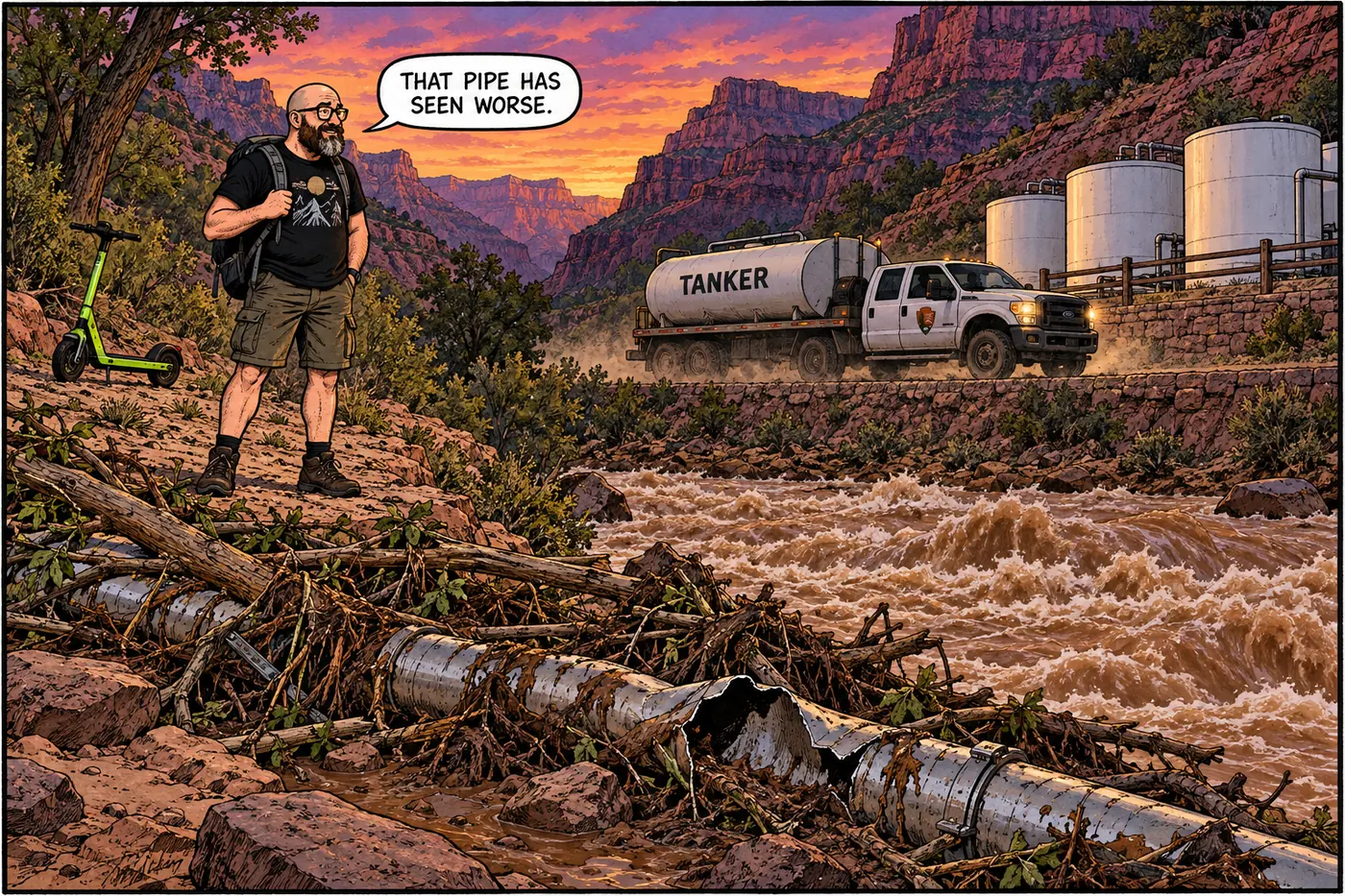
The August 29, 2026 flash flood was not routine. It hit Bright Angel Canyon and the Phantom Ranch area, destroyed roughly 40% of the legacy pipeline between Phantom Ranch and the North Rim, and heavily damaged both the Bright Angel Creek crossing infrastructure and the Roaring Springs intake area (see the Roaring Springs dossier for what happened at the source end). A footbridge downstream of Phantom Ranch was destroyed. The newer South Rim pipeline segments, not yet in service, came through undamaged. Three deaths were confirmed in the flood, and more than 80 people were rescued, some by helicopter, from the Bright Angel Creek corridor, Phantom Ranch, and Cottonwood Campground.
The response ran on two tracks at once: an emergency temporary intake at Bright Angel Creek, engineered to match the pre-flood capacity of 500 gallons per minute, and an accelerated push to bring the nearly-finished new South Rim treatment plant online early. Park-wide Stage 4 water restrictions — the most severe tier — cut daily use by roughly 137,000 gallons. As of the most recent public update located for this page (September 21, 2026), NPS was targeting mid-November 2026 to start pumping from the new Bright Angel Creek intake to the new treatment plant, November 16 for restoring South Rim service, and Thanksgiving 2026 for restoring service to residents — alongside a developing plan to truck in roughly 200,000 gallons a day to refill storage tanks in the meantime. Officials were explicit that the timeline could still change.
Piped water included from the start at the new mule-party layover campground.
Santa Fe Railway builds the reservoir, South Pumphouse, and 2.5 miles of pipe to the South Rim; the Rock Residence caretaker's house follows in 1942.
A CCC-built 1936 bridge near the Bright Angel Creek delta is wiped out; its stone abutments survive.
The Silver Bridge goes up to carry the new 12.5-mile gravity pipeline across the Colorado River; the 1957 bridge abutments are reused for a new water-system crossing.
Sources disagree on the exact year; it eventually replaces the original South Pumphouse after 1980s modifications.
A $208 million project replaces pipe, adds tanks, and relocates the main intake to Bright Angel Creek near Phantom Ranch.
Roughly 40% of the legacy pipeline and a footbridge downstream of Phantom Ranch are destroyed; emergency repairs and an accelerated project timeline follow.
What’s actually off-limits (and why)
Several individual structures in this corridor are closed to public entry under the park’s Superintendent’s Compendium, each for its own reason rather than a blanket “inner canyon infrastructure” rule: the Phantom Ranch Wastewater Treatment Plant and its drying beds, located 100 yards north of the Colorado River near the Bright Angel Trail, are closed for public-safety reasons tied to wastewater handling. The Roaring Springs Pumphouse and its helistop are closed with a 100-foot public setback (covered in detail in the Roaring Springs dossier). None of the Havasupai Gardens-area pump buildings or the Silver Bridge itself currently carry a public-closure listing in the compendium — they sit in plain view along an active, heavily-hiked trail corridor — but as working utility structures, they’re not open for entry either, and 2026’s construction and flood-recovery work has added temporary access restrictions on top of the standing rules. Current, dated closures and trail-status information should always be checked against the park’s own alerts before any inner-canyon trip.
Sources
- Cross Canyon Corridor Historic District, National Register of Historic Places Nomination (2013) — National Park Service / npshistory.com
- Grand Canyon National Park Superintendent's Compendium, effective June 16, 2026 — National Park Service
- Transcanyon Waterline (TCWL) project page — National Park Service
- TCWL Design — National Park Service
- TCWL South Rim Construction — National Park Service
- Crews Battle Site, Logistics on $208M Grand Canyon Transcanyon Waterline Replacement Project — Engineering News-Record
- Grand Canyon to shut off backcountry water for pipeline work — KNAU Arizona Public Radio
- Grand Canyon National Park accelerates water restoration, search efforts continue — FOX 10 Phoenix
- Two dead, one hiker still missing after Grand Canyon flash flooding — KNAU Arizona Public Radio
- Body found in Grand Canyon was missing hiker, bringing flood death toll to 3 — KNAU Arizona Public Radio
- Grand Canyon officials set tentative timeline for restoring water service to South Rim — KNAU Arizona Public Radio