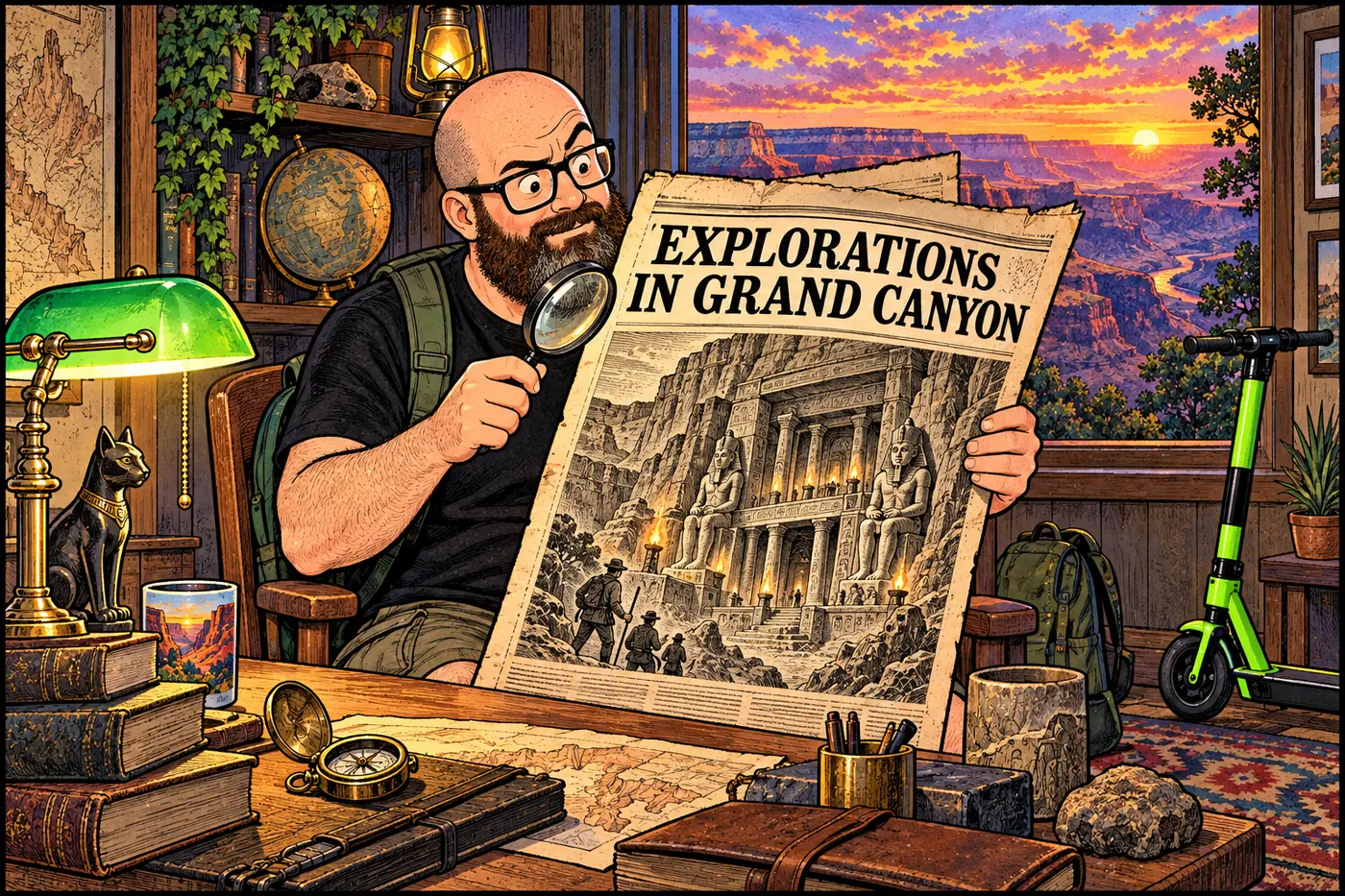
On April 5, 1909, a Phoenix newspaper announced that the Smithsonian had quietly excavated an Egyptian city carved into the Grand Canyon — mummies, hieroglyphics, and all. The Smithsonian says it never happened. The explorer named in the story can't be found in any other record from his own lifetime. And yet, a century later, park rangers still field calls about it every year. Here's what the paper trail actually shows.
The short version
- The Arizona Gazette ran a front-page story on April 5, 1909 claiming explorer G.E. Kincaid found a huge underground complex in the canyon, and that a “Prof. S.A. Jordan” was running a Smithsonian-funded dig there.
- The Smithsonian says — repeatedly, on the record — that it has no file on Jordan, no file on Kincaid, and no record of any such expedition.
- The only other newspaper of the era known to have touched the story, the Coconino Sun, dismissed it eleven days later as a “Mulhatton” — contemporary slang for a tall tale.
- The story went dormant for decades, then got a second life: reprinted in a 1962 clippings book, then picked up in 1992 by a fringe-archaeology author who reframed the Smithsonian’s denial itself as the cover-up.
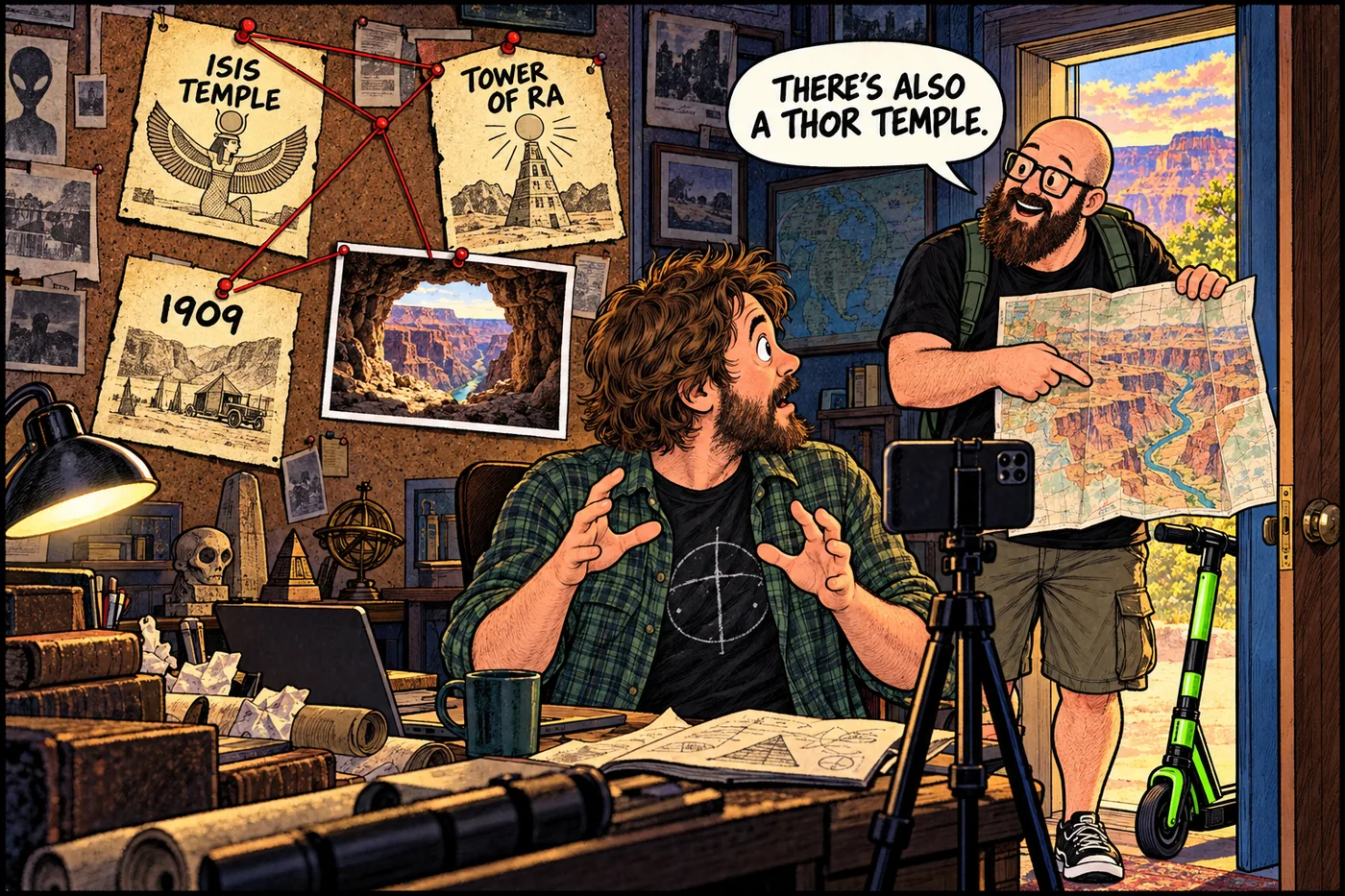
- Grand Canyon’s Egyptian-sounding place names (Isis Temple, Tower of Ra, Tower of Set) are real and official — but they were assigned by 19th-century surveyors decades before the 1909 article, as part of a naming scheme that also produced Vishnu Temple, Zoroaster Temple, and Thor Temple.
- The canyon does have real, currently-enforced restricted areas — but they’re closures for caves generally, fragile archaeology, and hazardous sites, not a sealed-off Egyptian city.
What the 1909 article actually claimed
The Arizona Gazette headline was “Explorations in Grand Canyon,” and the pitch was big even by 1909 tabloid standards. A river traveler named G.E. Kincaid, the story said, had floated the Colorado alone from Green River, Wyoming in the fall of 1908 and found a cave entrance roughly a thousand-plus feet up a canyon wall. Inside, he supposedly found passages running nearly a mile back into the rock, chambers hung with hieroglyphics, rows of mummies on stone shelves, copper tools, and a granary still holding ancient seed.
Kincaid then partnered with “Prof. S.A. Jordan of the Smithsonian,” who arrived with a crew of thirty to forty scientists to excavate. The line quoted in every retelling since credits “the archeologists of the Smithsonian Institute, which is financing the expeditions,” with concluding the cave’s occupants were “of oriental origin, possibly from Egypt, tracing back to Ramses.” Readers were told the area had been placed off-limits by the government while the dig continued.
That’s a named explorer, a named professor, an institutional sponsor, an exact-sounding depth figure, and a government closure order — wrapped around a story no other outlet, agency, or archive from 1909 corroborates.
What the record actually shows
Start with the sponsor. The Smithsonian has been asked about this story for decades and gives the same answer every time: nothing matches. In a 2000 email exchange with a researcher, the institution’s Department of Anthropology said it had “searched its files without finding any mention of a Professor Jordan, Kincaid or a lost Egyptian civilization in Arizona.” Smithsonian Magazine’s own myth-busting coverage lists this as Myth #4 among the institution’s most persistent, stating plainly: “The Smithsonian… has no record of any such expeditions, and it’s doubtful that Kinkaid existed.” The same piece cites a 2008 Arizona Republic column that reached the same conclusion: “the whole thing was a hoax.”
The named people don’t hold up either. No contemporary record of a “Prof. S.A. Jordan” doing Smithsonian-sponsored fieldwork in Arizona in 1908–09 has surfaced. “G.E. Kincaid” fares no better — no obituary, no expedition report, no photograph, nothing beyond the newspaper’s own byline. Believers have tried to match him to real figures with similar names (a real entomologist named Trevor Kincaid, a real ichthyologist named David Starr Jordan, both active in that era), but the initials, professions, and timelines don’t line up, and no direct link to the Grand Canyon claim has ever been documented.
Then there’s the coverage gap. A find billed as “not only the oldest archeological discovery in the United States, but one of the most valuable” should have gone national. It didn’t. The only other period newspaper known to have mentioned it is the Flagstaff Coconino Sun, which ran a dismissive note eleven days later, on April 16, 1909, headlined “Looks Like a Mulhatton Story.” A Mulhatton, in the slang of the day, meant a planted tall tale, named for a notorious traveling-salesman hoaxer. The Sun called the discovery “a splendid piece of imagination” and noted nobody at the canyon itself seemed to have heard of it — odd, if a Smithsonian crew of thirty-plus scientists were really working there.
The Grand Canyon Historical Society has looked into it too and treats it as a fabricated newspaper stunt rather than a suppressed discovery. The society’s president, Haley Johnson, told Discover that the images circulating with the legend are “obvious fakes” and questioned why no Indigenous oral history reflects an event of that scale — a reasonable expectation if an entire ancient civilization had really lived in the canyon.

Why the “Egyptian” angle specifically stuck
Here’s a detail that rarely makes it into the retellings: the original article’s own language leaned more toward vaguely “Oriental” and Asian imagery — a “shrine with cross-legged idol” — than specifically Egyptian. Researcher Jason Colavito, whose debunking work has since been reprinted in Kenneth Feder’s Encyclopedia of Dubious Archaeology, argues that later writers read the piece’s “Orient” framing as Egypt specifically, rather than the more Tibetan-flavored imagery the 1909 text actually uses. Once that stuck, it fused naturally with something already sitting on every USGS map of the canyon: a wall of officially registered “Egyptian” place names.
Those names are real, and that’s exactly the problem — real things get used to prop up fake ones. Starting in the 1870s, geologist Clarence Dutton began naming Grand Canyon peaks after world mythology, reasoning the canyon’s scale called for grand names. Egyptian gods went on the map — Isis Temple among them — right alongside Hindu, Norse, Greek, and Zoroastrian ones: Vishnu Temple, Brahma Temple, Shiva Temple, Thor Temple, Zoroaster Temple. Painter Thomas Moran and later surveyors including George Wharton James continued the tradition into the early 1900s; more than twenty-three peaks got “temple” designations, and the U.S. Board on Geographic Names formally adopted many, including Tower of Ra and Tower of Set, in 1906 — three years before the Gazette story ran. Egyptian names on a canyon map are a 19th-century poetic naming convention, not a 20th-century archaeological confession.
The comeback
The story didn’t stay dead. It got reprinted in 1962 in Arizona Cavalcade, a book of old Arizona newspaper clippings — likely how it survived long enough to reach a later, more receptive audience. The real turning point came in 1992, when fringe-history author David Hatcher Childress included it in Lost Cities of North & Central America and reframed the Smithsonian’s flat denial as evidence of the cover-up itself, rather than evidence the story was false. That reframing is the engine still running the legend today: any institutional “no” becomes proof of something to hide.
From there it followed the usual pipeline: cable television (History Channel’s Ancient Aliens and America Unearthed), long-form podcasts (The Joe Rogan Experience covered it in 2019), and a steady churn of YouTube and TikTok videos. Grand Canyon’s own cultural resource staff still get asked about it directly; the park’s cultural resources manager told WBUR’s Endless Thread the inquiries arrive about once or twice a year. Park archaeologists have also pointed out who gets erased by the legend: stories crediting ancient “transatlantic travelers” with sophisticated ruins tend to sideline the actual, well-documented Indigenous history of the region.
Claims vs. evidence
| Claim (1909 article and later retellings) | What the record actually shows |
|---|---|
| Smithsonian financed the dig and confirmed an “Oriental,” possibly Egyptian, origin | Smithsonian: no record of Jordan, Kincaid, or the expedition; the institution calls it a myth in its own published myth-busting piece |
| G.E. Kincaid and Prof. S.A. Jordan led the excavation | No contemporaneous record of either matching the description; no obituary, employment record, or expedition report has surfaced |
| Cave held hieroglyphics, mummies, copper tools, statues | No photographs, artifacts, or specimens have ever been produced; no other 1909 outlet corroborated the find |
| The area was sealed off by the government to protect the discovery | Grand Canyon’s cave-closure policy is a blanket, still-current rule covering all park caves, tied to fragile formations, fossils, and bat habitat — not a site-specific 1909 cover-up |
| Egyptian-named landmarks (Isis Temple, Tower of Ra, Tower of Set) prove an ancient Egyptian presence | Those names were assigned by 19th-century surveyors as part of a global-mythology naming scheme (Hindu, Norse, Greek, Egyptian alike), formally adopted in 1906 — three years before the Gazette story |
| The story was suppressed by the press | The only known contemporaneous pickup, the Coconino Sun, ran a dismissal eleven days later calling it a fabricated “Mulhatton” tale |
Clarence Dutton and later surveyors name canyon peaks after world mythology; Isis Temple, Tower of Ra, and Tower of Set are among the names formally adopted by the U.S. Board on Geographic Names in 1906.
"Explorations in Grand Canyon" credits explorer G.E. Kincaid and "Prof. S.A. Jordan" with a Smithsonian-backed find of an underground Egyptian-style complex.
The Coconino Sun dismisses the story as a "Mulhatton" — a period term for a planted tall tale — and notes nobody at the canyon itself had heard of it.
The story is reprinted in Arizona Cavalcade, a compilation of old Arizona newspaper clippings, giving it a route back into circulation decades later.
David Hatcher Childress includes the story in Lost Cities of North & Central America, recasting the Smithsonian's denial itself as evidence of suppression.
The Department of Anthropology tells a researcher by email it has searched its files and found no mention of Jordan, Kincaid, or a lost Egyptian civilization in Arizona.
Smithsonian Magazine lists the story among the institution's most persistent myths; the Grand Canyon Historical Society treats it as a fabricated newspaper stunt.
Ancient Aliens, America Unearthed, and The Joe Rogan Experience all cover the story; park staff still field public inquiries about it once or twice a year.
Why the framing persists
Part of why this story never fully dies is that the surrounding facts are, individually, all true. The Grand Canyon really does have officially registered Egyptian place names. The park really does keep all of its caves closed to visitors, with entry allowed only for approved research. Grand Canyon really does contain genuinely restricted zones — hazardous old mine workings like the Orphan Mine, fragile archaeological sites, sensitive bat habitat — that the public can’t just walk into. None of that is secret; NPS publishes the closures. But strung together by someone already primed to believe an institution is hiding something, ordinary land-management policy reads like confirmation. A cave you can’t walk into is not evidence of a cover-up. It’s a cave.
Sources
- Busting 13 of the Smithsonian's Most Persistent Myths — Smithsonian Magazine
- No, Egyptian Artifacts Were Never Found in the Grand Canyon — Discover Magazine
- The 1909 Grand Canyon Hoax — Jason Colavito
- The Grand Can-Spiracy — Endless Thread, WBUR
- Cave / Karst Systems — Grand Canyon National Park, National Park Service
- Sacred Temples in a Sacred Place — Arizona Highways
- Tower of Ra — Wikipedia
- Tower of Set — Wikipedia
- The Arizona Gazette (Phoenix, Ariz.) 1895-1928 — Library of Congress, Chronicling America