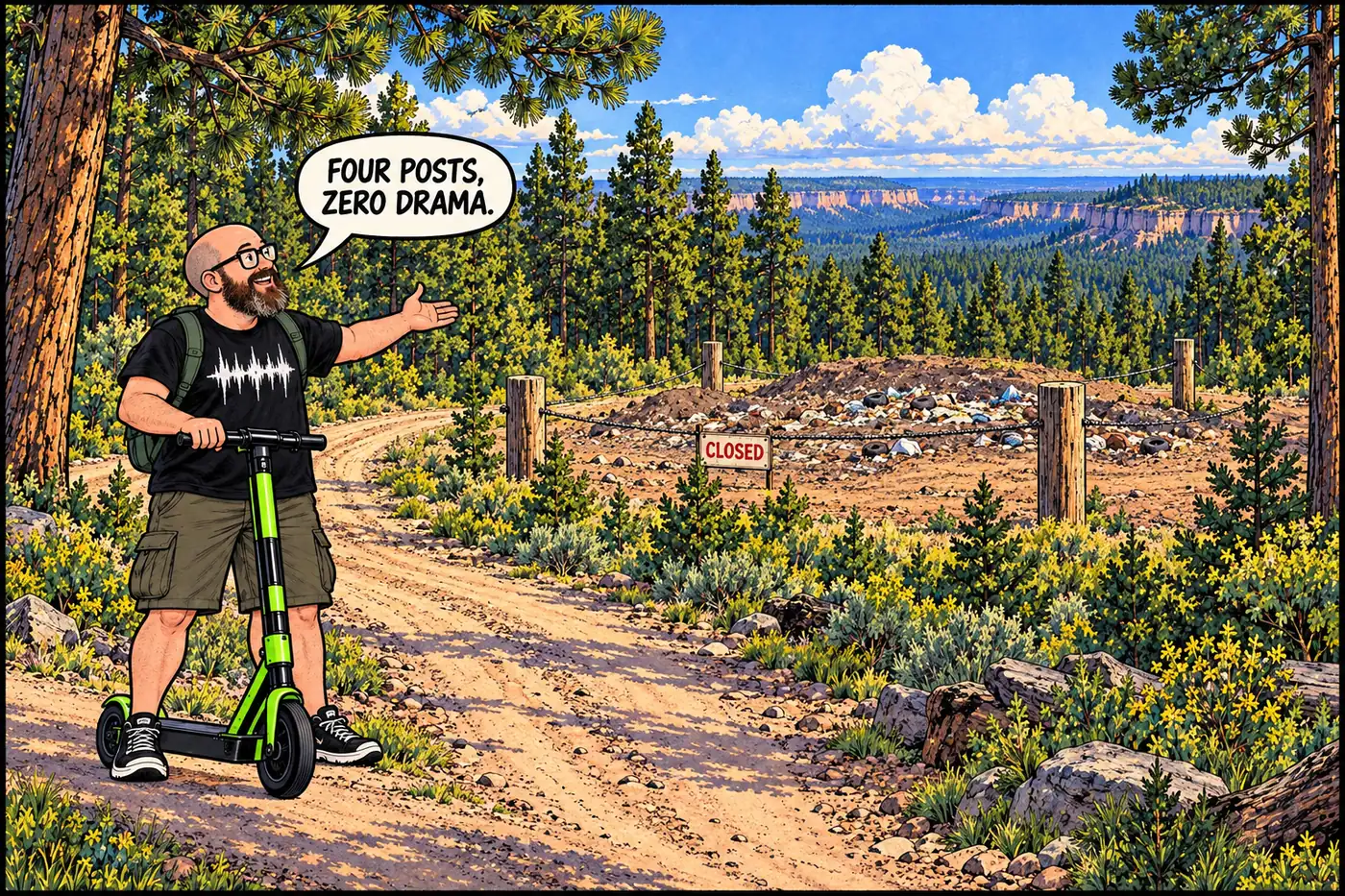
A mile and a quarter northeast of the Widforss trailhead, off a forest fire road most visitors never see, four corner posts mark the edge of the Marble Flats Landfill. It's the North Rim's answer to the Former South Rim Landfill — quieter, less documented, and closed for the same plain reason: it's an old dump, not a scenic overlook.
The short version
- The Marble Flats Landfill sits 1.25 miles northeast of the Widforss trailhead on fire road NW-1, marked by four corner posts, and is closed to public entry under the current Superintendent’s Compendium.
- A 2002 regional planning document says Grand Canyon National Park had two landfills on the North Rim — this one and the nearby Lindbergh Hill Landfill — both inactive since 1991.
- The North Rim didn’t get its own NPS-run utilities until relatively late: the concessioner-built sewage system wasn’t rebuilt and run by the Park Service until the early 1940s, and NPS didn’t take over North Rim utilities entirely until 1972.
- There’s no evidence this was ever a federal Superfund or state WQARF site; it’s managed as a public-safety closure, not a contamination emergency.
- The Widforss Trail near the site is currently closed (as of the park’s September 21, 2026 status update) — a reminder that the 2025 Dragon Bravo Fire and 2026 flash flooding have reshaped what’s accessible on the North Rim generally, though no source ties either event to the landfill itself.
A North Rim landfill, on North Rim time
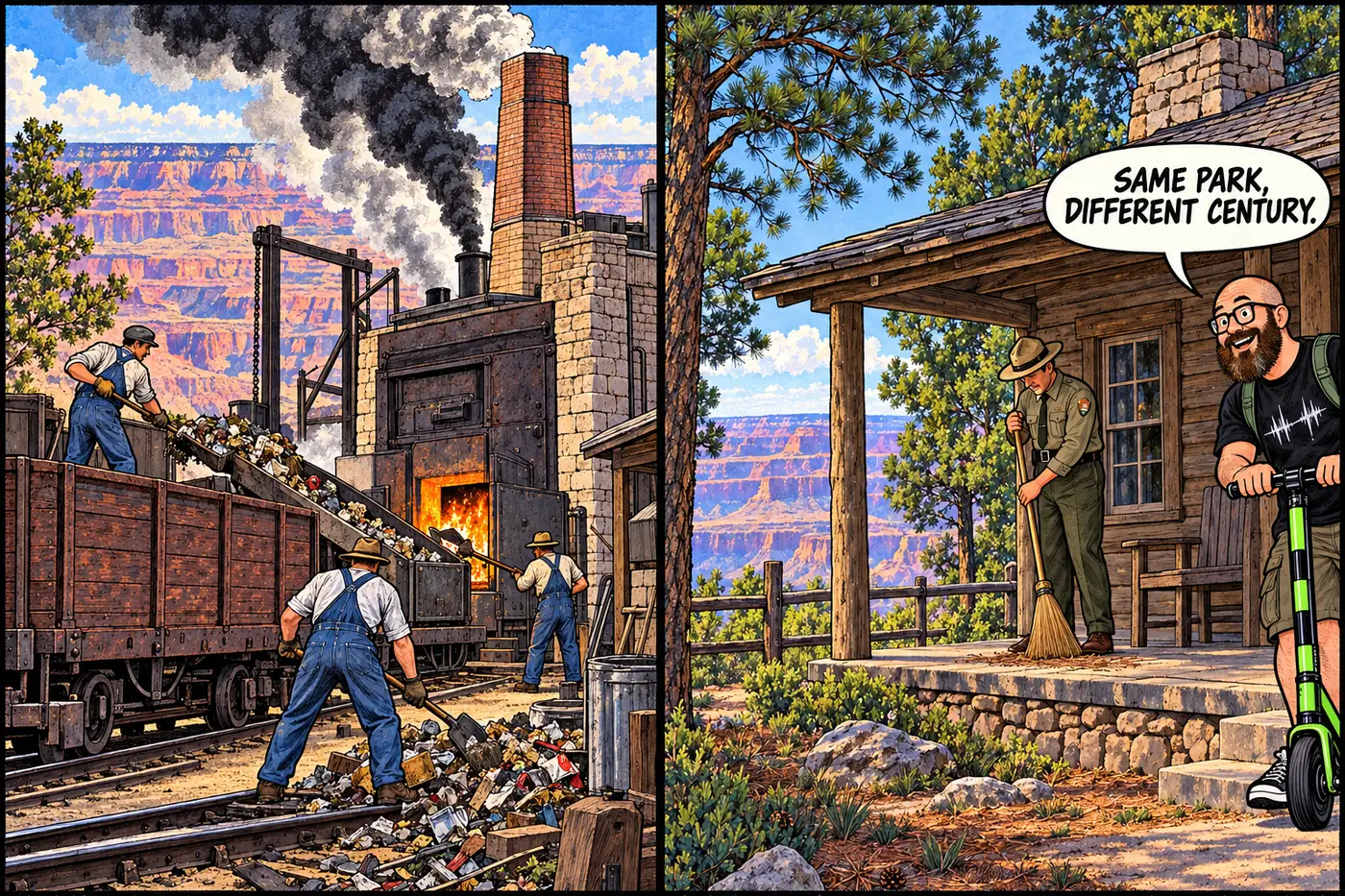
Grand Canyon’s two rims developed on very different schedules, and that shows up in how each one handled its trash. The South Rim had a railroad-funded incinerator by 1926. The North Rim, by contrast, was for years little more than a seasonal outpost — Congress didn’t even fund North Rim management through fiscal year 1924, and the handful of rangers sent over each summer slept wherever a pioneer or Forest Service cabin happened to be empty. Basic utilities followed the same slow curve. The North Rim’s sewage-disposal system was originally built and owned by the Union Pacific Railroad’s concession, the Utah Parks Company, and it wasn’t until the early 1940s that the National Park Service rebuilt and took over running it. By the mid-1950s, under the Mission 66 building program, NPS was also operating the North Rim’s incinerator directly — but the Park Service didn’t formally take over the rest of North Rim utilities (water, power infrastructure, the works) until 1972, when Union Pacific finally donated the remaining Utah Parks Company facilities to the federal government. That’s eighteen years after the South Rim’s equivalent handoff in 1954.
A landfill, somewhere on the plateau, was the natural next step once burning garbage in an incinerator stopped being the only option. Exactly when Marble Flats itself opened isn’t documented in any source found this session — no NPS history, planning document, or news article checked here gives a founding date for the site specifically.
Two landfills, both quiet since 1991
What is documented is the closure. A June 2002 regional water-quality planning report from the Northern Arizona Council of Governments (NACOG), assembled for the Arizona Department of Environmental Quality, states plainly that Grand Canyon National Park had two landfills on the North Rim that had already been inactive for over a decade by the time the report was written — since 1991 — while the South Rim’s landfill was still operating at the time and only slated to close by the end of September 2001. The report doesn’t name Marble Flats and Lindbergh Hill individually in that sentence, but they’re the only two North Rim landfill sites that turn up anywhere in the sources checked for this project, so by elimination, this is their shared closure story.
A separate, OCR-damaged passage in the same document appears to describe some continued, limited use of the North Rim site(s) for construction debris only, with a plan to inspect the closed landfill every two years to check for leaks. The scan quality makes it impossible to say with confidence which site did what, or for how long — it’s included here as evidence that “inactive since 1991” didn’t necessarily mean sealed and forgotten overnight, not as a precise operational record.

What’s actually off-limits (and why)
The current Superintendent’s Compendium closes the Marble Flats Landfill site to public entry under 36 CFR § 1.5(a)(2), citing the same standard language NPS uses for its other old dump sites: access has to be denied “to protect the public from a potentially hazardous site and materials,” per the Arizona Department of Environmental Quality. The closure area is narrow — the landfill footprint itself, marked by four corner posts off fire road NW-1, not the Widforss Trail or the surrounding forest. No source found this session indicates the site was ever placed on the EPA’s National Priorities List or Arizona’s WQARF registry (the state-level Superfund-equivalent); like the Former South Rim Landfill, it’s being managed as an old, unremediated dump that isn’t safe to walk on, not as an active contamination emergency.
Arizona’s current statewide directory of waste transfer stations lists exactly one Grand Canyon National Park facility — the transfer station on Shuttle Bus Road, which serves the South Rim. No separate North Rim transfer station appears anywhere in that directory; the nearest listed facility is the Town of Fredonia’s, well outside the park. Where North Rim solid waste actually goes today isn’t documented in any source checked this session — a genuine gap, not filled in here with a guess.
Congress declines to fund North Rim management through fiscal 1924; there are no NPS facilities and only a couple of summer rangers.
The Park Service rebuilds and begins operating the sewage-disposal system originally built by the Utah Parks Company concession.
Mission 66-era records show NPS operating the North Rim incinerator alongside the concessioner-owned water and power systems.
The remaining Utah Parks Company facilities at the North Rim are donated to the federal government; NPS assumes full utility responsibility.
A 2002 regional planning report describes both North Rim landfills as already inactive since 1991, years ahead of the South Rim's 2001 closure plan.
The Superintendent's Compendium still lists Marble Flats as closed to public entry; the adjacent Widforss Trail is separately closed as of the park's September 21, 2026 status update, amid ongoing recovery from the 2025 Dragon Bravo Fire and 2026 flash flooding.
Sources
- Grand Canyon National Park Superintendent's Compendium, effective June 16, 2026 — National Park Service
- Section 208 Water Quality Management Plan — Northern Arizona Council of Governments, June 2002
- Polishing the Jewel: An Administrative History of Grand Canyon National Park — Michael F. Anderson / National Park Service (npshistory.com)
- Waste Transfer Stations List — Arizona Department of Environmental Quality
- Status of the North Rim — National Park Service
- Dragon Bravo Fire — Wikipedia (last resort, flagged; used only for acreage/structure-count corroboration)