The North Rim gets its drinking water the same way the South Rim does — gravity and a very long uphill fight from one spring at the bottom of the canyon. In July 2025 a wildfire burned that system's North Rim end to the ground, and as of this month the rim still doesn't have running water for visitors.
The short version
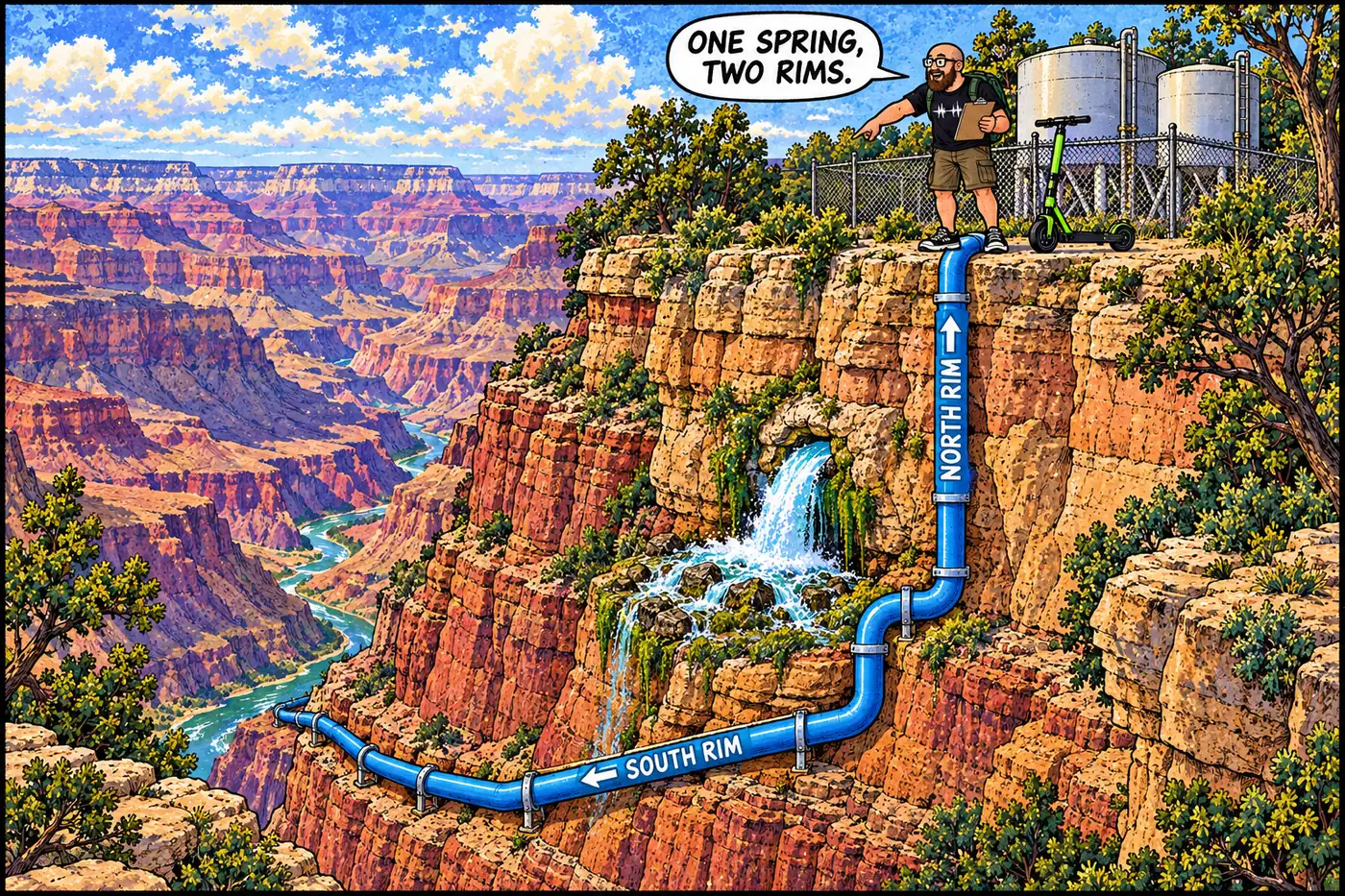
- Roaring Springs, on the canyon wall below the North Rim, supplies both rims: it gravity-feeds south toward Indian Garden and the South Rim, and a separate seven-mile pipeline pumps water directly up to the North Rim’s own tanks.
- The North Rim system dates to the mid-1960s, the same era as the Transcanyon Waterline it runs alongside.
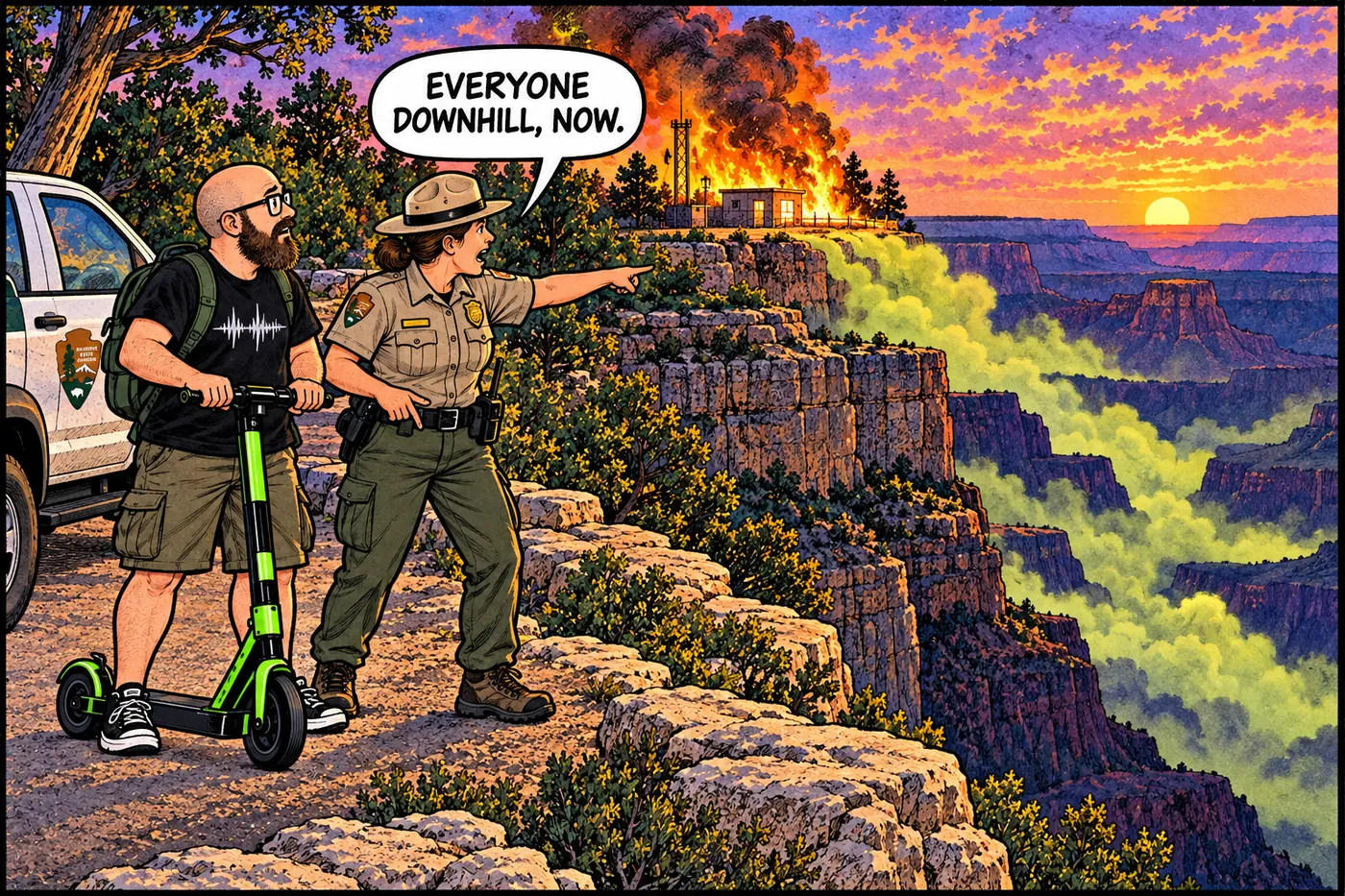
- The 2025 Dragon Bravo Fire destroyed the North Rim’s water treatment facility and damaged pipes and equipment on July 12, 2025, releasing a chlorine gas cloud that forced evacuations, including at Phantom Ranch.
- The North Rim reopened for day use and camping in 2026, but NPS provides no potable water there — campers have to haul their own or buy it.
- A federal rehabilitation project — new boreholes, a new treatment plant, more storage — went to public comment in spring 2026 but hadn’t been funded or started construction as of this writing.
- The North Rim Water Tanks and the North Rim Wastewater Treatment Plant are both separately fenced and closed to the public under the park’s Superintendent’s Compendium.
One spring, two rims, opposite directions
Almost all of Grand Canyon National Park’s developed water — north and south — comes from a single source: Roaring Springs, which emerges from the canyon wall roughly 3,500 feet below the North Rim. From there the system splits. Water gravity-feeds down to Indian Garden/Havasupai Gardens, where it’s pumped roughly 7,000 feet up the Transcanyon Waterline to the South Rim. A separate line runs the other way: a seven-mile pipeline pumps water straight up from the spring to North Rim storage tanks, a shorter but still serious lift of around 3,500 feet. Both pipelines share an origin point and an era — the North Rim line was established in the mid-1960s, alongside the original Transcanyon system.
That means the North Rim’s water security depends on the same fragile piece of infrastructure the South Rim’s does: the Roaring Springs Pumphouse, deep in the inner canyon, is the shared choke point for both. See the Grand Canyon water system overview for how all the rim-level pieces connect.
What’s normally fenced off, fire or no fire
Even before 2025, the North Rim’s water infrastructure was closed ground under the park’s rules. The current Superintendent’s Compendium — the same rulebook that governs the Orphan Mine closure — lists the North Rim Water Tanks as a chain-link-fenced restricted area, closed to public entry “for public safety and the safety of a public water supply.” A separate closure covers the North Rim Wastewater Treatment Plant and its lagoons, located about half a mile northwest of the North Rim’s administration building, also fenced and off-limits, citing hazards flagged by the Arizona Department of Environmental Quality. And down at the source, the Roaring Springs Pumphouse and its helistop are closed with a 100-foot public buffer around all water infrastructure there — a closure fully documented on the Transcanyon Waterline page, since it protects the same pumphouse both rim systems rely on.
None of that is new or fire-related. It’s the standard posture for any water-treatment or storage site in the park: fence it, restrict it, cite public-safety hazards. What changed in 2025 is that a large piece of what was inside those fences stopped existing.
The Dragon Bravo Fire
The Dragon Bravo Fire started from a lightning strike on July 4, 2025, on the North Rim. It stayed manageable for about a week, then blew up on the night of July 11-12 after unusual northwest wind gusts pushed it past containment lines. On the afternoon of July 12 — NPS puts it at around 3:30 p.m. — the North Rim’s water treatment facility caught fire. The building chlorinates drinking water drawn from Roaring Springs, and the fire released a chlorine gas cloud. Because chlorine gas settles into low ground, NPS evacuated firefighters and precautionarily evacuated inner-canyon hikers, including at Phantom Ranch, well downhill and downwind of the fire itself. NOAA atmospheric modeling found no critical threat to nearby communities like Marble Canyon or Lees Ferry, though the smell might have reached that far.
Somewhere between 50 and 80 structures were lost in the broader fire, including the historic Grand Canyon Lodge. NPS’s own releases describe the burned building specifically as the “water treatment facility,” tied directly to Roaring Springs chlorination — but some other reporting describes a “wastewater treatment plant” being lost in the same event, and it’s not fully clear from the public record whether that’s the same building described differently, or whether both the water and wastewater facilities were damaged. What is clear: the fire also damaged pipes and equipment beyond the treatment building itself, forcing crews onto water trucks and raising contamination concerns, and NPS has said rebuilding the water and wastewater lines will take longer than most of the rest of the recovery.

Where things stand in 2026
The North Rim reopened for its 2026 season — roads, campground, day-use areas — starting mid-May. But per NPS’s own status page, the park does not provide potable water on the North Rim this year. Campers are told to bring all their water with them or buy it from the General Store. The Grand Canyon Lodge and the North Rim Visitor Center remain closed, and NPS states plainly that the North Rim’s water pipeline and water treatment plant were “severely damaged” in the fire.
That’s the backdrop for a longer-term fix already in the pipeline (so to speak). NPS floated a Great American Outdoors Act-funded project called “Rehabilitate the North Rim and Roaring Springs Utility Systems,” arguing the existing infrastructure was already past its design life before the fire made the case more urgent. The proposal: replace the North Rim-to-Roaring Springs waterline, drill two new boreholes for separate potable and raw-water lines, build an entirely new North Rim water treatment plant, add storage tanks at both the North Rim and the Roaring Springs Pumphouse, and rehab the pumphouse itself — aiming for 75 years of service life. Public comment ran March 6 through April 5, 2026. As of this writing there’s no public record of the project being funded or under construction; it’s a separate effort from the already-underway, South Rim-focused Transcanyon Waterline rebuild.
Visitation numbers reflect the disruption: park-wide attendance dropped from 4.9 million visitors in 2024 to 4.3 million in 2025, a decline reporting has tied to the fire and the North Rim closures. NPS has reportedly been weighing how much of the North Rim’s visitor infrastructure to rebuild at all — as seasonal-only buildings, as year-round facilities, or as an expanded footprint — with public input expected later in 2026.
A seven-mile pipeline begins pumping water from Roaring Springs up roughly 3,500 feet to North Rim storage tanks, alongside the newly built Transcanyon Waterline serving the South Rim.
Lightning starts a fire on the North Rim; it stays contained for about a week.
Unusual northwest wind gusts push the fire past containment overnight.
Around 3:30 p.m., the North Rim's water treatment facility catches fire; a chlorine gas cloud forces evacuations at Phantom Ranch and elsewhere in the inner canyon. 50-80 structures are ultimately lost park-wide.
Roughly 145,000+ acres burned in total.
NPS seeks input on a full North Rim/Roaring Springs utility system rebuild, including new boreholes and a new treatment plant.
Roads and campground reopen for the season; visitors must bring or buy their own water. The Lodge and Visitor Center remain closed.
What’s actually off-limits (and why)
Three separate closures apply to North Rim water infrastructure under the current Superintendent’s Compendium, all under 36 CFR § 1.5(a)(2): the fenced North Rim Water Tanks (public-safety and water-supply protection), the fenced North Rim Wastewater Treatment Plant and lagoons half a mile from the rim’s administration building (wastewater hazards per state environmental regulators), and the Roaring Springs Pumphouse far below the rim, with its 100-foot public buffer around all water infrastructure there. These are standing closures, not fire-related emergency orders — they’d exist whether or not Dragon Bravo had ever ignited. The fire simply means that, for now, some of what’s behind those fences is a burned-out shell rather than working equipment.
Sources
- North Rim water pipeline photo caption — National Park Service (official Flickr account)
- Grand Canyon National Park Superintendent's Compendium, effective June 16, 2026 — National Park Service
- Dragon Bravo Fire Update, July 13, 2025 — National Park Service
- Chlorine Gas Leak Update, July 2025 — National Park Service
- Grand Canyon's Dragon Bravo Fire damaged water infrastructure — Fast Company
- North Rim Status — National Park Service
- Grand Canyon National Park Seeks Input on North Rim Water System — National Park Service
- After the Fires: Grand Canyon's North Rim — Grand Canyon Trust
- Dragon Bravo Fire — Wikipedia (flagged, last resort, used only for acreage/containment date)