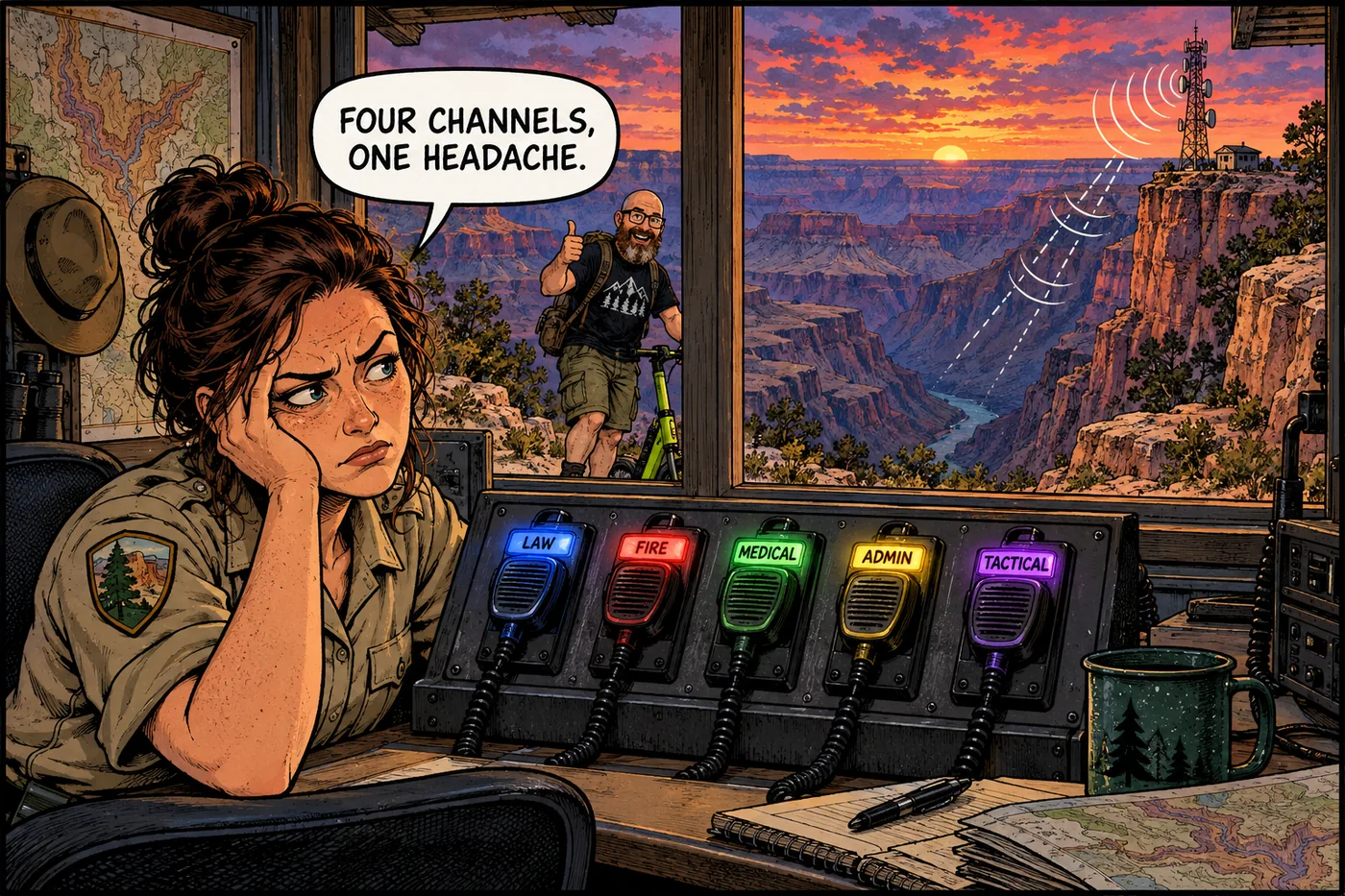
Every rescue, every fire, every medical call at Grand Canyon runs through the same rim-top repeater network — split into channels that keep a structure fire from stepping on a search-and-rescue call. It's a system built for a place that averages roughly 300 search-and-rescue incidents a year, in terrain where the radios themselves sometimes can't reach.
The short version
- Grand Canyon’s public-safety radio traffic runs on four separate operational channels — Law Enforcement, Fire, Medical, and Administrative — plus a tactical channel reserved for active incidents.
- The park’s Emergency Services program covers five functions: EMS, search and rescue, structural firefighting, preventive search and rescue, and all-hazard incident management.
- NPS logged 265 search-and-rescue incidents in 2018 (a below-average year) against a 10-year average of 294; more recent reporting cites roughly 310 incidents a year.
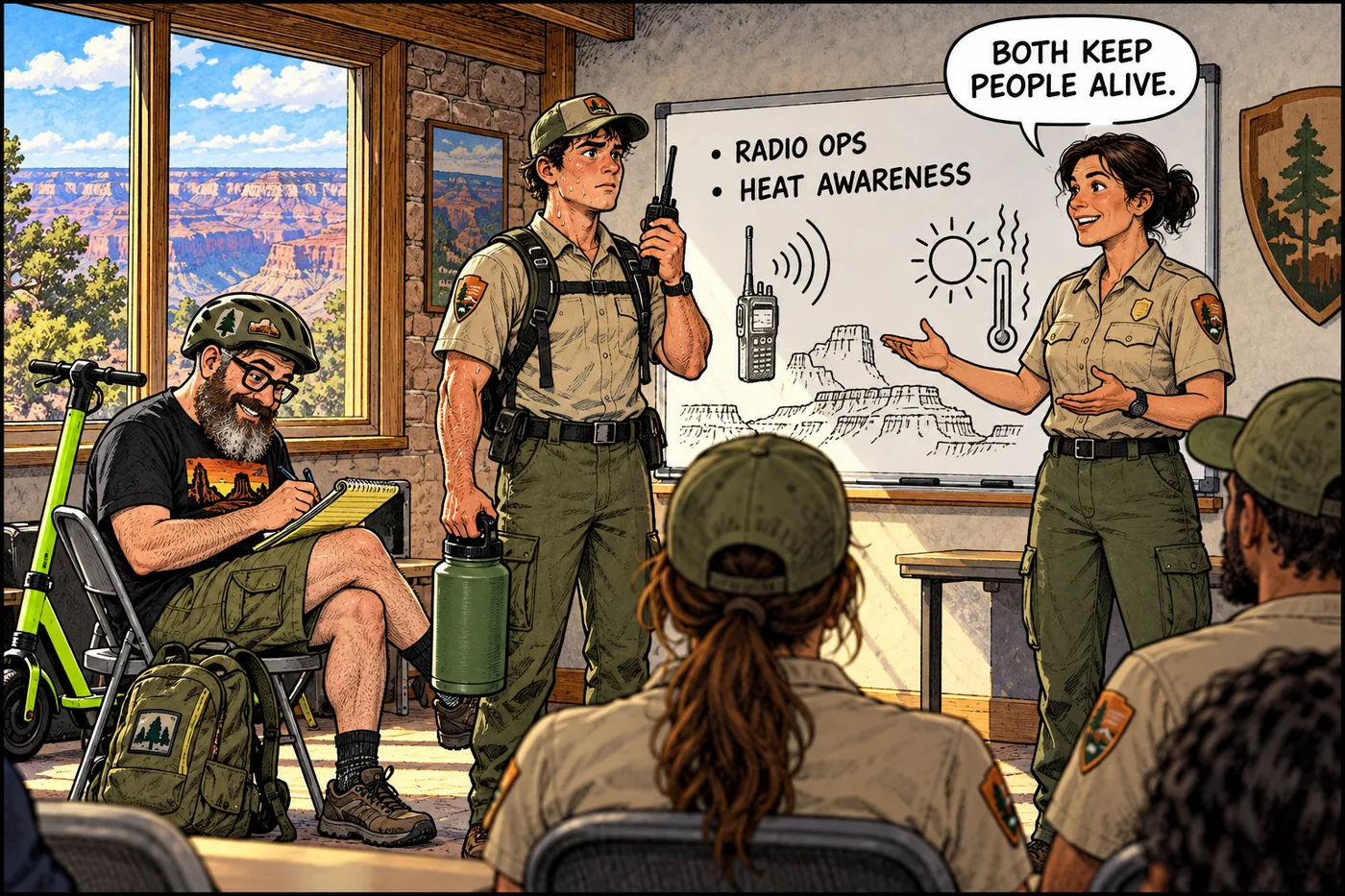
- Radio operations is literally on the training curriculum for the park’s volunteer-and-ranger Preventive Search and Rescue program, alongside heat-illness awareness.
- A federal mandate — not a park initiative — forced Grand Canyon onto newer digital “narrowband” radio technology, largely to preserve the ability to talk to other agencies as they modernized.
- A newer satellite-texting alert system now backs up radio for river and backcountry travelers, and got its first real test during the August 2026 Bright Angel Canyon flash flood.
Four channels, one canyon
Grand Canyon’s public-safety radio network isn’t one big shared channel — it’s split by function. As of the most detailed public breakdown available (a 2007 federal planning document), the park’s repeaters carry four separate operational networks: Law Enforcement, Fire, Medical, and Administrative, plus a tactical network kept open for active incident response. That separation matters in a park this size: a ranger running a traffic stop and a helicopter crew hoisting an injured hiker out of the inner canyon shouldn’t have to fight over the same channel to be heard.
The organization on the ground mirrors that split. Grand Canyon’s Emergency Services program covers five distinct functions — Emergency Medical Services, Search and Rescue, Structural Firefighting, Preventive Search and Rescue, and All-Hazard Incident Management — each drawing on the radio network differently but sharing the same repeater infrastructure across the rims.
The numbers behind the calls
Search and rescue is the function that generates the most public attention, and the numbers explain why. NPS’s own 2018 Branch of Emergency Services annual report counted 265 SAR incidents that year — a below-average year, the report notes, attributed partly to staffing shortages, against a 10-year average of 294 incidents annually. More recent public reporting from the Grand Canyon Conservancy cites a rounder figure of roughly 310 incidents a year. Those aren’t necessarily the same measurement taken at different times — the two figures come from different years and different sources — but together they put the park’s search-and-rescue tempo at somewhere around one incident every day to every day and a half, year-round.
Money follows call volume. In 2018 alone, total SAR costs came to $444,556, with $288,960 of that going to NPS helicopter aviation costs — the single biggest line item, unsurprising in terrain where a helicopter is often the only fast way in or out. That year, 192 individual incidents were expensive enough to cross the $500 threshold that shifts costs from the park’s own budget to NPS’s service-wide emergency funding.
Not every incident needs a chopper and a stretcher. The park runs a Preventive Search and Rescue (PSAR) program specifically to catch trouble before it becomes a rescue — rangers and trained volunteers patrol popular trails, checking on hikers who look overextended, dehydrated, or under-prepared for the heat. Radio operations is literally listed as part of the PSAR training curriculum, right alongside preparedness and risk assessment and heat-illness awareness — reach-back to dispatch is as much a taught skill as reading a hiker’s symptoms. In 2025, Grand Canyon’s PSAR teams logged 18,400 preventive actions, 444 hiker assists, 2,583 patrol hours, and 140,362 visitor contacts. The program has grown into enough of a model that Grand Canyon co-hosted a national PSAR symposium with Joshua Tree National Park in April 2023, drawing about 150 participants a day, including managers from 31 different NPS units learning how to build the same kind of program at their own parks.
A network nobody could opt out of upgrading
None of this runs on equipment the park chose to modernize purely on its own schedule. A federal law — the Omnibus Budget Reconciliation Act of 1993 — put the National Telecommunications and Information Administration and the Department of Commerce in charge of moving all civilian federal radio users onto digital “narrowband” technology, originally targeting 2008, largely to free up spectrum and let public-safety agencies meet tighter privacy and security standards. Staying on the old wideband analog system risked more than obsolescence: as neighboring agencies converted, Grand Canyon’s rangers risked losing the ability to talk to them at all during a shared emergency.
That interagency dependence showed up directly during the park’s 2007 planning process. The county Sheriff’s Department, the Arizona Department of Public Safety, and the Navajo Nation’s Department of Resource Enforcement all separately asked to be considered for continued or new access to the park’s shared Desert View radio site, specifically to improve backup radio coverage for search-and-rescue calls and mutual aid with NPS officers. The park’s own aviation contractor, meanwhile, told NPS its radio link at that same site was “critical to aviation safety” for helicopter operations. Grand Canyon’s radio system, in other words, isn’t just a National Park Service tool — it’s shared load-bearing infrastructure for public safety across jurisdictional lines. (For how the underlying repeater network itself is built and sited, see the full system overview and the Hopi Point repeater site.)
When radio isn’t enough
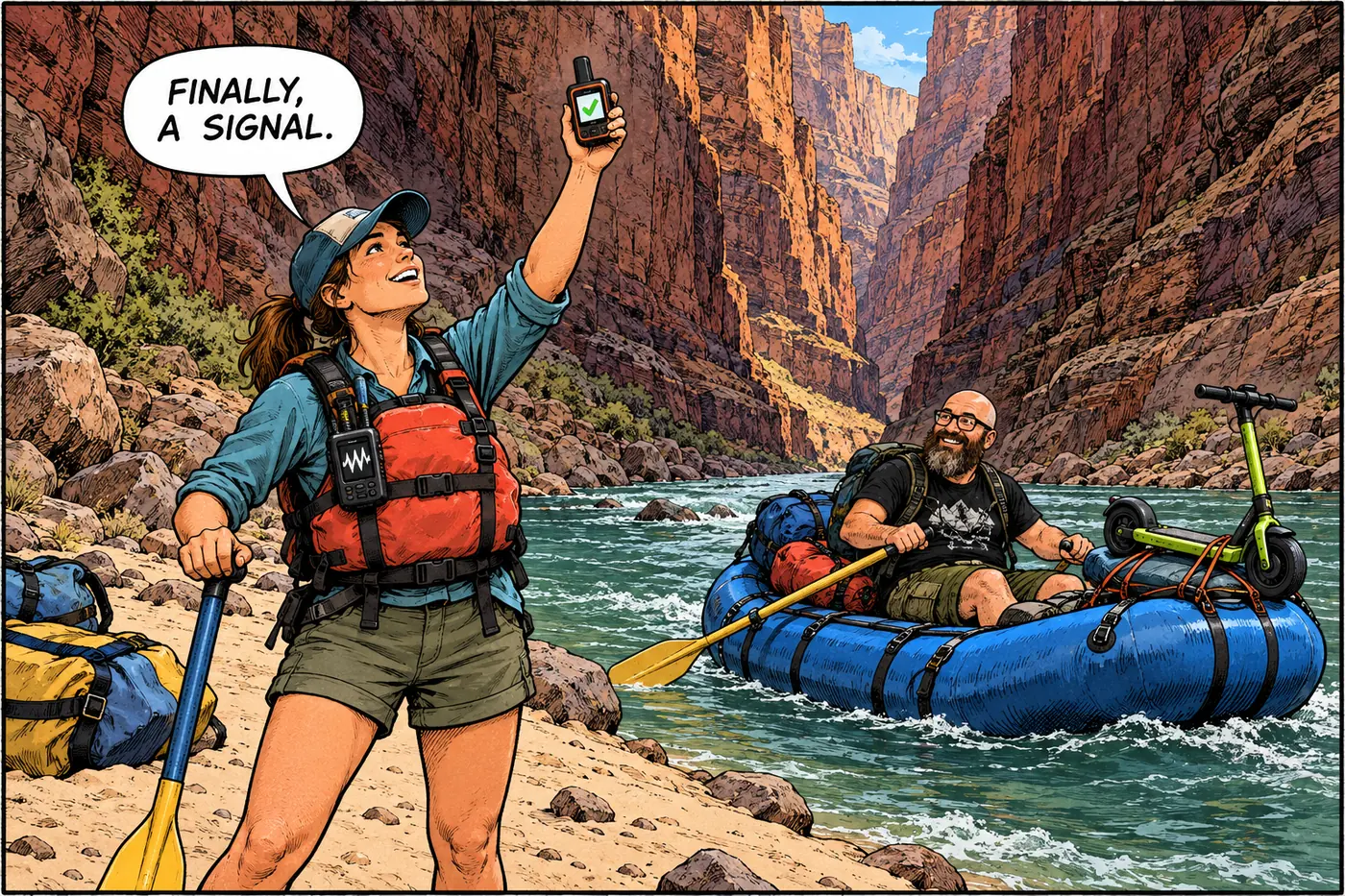
Even a fully modernized radio network runs into the canyon’s basic geography: large stretches of backcountry and inner-canyon terrain simply don’t get radio coverage, according to NPS’s own planning documents. Satellite phones were the park’s longtime fallback — and NPS found them, if anything, less dependable than radio in that terrain, with connections dropping as satellites moved out of position relative to the deep canyon walls.
The newest layer of backup isn’t a radio technology at all. The Grand Canyon River Alert system — built jointly by USGS’s Grand Canyon Monitoring and Research Center, Coconino County Emergency Management, the National Weather Service, and NPS — pushes hazard alerts directly to visitors’ personal satellite messaging devices, the same consumer units (Garmin inReach, SPOT, and similar) that many backcountry and river travelers already carry. Register by texting a keyword to a park number before a trip, and the system can push warnings about flash floods, extreme weather, dam releases, and missing persons straight to a device that doesn’t depend on the park’s own repeater network at all.
That system got an unplanned real-world trial on August 29, 2026, when a flash flood tore through Bright Angel Canyon and Phantom Ranch — the kind of fast-moving inner-canyon emergency the park’s fixed radio network has always struggled to cover completely. NPS’s own public update on the flood specifically credits “river operations rangers and the Grand Canyon River Alert system” with directing river parties who were already in the canyon during the event; 62 people were evacuated from Phantom Ranch and the lower North Kaibab Trail by the following morning, and nearly all the footbridges spanning Bright Angel Creek were destroyed. It’s a small, concrete example of a park layering newer consumer technology on top of a public-safety radio system that, by its own planning documents, has never quite covered the whole canyon.
Congress directs all civilian federal radio users toward digital technology, eventually forcing Grand Canyon's hand.
NPS's own Environmental Assessment documents large coverage holes across backcountry and inner-canyon terrain, and finds satellite backup less reliable than radio.
265 SAR incidents, $444,556 in total costs, $288,960 of it for helicopter aviation support alone.
Grand Canyon hosts the first in-person Preventive Search and Rescue symposium, radio training included in the curriculum.
NPS issues a Finding of No Significant Impact on a broader telecommunications plan covering towers, small-cell sites, and fiber.
Grand Canyon's PSAR teams log 18,400 preventive actions and over 140,000 visitor contacts in a single year.
The Grand Canyon River Alert system helps direct river parties during the August 29 Bright Angel Canyon flash flood.
Sources
- Narrowband/Digital Radio System Conversion Environmental Assessment, May 2007 — National Park Service
- Minimum Requirement Analysis, Appendix B — National Park Service
- Emergency Services — National Park Service
- Search and Rescue (SAR) — Grand Canyon Conservancy
- 2018 Branch of Emergency Services Annual Report — National Park Service
- PSAR Symposium — Grand Canyon Conservancy
- Preventive Search and Rescue (PSAR) — Grand Canyon Conservancy
- Telecommunications Plan FONSI, November 19, 2020 — National Park Service
- Grand Canyon Backcountry & River Alerts — National Park Service
- Significant Flash Flooding Closes Phantom Ranch and North Kaibab Trail — National Park Service