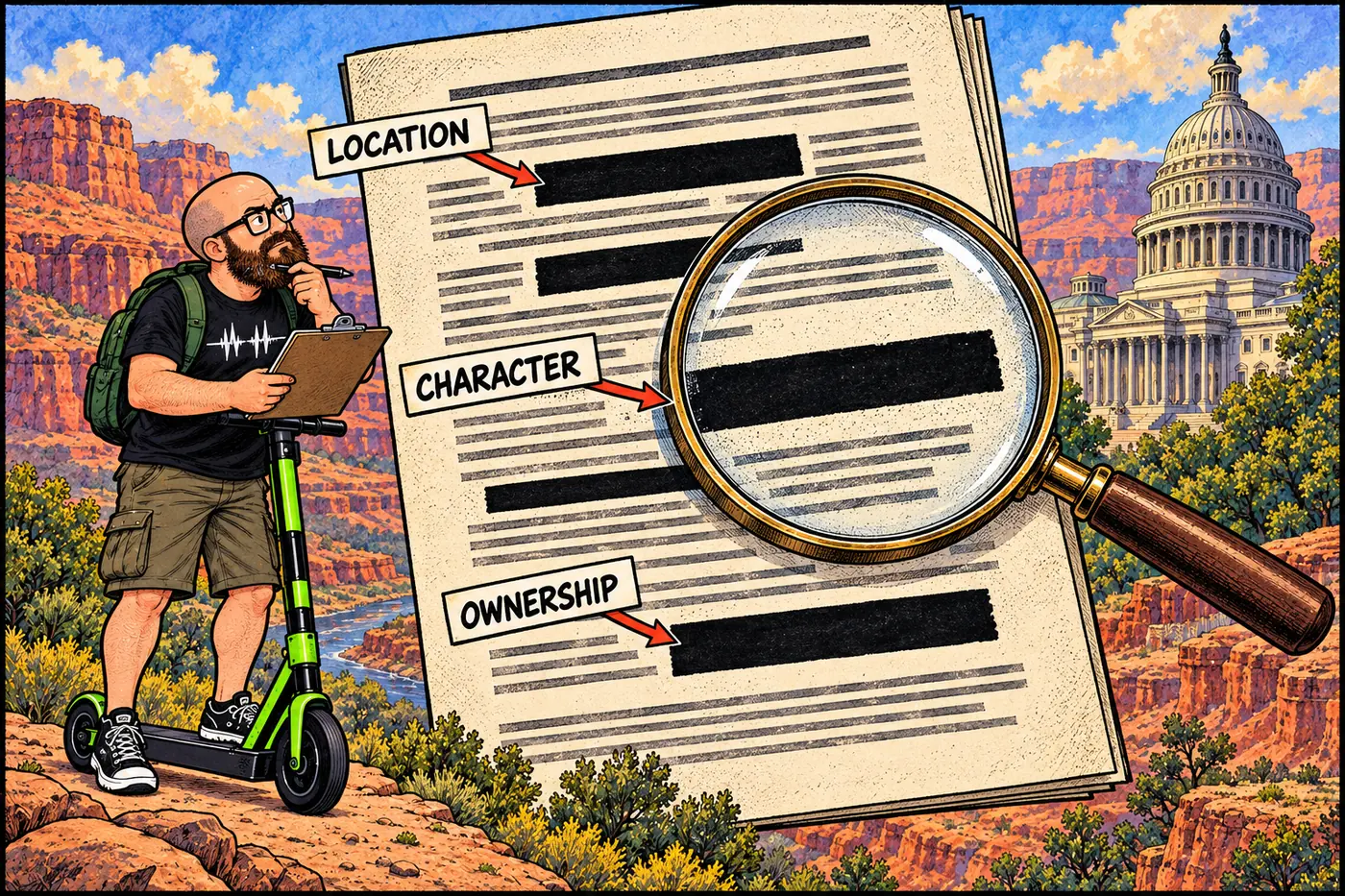
Every closure order in this project that touches a cultural site reads the same way: a name, a boundary, and one sentence — "protection of a significant cultural resource." No description of what's there, no photo, no explanation. That's not the National Park Service being cagey. It's federal law, written specifically to keep that information out of public records.
The short version
- The Archaeological Resources Protection Act (ARPA) makes it illegal for federal land managers to release the nature or location of an archaeological resource requiring a permit, unless disclosure would serve the law’s own purposes without risking harm.
- Section 304 of the National Historic Preservation Act lets agencies withhold a historic property’s location, character, or ownership if release could invite privacy invasion, harm to the site, or interference with traditional religious use — but only for properties already found eligible for the National Register.
- Not everything is covered: field notes, general archaeological data, and ineligible sites fall outside Section 304’s withholding power.
- Grand Canyon National Park has consulted with 11 traditionally associated tribes for more than 40 years, and federal agencies typically run National Historic Preservation Act and National Environmental Policy Act tribal consultation as one combined process rather than two separate ones.
- A related but distinct concept, the Traditional Cultural Property (TCP), entered U.S. preservation practice around 1990-91 and can cover living cultural relationships to a landscape, not just buried artifacts.
- None of this project’s dossiers on Grand Canyon cultural closures include coordinates or river-mile-level directions beyond what NPS itself has already published — that omission isn’t caution for its own sake, it’s the law described above, applied consistently.
The law that makes silence legal
The Archaeological Resources Protection Act, at 16 U.S.C. § 470hh, is blunt about it: information on the nature and location of an archaeological resource requiring a permit “may not be made available to the public” unless the federal land manager decides disclosure would further the statute’s own purposes and wouldn’t create a risk of harm to the resource or site. There’s a narrow carve-out for state governors, who can request that information in writing if they name the specific site, state their purpose, and commit in writing to protecting its confidentiality — the land manager then “shall provide” it, but only under those conditions.
Section 304 of the National Historic Preservation Act, now codified at 54 U.S.C. § 307103, works on a parallel track for historic properties rather than archaeological resources specifically. It lets an agency head withhold information about a historic property’s location, character, or ownership if disclosure might cause significant privacy invasion, risk harm to the property, or impede a traditional religious site’s use by practitioners. The Advisory Council on Historic Preservation, which administers the law’s guidance, is explicit that Section 304 has real limits: “Not all archaeological records, field notes, or data analyses are subject to withholding under Section 304… only information about a property’s ’location, character, or ownership.’” And the property has to already be determined eligible for the National Register — Section 304 doesn’t apply before that determination is made. Once a withholding decision is made, the Secretary of the Interior, working with the relevant agency, decides who — if anyone — gets access, and the withheld material has to be redacted from public documents, including environmental review paperwork.

Why “who might use this information” matters
The Advisory Council’s own guidance frames the question agencies actually have to answer: are private rituals or specific behaviors in danger of being widely known if the location or character information gets released? That’s a fundamentally different test than “is this interesting” or “would the public like to know.” It’s asking whether publication would let anyone — well-meaning or not — show up and interfere with something still in active, living use.
That framing lines up with how tribes describe their own cultural resources when they choose to speak publicly. Hopi cultural resources, for instance, have been described in academic literature as encompassing far more than what NHPA formally defines as archaeological sites or TCPs — extending to the interacting pieces of an ecosystem that shaped Hopi culture and the intangible links tying Hopi people to a landscape. A law built only to protect physical artifacts wouldn’t cover that. Section 304’s location/character/ownership framing, paired with the TCP concept that entered U.S. preservation practice around 1990-91, comes closer.
Consultation isn’t a formality
Section 106 of NHPA requires federal agencies to consult with tribal nations when a proposed action might affect historic properties, giving tribes a real chance to weigh in before anything happens — not a courtesy notice after a decision is made. In practice, agencies generally run that requirement alongside NEPA’s own tribal consultation mandate as one combined process rather than duplicating the work twice.
At Grand Canyon specifically, NPS states that at least 11 federally recognized tribes are traditionally associated with the park, and that “park staff have been working with Tribal communities for more than 40 years, developing numerous innovative and collaborative tribal partnerships.” That consultation relationship is also why this project can describe places like the Hopi Salt Mines using the Hopi Tribe’s own public statements: the tribe has a formal, decades-long channel through which it already speaks for itself on these matters, rather than needing an outside source to speak for it.
Two other federal statutes round out the picture without changing the basic logic. The Federal Cave Resources Protection Act of 1988 restricts release of “significant cave” location data on similar grounds. And the Native American Graves Protection and Repatriation Act requires that human remains “be treated with dignity and respect at all times,” recognizing that culturally affiliated items and remains belong to lineal descendants, tribes, and Native Hawaiian organizations — not to whoever finds them. It’s a separate legal track from location confidentiality, but it shapes the same outcome: burial-associated landscapes don’t get mapped for public consumption either.
Archaeological Resources Protection Act bars public release of archaeological site nature/location data, with narrow exceptions.
Extends similar location-confidentiality logic to "significant caves" on federal land.
U.S. preservation practice recognizes TCPs — living cultural relationships to a landscape — ahead of NHPA's later amendment to formally include them.
Establishes that Native American human remains and cultural items belong to descendants and tribes, not to whoever finds them.
Now 54 U.S.C. § 307103 — lets agencies withhold a historic property's location, character, or ownership under defined conditions.
NPS states park staff have worked with the park's 11 traditionally associated tribes for more than four decades.
What’s actually off-limits (and why)
None of this legal scaffolding requires NPS to explain itself beyond a boundary and a one-line justification, and Grand Canyon’s Superintendent’s Compendium takes it at exactly that: closures for the Hopi Salt Mines, Furnace Flats, and Anasazi Bridge all cite “protection of a significant cultural resource” with only broad river-mile ranges attached — ranges NPS has already made public, not additional detail this project is disclosing. What’s withheld is the specific thing: what exactly is there, what condition it’s in, and — for still-active tribal sites — what continues to happen there. That’s the whole point of Section 304 and ARPA working as designed. A closure that gives you a boundary and a reason, and nothing else, isn’t an incomplete answer. It’s the complete, legally intended one.
Sources
- 16 U.S.C. § 470hh — Archaeological Resources Protection Act, Confidentiality of Information
- 54 U.S.C. § 307103 — National Historic Preservation Act, Confidentiality of Information (Section 304)
- Frequently Asked Questions: Protecting Sensitive Information — Advisory Council on Historic Preservation
- Homeland of Tribal Communities — Grand Canyon National Park, National Park Service
- Native American Graves Protection and Repatriation Act — National Park Service
- Grand Canyon National Park Superintendent's Compendium, effective June 16, 2026 — National Park Service