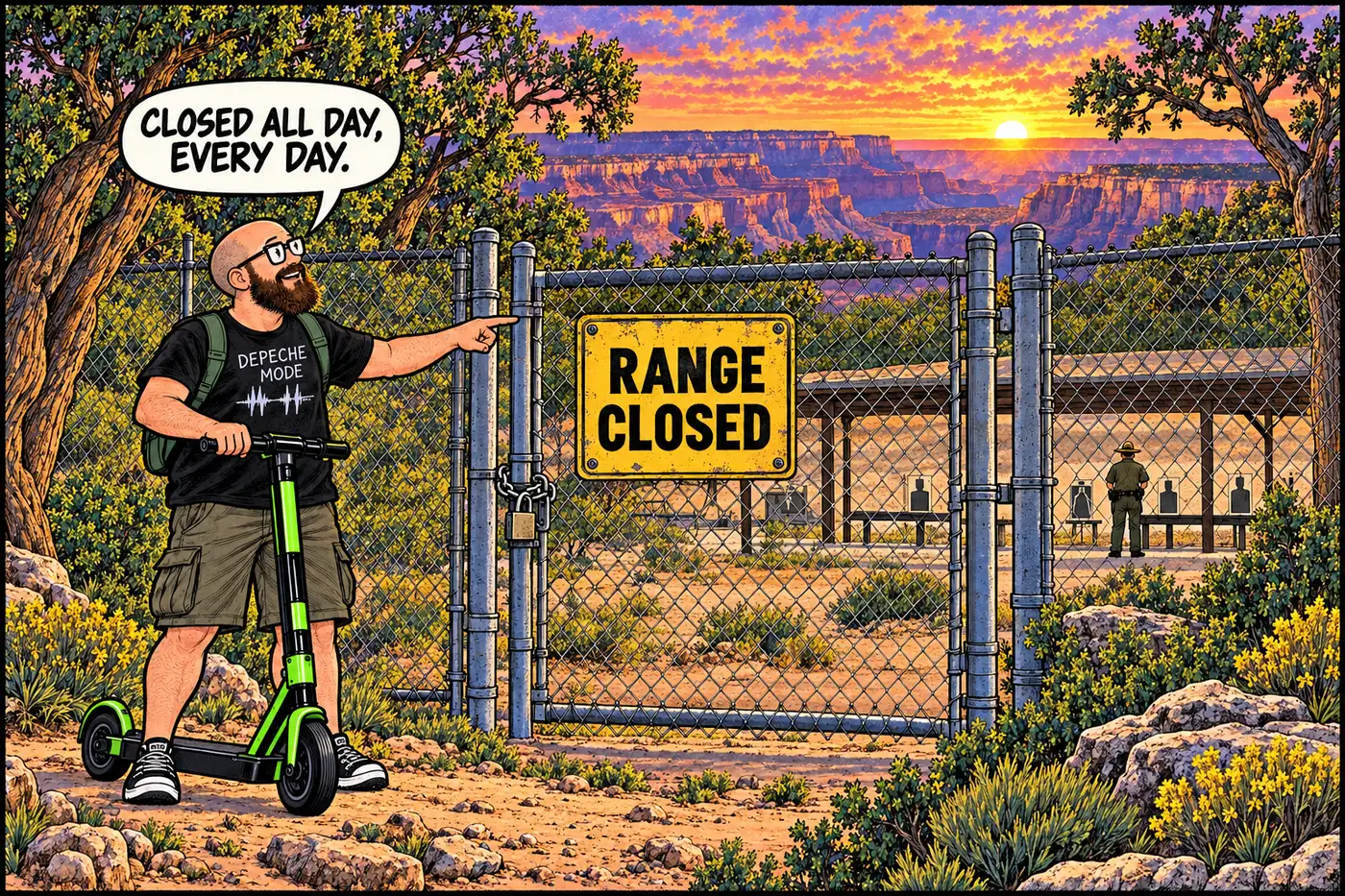
Off Rowe Well Road on the South Rim, a fenced range and its access road are closed to the public around the clock — not because anything's hidden there, but because the park's rangers are, statistically, some of the busiest law enforcement officers in the entire National Park System.
The short version
- The South Rim Range and Range Road are closed to public entry under 36 CFR § 1.5(a)(2), full stop, per the current Superintendent’s Compendium.
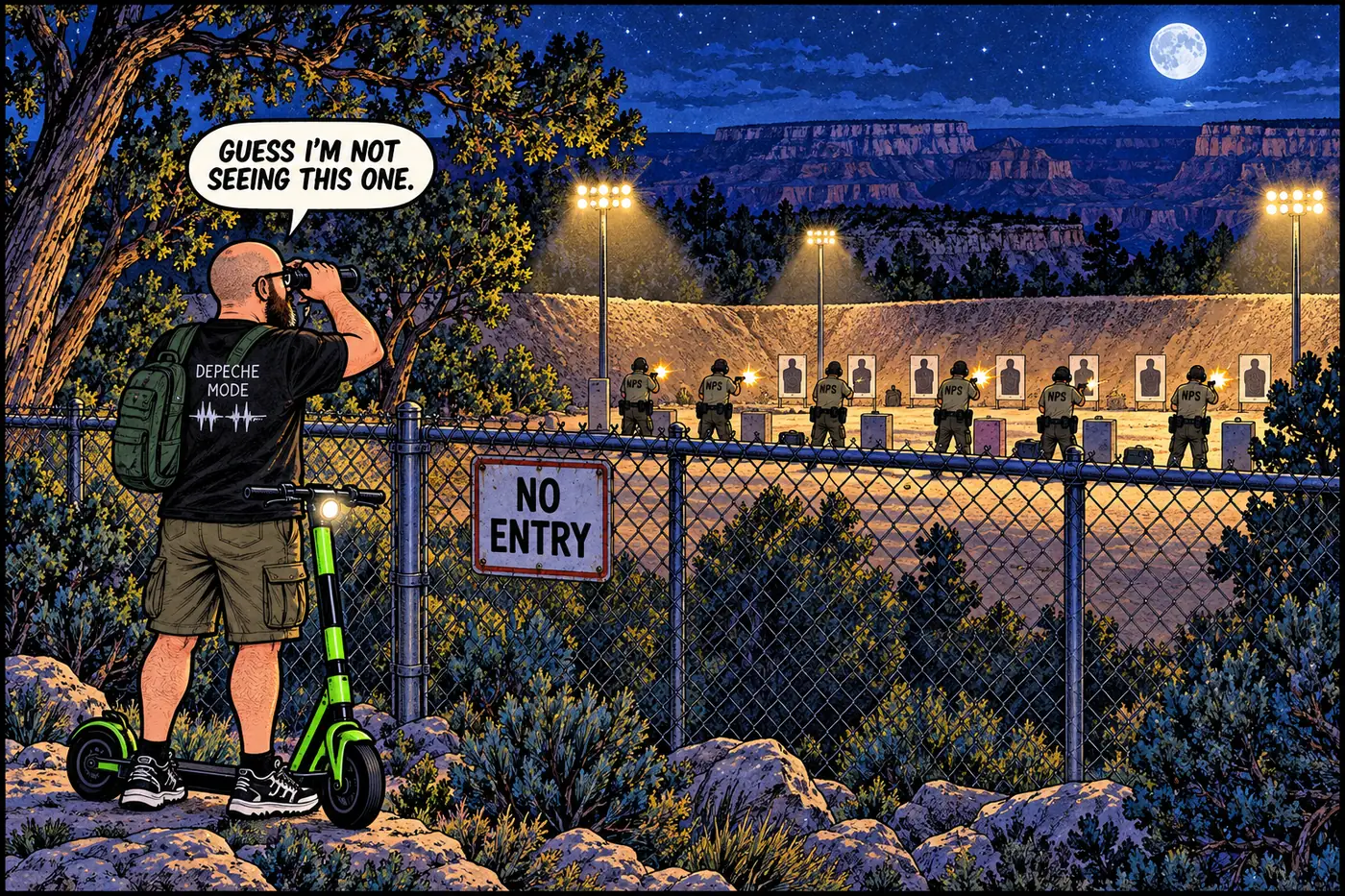
- NPS’s own explanation is blunt: firearms training and qualifications can happen there at any hour, day or night, and the closure keeps hikers and drivers out of the path of stray rounds.
- It’s a working range, not a museum piece — new NPS law enforcement rangers spend roughly 18 weeks at the Federal Law Enforcement Training Center before an additional 11-week field training program, and qualification shoots continue for the rest of a ranger’s career.
- Grand Canyon’s Visitor and Resource Protection division calls its own workload “one of the most complex, challenging and innovative protection programs in the National Park Service” — rangers here do law enforcement, fire response, EMS, river patrol, and search and rescue, often on the same shift.
- A single bad summer in 1996 — five heat deaths, 482 total search-and-rescue calls — is part of why the park built out the protection program it has today, the same program that uses this range.
- There’s a matching, separately-closed range on the North Rim (covered here); this one is the South Rim’s.
What the compendium actually says
The Superintendent’s Compendium — Grand Canyon’s official rulebook for closures — doesn’t dress this one up. Item 13, filed under the South Rim District:
“South Rim Range and Range Road - Closed to Public / Restricted Area: Public presence, use, and access on the South Rim Range and Range Road is prohibited. 36 CFR § 1.5 (a)(2)”
The explanatory note that follows is the whole story in two sentences: “Firearms training and qualifications can occur at any time of day or night. This closure protects the public from exposure to projectiles.” No hours posted, no “range currently in use” sign required — because the range can go hot at any time, the closure is permanent and total, not scheduled around visitor hours.
That’s a meaningfully different kind of restriction than most of this series covers. It’s not about protecting an archaeological site or a contaminated mine shaft. It’s a live-fire safety buffer, the same logic that closes the area around any police or military range anywhere — except this one sits inside a national park most people think of as pure scenery.
Why Grand Canyon rangers need a range at all
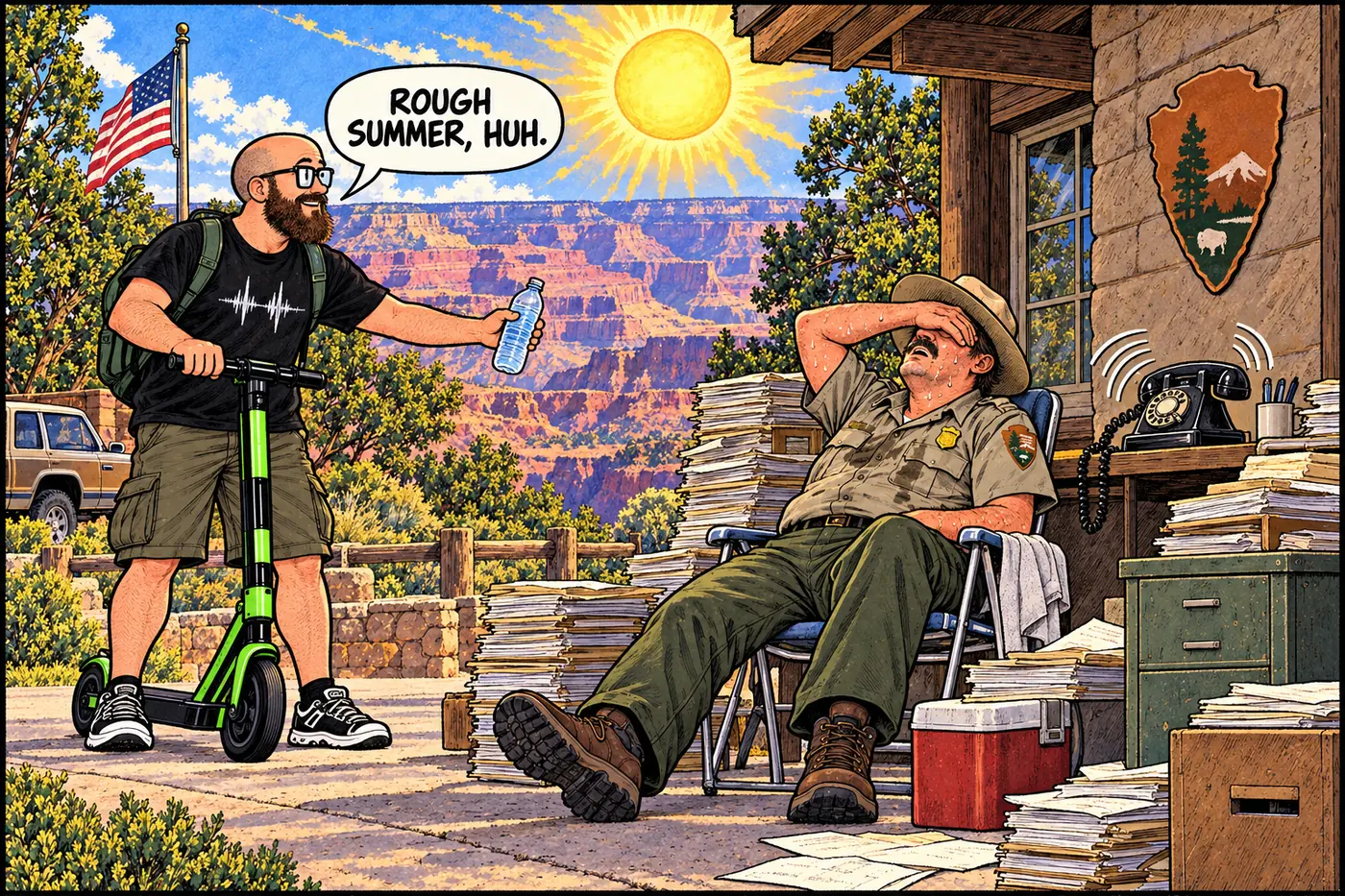
It’s easy to picture “park ranger” as a naturalist job — trail talks, junior ranger badges, pointing out condors. At Grand Canyon, that’s one slice of a much bigger job description. The park’s Visitor and Resource Protection (VRP) division describes its own mandate as covering “a multitude of varied functions including enforcing laws that protect people and the parks, administering the fee program, protecting and preserving the resources, fire management, structural fire prevention and response, providing search and rescue, providing emergency medical response and care, managing large-scale incidents, field training our newest park rangers, responding to and managing developing emergencies, actively participating in the park’s aviation program, patrolling and protecting the river, and providing a level of on-the-ground customer service.” NPS’s own summary line for the division: “one of the most complex, challenging and innovative protection programs in the National Park Service.”
Some of that complexity is just volume. In 1996, Grand Canyon logged five heat-related deaths, 300 heat-related search-and-rescue incidents, and 482 total SAR incidents in a single year — enough that, according to the park’s retired SAR branch chief Ken Phillips, “we were totally in a reactionary mode and everything was based off the South Rim.” SAR costs were running about $1 million a year by the late 1990s, which is part of why the park built its now-influential Preventive Search and Rescue (PSAR) program instead of just adding more rescue crews. Even after PSAR started catching problems earlier, the numbers stayed big: 2011-2015 averaged 300 SAR incidents and 530 additional hiker assists a year, and in the summer of 2015 alone, rangers made contact with 117,267 people on the inner-canyon corridor trails, with roughly a quarter of those contacts requiring some kind of directive advice — meaning a ranger stepping in to stop someone from making a bad call before it became a rescue.
Officers doing that job — plus actual law enforcement, from traffic stops to felony warrants — carry firearms and are required to stay current on them. Commissioned NPS law enforcement rangers go through Ranger-Specific Basic Training and Land Management Police Training at the Federal Law Enforcement Training Center, a combined track expected to run about 18 weeks, followed by a mandatory Field Training and Evaluation Program of roughly 11 more weeks for new hires. (Officers who already have law enforcement experience elsewhere can instead go through a shorter, roughly four-week bridge academy.) None of that training stops once someone’s commissioned — sworn rangers are expected to maintain firearms proficiency for as long as they carry, which means recurring qualification shoots for the life of a career, not just at the academy.
That’s the range’s job: give a park with one of the busiest, broadest-scope ranger operations in the system somewhere to keep several hundred armed federal officers current, without putting a stray round anywhere near a hiking trail or an overlook.
What’s actually off-limits (and why)
The closure covers the range itself and its access road — nothing more, nothing vaguer. The compendium doesn’t gesture at a general area; it names the range and the road by function and closes both outright, all day, every day, regardless of whether training is actively happening at that exact moment. That’s a deliberate design choice: a range that’s sometimes open and sometimes closed invites people to guess wrong about which day it is. A range that’s simply always closed to the public doesn’t.
This dossier doesn’t include the range’s precise location, access route, or any detail about what’s fired there — that’s consistent with how NPS itself describes it (function and hazard only) and with this project’s own rule against publishing routes into closed areas. What is public is the reasoning, and the reasoning holds up: Grand Canyon’s rangers do more, and more dangerous, work per capita than almost anywhere else in the park system, and a range is table stakes for keeping that operation trained and legal.
Five heat-related deaths and 482 total search-and-rescue incidents in one year leave rangers, in the SAR branch chief's words, "totally in a reactionary mode."
The cost of purely reactive rescue work pushes the park toward a prevention-first model instead of just adding more rescuers.
Even with prevention programs running, the park averages 300 SAR incidents and 530 hiker assists a year; in summer 2015, rangers contact over 117,000 people on corridor trails.
The South Rim Range and Range Road remain closed to the public under 36 CFR § 1.5(a)(2) in the Superintendent's Compendium effective June 16, 2026, so firearms training can run at any hour without exposing visitors to projectiles.
Sources
- Grand Canyon National Park Superintendent's Compendium, effective June 16, 2026 — National Park Service
- Visitor & Resource Protection — Grand Canyon National Park, National Park Service
- NPS Law Enforcement Ranger Training and Employment Process — National Park Service
- Law Enforcement Ranger Jobs and Training Requirements — ParkRangerEdu.org
- Preventive success! Grand Canyon's response to search-and-rescue overload — Park Science / National Park Service