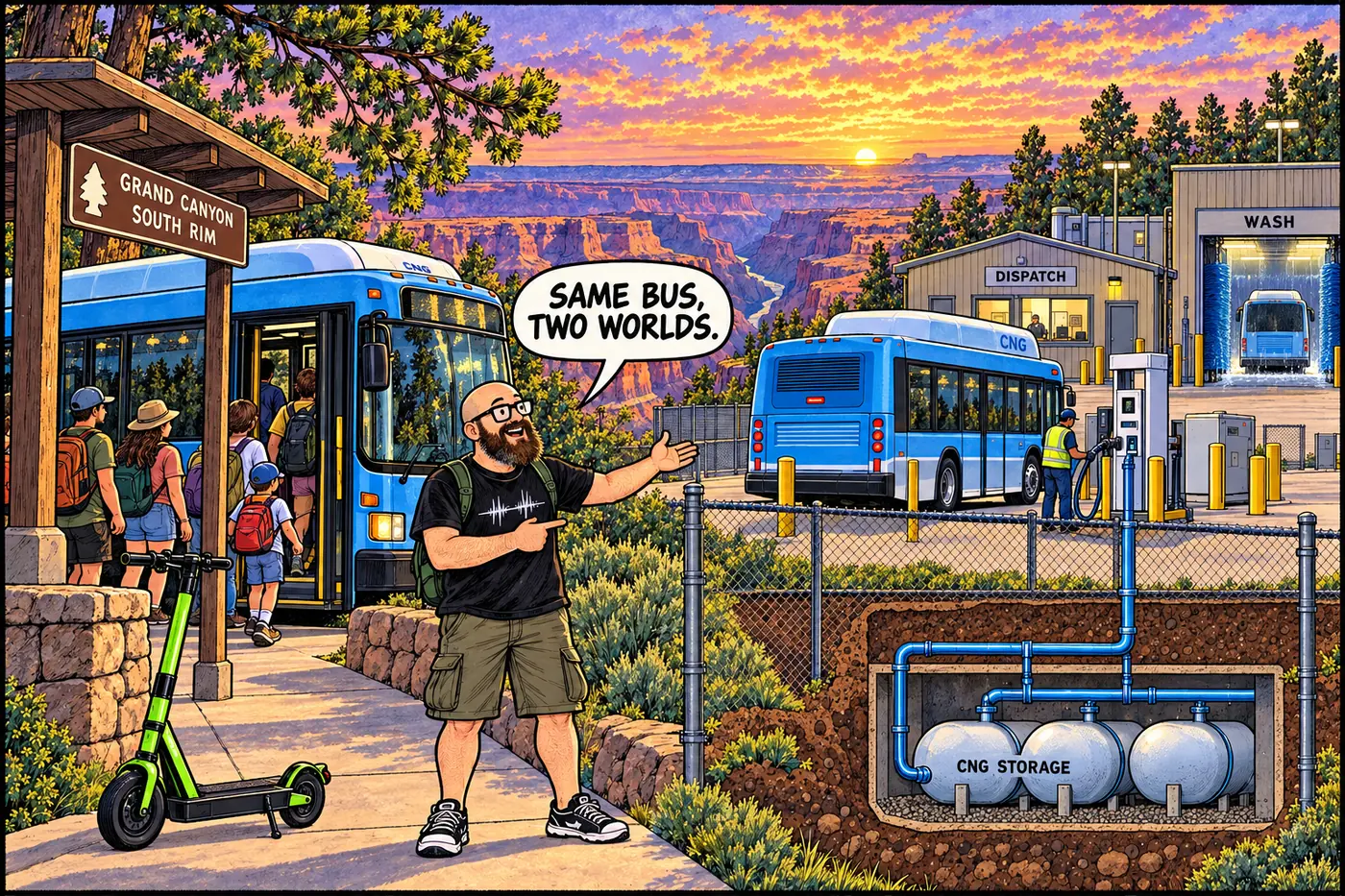
Grand Canyon's free shuttle system carried 7.6 million boardings in a single year — more than every national park transit system in the country except the Statue of Liberty ferry. The fleet, the depot, and the road that leads to it are all fenced off from the very visitors it exists to move.
The short version
- The South Rim shuttle system has run since 1974, making it over half a century old.
- It’s free, funded through park entrance fees, and runs a fleet of 33 compressed natural gas buses on four routes.
- One contractor, Paul Revere Transportation, has run the system since 2000 and holds a 10-year federal contract through November 2030.
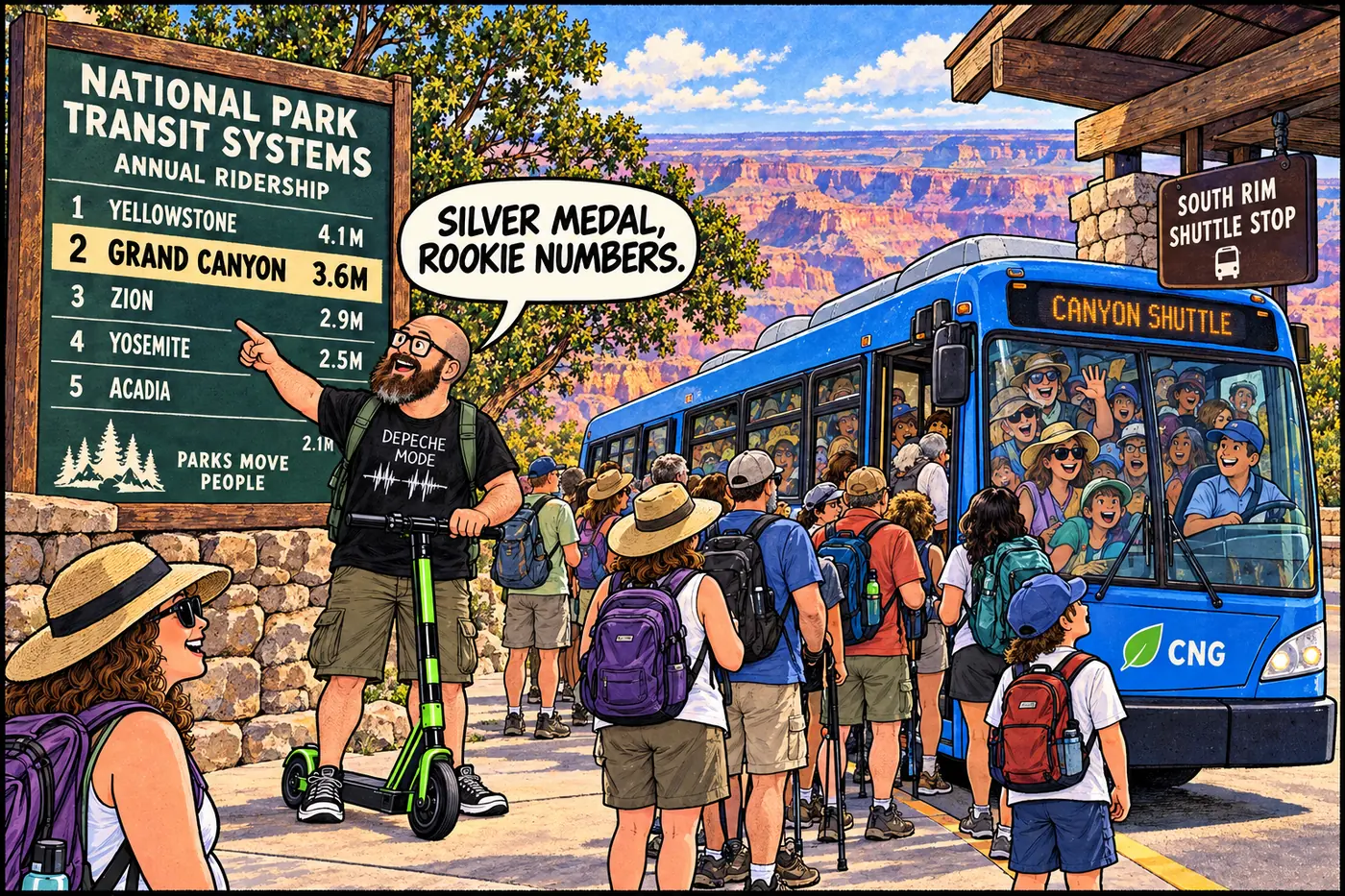
- In 2019, Grand Canyon’s shuttle recorded 7,644,231 boardings — the second-highest ridership of any transit system in the entire National Park Service.
- The buses themselves are public. The compound they’re dispatched from, fueled at, and stored in overnight is not — it’s fenced inside the same restricted government yard as the park’s maintenance center and fire base.
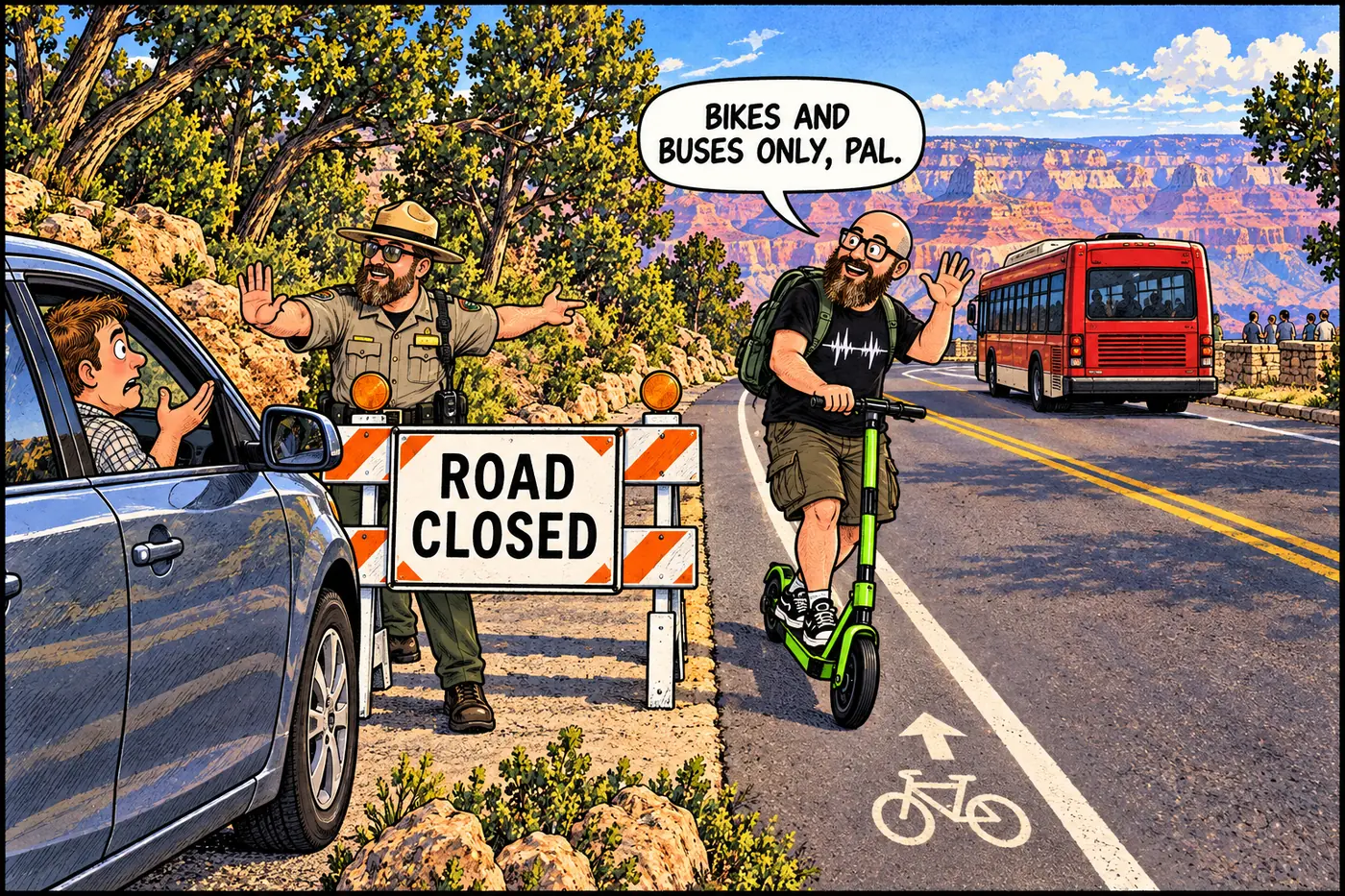
- Hermit Road, the shuttle system’s most scenic route, is closed to private vehicles eight months a year specifically so the buses can run it without competing for the road.
Half a century of running buses instead of cars
The National Park Service has operated shuttle buses on the South Rim since 1974. That’s not a modern congestion fix bolted onto an older park — it’s been the operating model for most of Grand Canyon Village’s modern history. NPS describes the current arrangement plainly: “The National Park Service has provided free shuttle bus service on the South Rim of Grand Canyon National Park for more than 40 years,” and all of it is included in the park entrance fee. No separate ticket, no fare box.
Today’s system runs four routes. The Village (Blue) Route connects the visitor center, lodges, campgrounds, and Market Plaza. The Kaibab Rim (Orange) Route serves South Kaibab Trailhead, Yaki Point, and the Yavapai Geology Museum. Hikers’ Express runs early-morning trips out of Bright Angel Lodge at 6, 7, and 8 a.m., timed for people trying to beat the heat into the canyon. And the Hermit Road (Red) Route covers seven miles of the park’s most photographed overlooks. Every bus in the fleet runs on compressed natural gas rather than diesel or gasoline — a fuel choice the Park Service made specifically to cut tailpipe emissions in a park built around long-distance views.
The contractor and the fleet
One company has run the whole thing for a quarter century. Paul Revere Transportation, a Boston-based firm, has operated Grand Canyon’s shuttle bus system since 2000. In January 2021, NPS announced a new 10-year service contract with the company, running from December 1, 2020 through November 30, 2030, covering a fleet of 33 CNG transit buses.
That contract structure is itself a little unusual. Most National Park Service transit systems either run as NPS-owned-and-operated operations or as concession contracts, where a company owns the buses and pays the government for the right to run them. Grand Canyon’s shuttle does neither — it’s a service contract, where NPS owns the buses and pays a private company to drive and maintain them. According to NPS’s own 2019 national transit inventory, only six systems in the entire agency work this way: Grand Canyon’s South Rim Shuttle, plus smaller operations at Harpers Ferry, Kennesaw Mountain, Yosemite’s Mariposa Grove, Zion, and the Adams Trolley at Adams National Historical Park. Grand Canyon’s is by far the biggest of the six.
Second-busiest transit system in the National Park Service
Ridership numbers put Grand Canyon’s shuttle in rare company. NPS’s 2019 National Transit Inventory and Performance Report — the agency’s own annual accounting of every transit system it runs or funds — recorded 7,644,231 passenger boardings on the GRCA South Rim Shuttle Service that year. Across the entire National Park Service, only one system moved more people: the Statue of Liberty and Ellis Island ferry operation, at 10,370,679 boardings. Grand Canyon’s shuttle outran Zion’s celebrated Canyon Shuttle (6,777,100) and the DC Circulator serving the National Mall (5,565,092). The same report names Grand Canyon as one of just seven NPS transit systems nationwide that broke a million annual boardings at all — the others being the Statue of Liberty/Ellis Island ferries, Zion, the National Mall, Yosemite, Alcatraz Island, and Pearl Harbor.
That volume has a real environmental tradeoff the federal report is candid about. Grand Canyon’s heavy reliance on CNG buses is a significant contributor to the Intermountain Region’s relatively high transit-fleet carbon monoxide output — CNG combustion produces more CO than diesel or gasoline under some conditions. The upside the agency cites: those same buses emit roughly 50% less nitrogen oxide than conventional fuel, which matters more for a park whose main asset is its long-distance viewshed, since nitrogen oxides are a smog precursor.
Not every route has survived. The inventory’s 2019 edition notes that Grand Canyon’s “North Rim Hiker Shuttle” had previously operated but wasn’t running that year and was dropped from the federal count — a reminder that the shuttle network isn’t static, and that the North Rim’s much smaller, seasonal transit needs don’t map onto the South Rim’s year-round operation.
The road built for it
Hermit Road, the shuttle system’s signature scenic route, predates the buses that now run it by four decades. The Bureau of Public Roads and the National Park Service designed and built it in 1934-1935. It underwent a major rehabilitation that reopened in November 2008 — one that specifically preserved the road’s original metal handrails and rustic-style stone retaining walls rather than replacing them with modern standard fixtures — and got a fresh resurfacing in 2020.
Under the current Superintendent’s Compendium, Hermit Road (officially West Rim Drive) is closed to private motor vehicles from March 1 through November 30 every year. During those eight months, the only way most visitors reach its overlooks by vehicle is the Hermit Road shuttle; the road stays open for park employees, residents, official and administrative use, permit holders, and handicap-permit access, and bicycles can use it year-round regardless of season. It’s a road built for tourists that spends most of the year off-limits to the tourists’ own cars — a trade the park has clearly decided is worth it, twice over, since it rebuilt the same restriction into two separate generations of pavement.
The Bureau of Public Roads and NPS construct the road that will eventually become the shuttle system's signature route.
NPS starts running free shuttle buses on the South Rim — a program that's still running, unbroken, 52 years later.
The Boston-based contractor begins operating the fleet; it's still the operator today.
A major restoration reopens the road in November, preserving its original handrails and stone retaining walls.
NPS's national transit inventory ranks Grand Canyon's shuttle #2 systemwide, behind only the Statue of Liberty ferry.
NPS re-signs Paul Revere Transportation for a decade, through November 2030, covering 33 CNG buses.
What’s actually off-limits (and why)
The buses, the routes, and the stops are all public — that’s the point of the system. What’s closed is the infrastructure behind it. The current Superintendent’s Compendium restricts the Shuttle Bus compound as part of the same fenced government zone that holds the Maintenance Operations Center, fueling facilities, and Wildland Fire Base: public access is prohibited within the compound itself, and on Shuttle Bus Road (including its dirt shoulder) beyond a point 250 feet south of its intersection with Center Road. NPS’s stated justification is protecting government property and employee safety, the same standard language used across the park’s other operational-yard closures. Separately, commercial buses of every other kind — charter, tour, school — are barred from idling except while actively loading or unloading passengers; the compendium exempts Park Shuttle Buses specifically from that rule, since they’re doing exactly what the restriction was written to reduce for everyone else.
Sources
- Grand Canyon National Park Superintendent's Compendium, effective June 16, 2026 — National Park Service
- South Rim Shuttle Bus Routes — National Park Service
- News Release: Shuttle Bus Contract Awarded to Paul Revere Transportation — National Park Service
- NPS National Transit Inventory and Performance Report, 2019 — National Park Service
- The Scenic and Historic Hermit Road — National Park Service