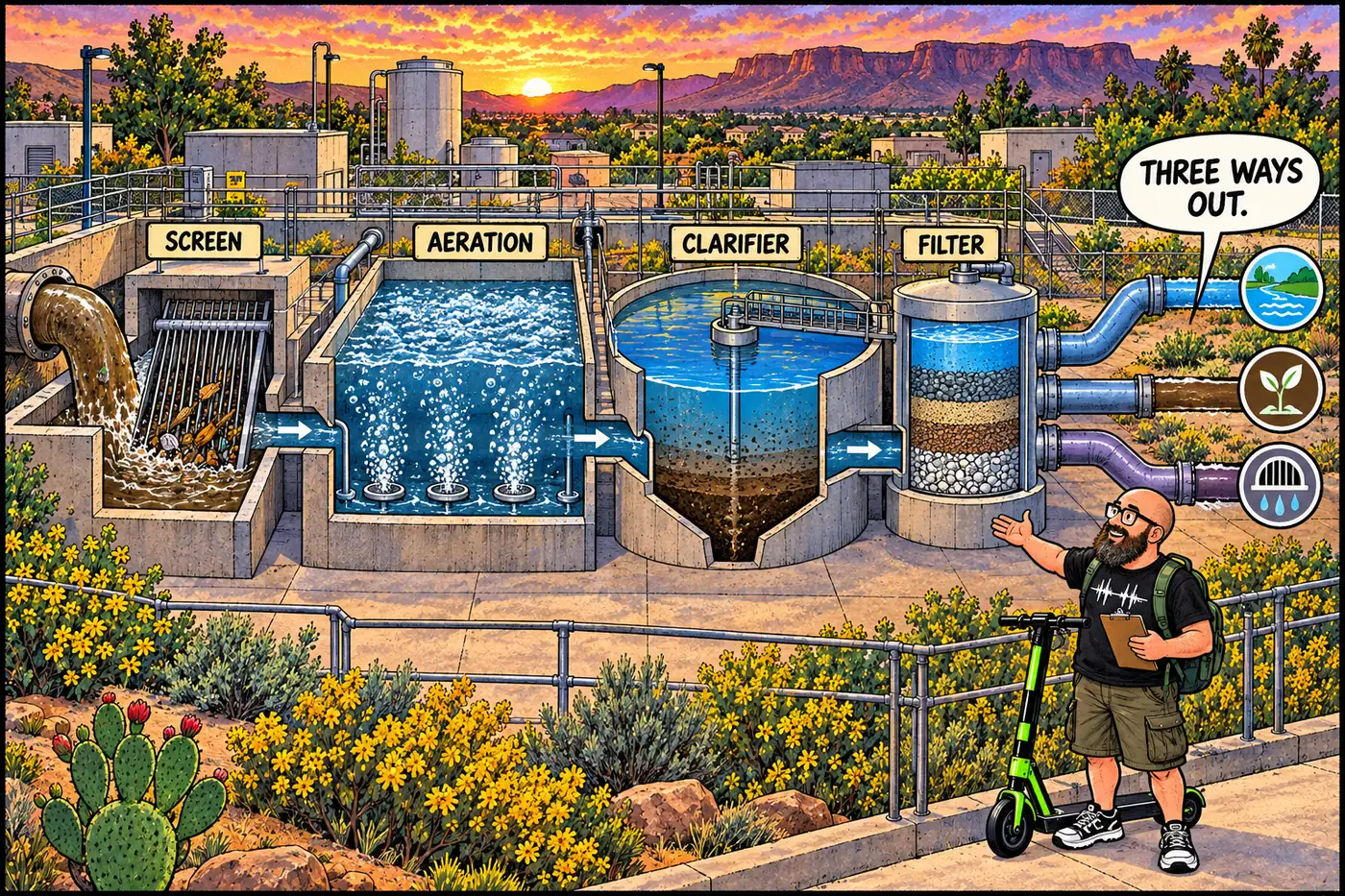
Everything you flush at the South Rim goes to a fenced plant east of Rowe Well Road, gets treated three different ways, and then splits into three different afterlives — irrigation water, a set of lagoons, or a wash that a 2025 federal study just found carrying PFAS and painkillers into a nearby spring.
The short version
- The South Rim Wastewater Treatment Plant (SRWTP) was built in 1972, about 0.3 miles from the original 1926 plant it replaced — see the 1926 plant’s own page for that history.
- It runs a standard modern process: screening and grit removal, activated-sludge biological treatment, clarification, then tertiary polishing (flocculation, coagulation, filtration) and chlorine gas disinfection.
- Treated water leaves the plant three ways, roughly in thirds: back into the park’s reclaimed-water system, out to a separate set of lagoons, or discharged into Bright Angel Wash.
- Discharge volume is a visitation gauge in its own right — averaging about 6 million gallons a month from 2010-2022, peaking at 9.9 million gallons in the busy summer of 2015.
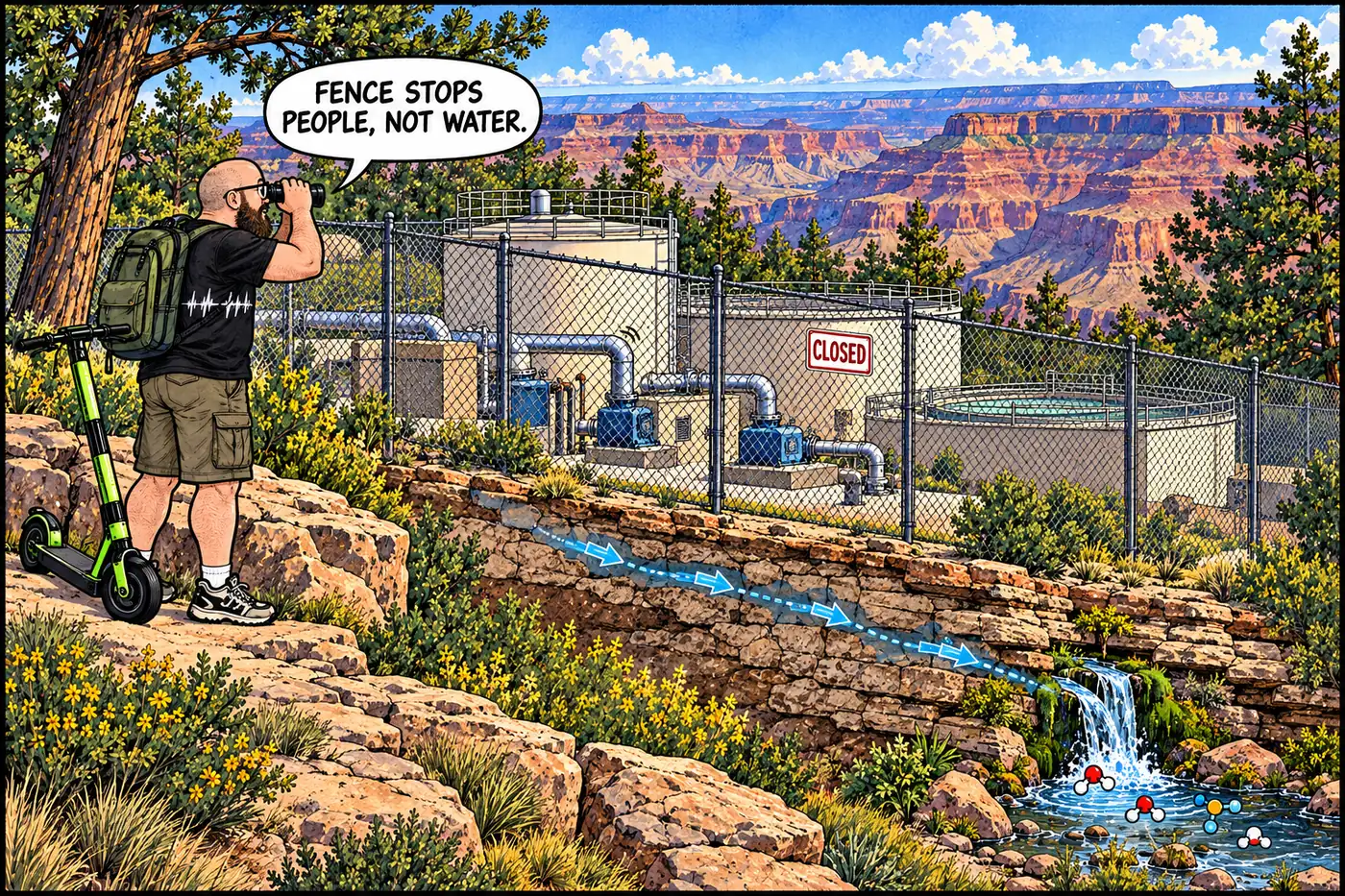
- A 2025 USGS/NPS study sampling in April 2021 found PFAS chemicals and pharmaceuticals in the treated effluent, and traced some of the same compounds into nearby springs — evidence the wastewater is finding its way underground through the Bright Angel Fault.
- Both the plant and its lagoons are separately fenced, separately regulated, and closed to the public under the park’s Superintendent’s Compendium.
From steam engines to sludge
The South Rim has almost no natural water, which is the reason any of this infrastructure exists at all. The park’s original answer, a 1926 water-reclamation plant built by the Santa Fe Railway, is its own story — read it here. That plant ran for decades, expanded once in 1934, and was eventually outgrown. In 1972, the National Park Service built a new, larger activated-sludge treatment plant about 0.3 miles east of the original site to take over. The old plant didn’t get demolished — it got fenced off and, in 1974, added to the National Register of Historic Places. The new plant is the one still running today, and it’s the subject of this page.

Inside the plant
The SRWTP’s treatment train is a fairly conventional wastewater-engineering setup, just built for a park instead of a city. Influent first passes through screening and aerated grit chambers to strip out solids and grit. From there it goes through biological treatment using activated sludge — the same principle the 1926 plant pioneered, just at larger scale and with modern equipment — followed by secondary clarification to settle out biological solids. A tertiary stage then polishes the water further: flocculation and coagulation clump remaining fine particles, sedimentation and filtration remove them, and chlorine gas disinfects the water before it leaves the plant.
What makes the South Rim’s system unusual isn’t the treatment train — it’s what happens to the water afterward.
| Destination | Approximate share | Use |
|---|---|---|
| Reclaimed-water system | ~1/3 | Non-potable reuse around the South Rim (irrigation, facilities), continuing the role the 1926 plant pioneered |
| Lagoons | ~1/3 | Storage/further settling at a separate, fenced site about 3 miles south of the rim |
| Bright Angel Wash | ~1/3 | Discharged for irrigation, facilities use, and fire management |
That three-way split means the plant, the lagoons, and the wash all function as one connected system, even though — as the closures below show — they’re treated as three separate restricted sites on paper.
What’s showing up downstream
In April 2021, USGS and NPS ran a synoptic sampling study across the South Rim’s wastewater and spring network, published in 2025 as part of an assessment of treated-wastewater infiltration into Bright Angel Wash. The treated effluent itself tested positive for nine perfluoroalkyl acids — the PFAS family of “forever chemicals” — with PFOA measured at 84.6 nanograms per liter, above EPA guidance levels. Seven pharmaceutical compounds also turned up, with the antihistamine diphenhydramine and the anticonvulsant carbamazepine at the highest concentrations. Those are unremarkable findings for treated municipal-style wastewater almost anywhere in the country; modern treatment plants aren’t designed to strip out PFAS or pharmaceuticals, and neither is this one.
The more interesting part is what the study found outside the plant. Monument Spring, downhill from the SRWTP, showed detections of five PFAS compounds and eight pharmaceutical compounds. Upper Horn Bedrock Spring also showed PFAS. The study’s read is that some of the treated wastewater discharged to Bright Angel Wash is infiltrating through the Bright Angel Fault — the same fault system that shapes much of the South Rim’s underlying plumbing — and re-emerging in springs downstream. Other springs sampled in the study showed no contamination, so this isn’t a park-wide problem; it’s specific to the drainage the plant discharges into.
None of this means South Rim tap water is unsafe — treated effluent and drinking water are entirely separate systems here, and the springs in question aren’t part of the potable supply. But it’s a concrete, federally documented example of exactly why the compendium fences these sites off: wastewater infrastructure has downstream effects that don’t stop at the fence line.
Santa Fe Railway builds the South Rim's first water reclamation plant to cope with the rim's lack of natural water.
A third aeration tank is added to serve the new Bright Angel Lodge.
NPS replaces the aging original plant with a new activated-sludge facility about 0.3 miles east.
The original 1926 site is listed on the National Register of Historic Places and taken out of active service.
Average monthly discharge to Bright Angel Wash runs about 6 million gallons, peaking at 9.9 million gallons in 2015.
A synoptic study in April samples SRWTP effluent and nearby springs for contaminants of emerging concern.
USGS Scientific Investigations Report 2025-5095 documents PFAS and pharmaceuticals in effluent and in Monument Spring and Upper Horn Bedrock Spring.
What’s actually off-limits (and why)
The Superintendent’s Compendium treats the plant and the lagoons as two separate closures. The South Rim Wastewater Treatment Plant itself, east of Rowe Well Road and about half a mile south of the canyon rim, is enclosed by a six-foot chain-link fence and closed to public entry, access, or presence under 36 CFR § 1.5(a)(2) — the stated reason is protecting the public from hazards associated with wastewater treatment, per Arizona Department of Environmental Quality standards. The South Rim Wastewater Lagoons, at the end of fire road W-6 about 3 miles south of the rim and 0.4 mile northwest of Rowe Well Road, get their own closure: a three-strand wire fence with posted closure notices, same regulation, same underlying rationale.
The historic 1926 plant is closed separately too, with its own 300-foot public stay-back rule — it’s a different site with a different reason (preserving a historic structure) layered on top of the same basic hazard logic. None of these closures are about hiding anything exotic. They’re standard industrial-site fencing, for standard industrial-site reasons: open tanks, chemical disinfection, and machinery aren’t safe to wander into, whether the plant is 3 years old or 100.
Sources
- Assessment of treated wastewater infiltration in Bright Angel Wash and the potential for contaminants of emerging concern influencing spring water quality along the South Rim of the Grand Canyon in Grand Canyon National Park, Arizona — U.S. Geological Survey Scientific Investigations Report 2025-5095
- Grand Canyon National Park Superintendent's Compendium, effective June 16, 2026 — National Park Service
- Grand Canyon Water Reclamation Plant — Wikipedia (flagged: used only for corroborating background on the 1926 predecessor plant; primary NRHP nomination form used for factual claims)
- Designing a Water System for the Future — Grand Canyon Conservancy (used only to distinguish the separate, newer potable-water treatment plant from the SRWTP)