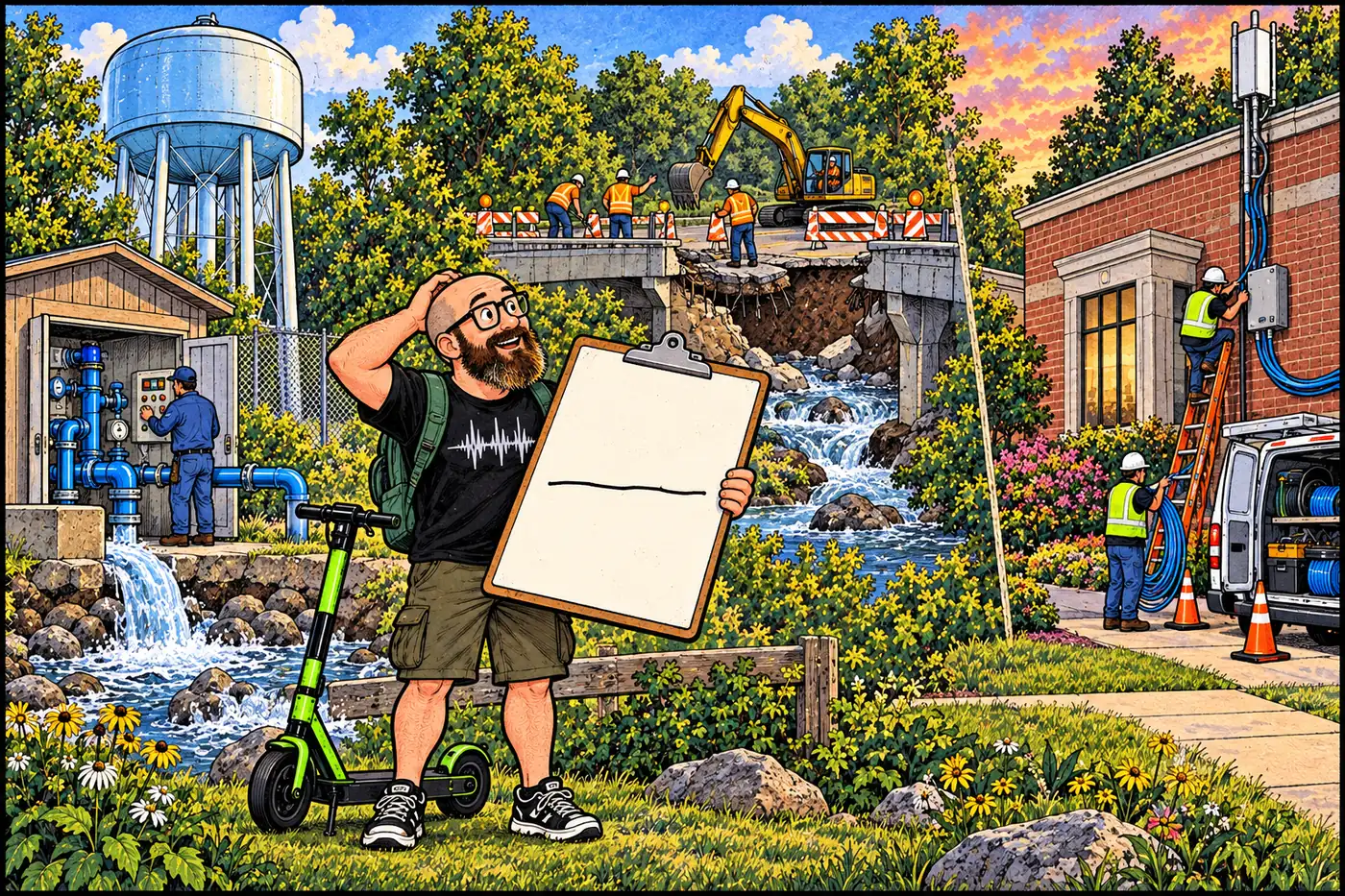
A pipe to a village, a graded road, a working internet connection: none of these becomes a park amenity just because the Grand Canyon is nearby. The communities around it run their own services, solve different engineering problems and deal with other governments when a line or a funding application crosses a boundary.
The short version
- Supai is on Havasupai land outside Grand Canyon National Park, with no road into the village.
- The Havasupai Tribe’s 2022 hazard plan describes its own groundwater-fed village water system, sewer system and grid power. It also describes aging facilities and flood-related interruptions as of that plan, not a verified 2026 outage.
- The Hualapai Tribe publishes separate public-works and tribal-utility responsibilities for community services and Grand Canyon West.
- Hopi tribal agencies manage roads and water planning; Hopi Utilities Corporation and Hopi Telecommunications have described major water and broadband projects.
- A broadband award is not a completed connection. NTIA’s published Havasupai status in April 2024 was environmental review, with household connections still ahead.
Supai is a community, not a park service area
NPS says it plainly: Supai Village is not reachable by road, and the Havasupai Tribe administers land outside the park’s boundary and jurisdiction. The Tribe’s own November 2022 hazard-mitigation plan describes groundwater as the source for its reservation’s public water systems and identifies Havasupai Facilities & Maintenance Services as the operator of the Supai village system. It reported service to more than 500 residents in approximately 130 homes, plus the school and clinic. Those are the plan’s figures, not a current census.
The same plan called the village water and sewer systems old and in need of major work. Flash floods could damage them, and power interruptions could stop water delivery. It described a village sewer system. That distinction matters: a drinking-water or toilet arrangement for visitors is not an inventory of what serves homes. The school and clinic need it on an ordinary Tuesday.
Power tells a similar jurisdiction story. In its 2022 account, the Tribe described electric supply crossing Hualapai and Havasupai lands and other property before reaching the community, with a separately managed village distribution system. The document reported problems using a solar installation as backup at that time. It would be irresponsible to turn that old engineering account into a claim that the backup still fails today; it does show why a line on a map cannot tell you who operates the whole service, or whether every part of it works together.
A road can stop; maintenance cannot
No road into Supai means access to the village relies on non-road transportation. Keep the visitor logistics separate from essential services. In 2024, KNAU reported that 2022 flooding damaged bridges and left fallen trees across trails needed to reach the village. The station also reported $933,000 in federal grant funding and technical assistance for a Havasupai flood-warning system and siren. That is an announced project, not evidence that a warning system was already operating. The Tribe’s planning document treats bridges, trails, utilities and solid waste together as community infrastructure; a failed connection affects more than a vacation schedule.
Elsewhere the work looks less dramatic. The Hualapai Tribe’s Public Works page lists water-system upkeep, sewer maintenance, streetlights and both paved- and unpaved-road maintenance, including storm-damage repair. The Tribe separately describes the Hualapai Tribal Utility Authority’s mission as providing electric power, water and sewer service for Grand Canyon West, with possible additional services on tribal land at the Tribal Council’s direction. Don’t collapse that utility’s Grand Canyon West mission into the responsibilities of the community Public Works department.
The Hopi Department of Transportation says the Tribal Council established it in 2013 to oversee road maintenance and construction across Hopi lands. Its published description names Bureau of Indian Affairs and Federal Highway Administration funding arrangements, including a possible direct federal agreement. This is not the park assigning road jobs to a neighboring tribe; it is a tribal government setting priorities and using the programs available to it.
| Place and system | Publicly documented responsibility | What the record does not prove |
|---|---|---|
| Supai village water and sewer | Havasupai Facilities & Maintenance Services operated the village water system in the Tribe’s 2022 plan; the plan describes village sewer infrastructure. | Its exact condition or operator changes in September 2026. |
| Hualapai community roads and utilities | Hualapai Public Works lists road, water and wastewater maintenance; the tribal utility authority states a separate Grand Canyon West service mission. | That one agency runs every water or power service on all Hualapai lands. |
| Hopi roads and village water planning | Hopi transportation and water-resources programs state their responsibilities; Hopi Utilities Corporation described a regional drinking-water project. | That every proposed extension and household hookup is complete. |

Water and fiber take more than a construction check
The Hopi Tribe’s newspaper carried an August 2022 account from Hopi Utilities Corporation of the Hopi Arsenic Mitigation Project. The corporation described a regional water delivery system costing more than $20 million, built to replace arsenic-affected well water. Its account said an extension to the Bureau of Indian Affairs water system at Keams Canyon was under construction then. That is a milestone, not a claim that every planned connection is finished now. The Tribe’s Water Resources Program says its work includes helping villages upgrade water and wastewater systems and training operators. Pipes need people after the ribbon is cut.
For communications, Hopi Telecommunications wrote that it acquired an existing telephone provider’s assets in 2005. In 2022 it announced approval of a $5.8 million USDA loan for fiber to homes. A September 2023 company notice in the tribal newspaper anticipated service drops to approximately 651 residential and business locations; it also said it would observe village guidelines, tribal ordinances and local consent. The projected completion date in that notice was just that: a projection. This page has not verified a final installed count.
NTIA awarded the Havasupai Tribe $7,077,145 for a broadband proposal described as connecting 102 unserved households and 33 community institutions. In its April 2024 annual-report account, NTIA said environmental review had begun and described the home connections in the future tense. So the honest sentence is “funded and planned,” not “102 homes connected.” A grant award does not pull fiber across a jurisdictional boundary by itself, much less light up a subscriber’s connection.
What’s actually off-limits (and why)
The Havasupai Tribe, not NPS, administers entry to its reservation. The NPS visitor page updated January 2026 says reservations are required and warns that parts of Havasu Canyon affected by past floods are off-limits to visitors while repair or unstable-ground conditions persist. Conditions and permissions can change: check the Tribe’s own current notices rather than treating an NPS information page, a project map or a utility corridor as authorization to enter. For more on why the park’s rules do not automatically govern neighboring tribal land, see tribal versus NPS jurisdiction and what is off-limits.
As of September 23, 2026, the public documents used here establish governance, historical condition, announcements and project intentions. They do not supply a verified live service dashboard for every village. The most useful hidden-infrastructure fact is also the least mysterious: a canyon community needs its own operators, funding decisions and authority, whether or not anyone is selling a postcard nearby.
Sources
- Havasupai Tribe Hazard Mitigation Plan, November 21, 2022 — Havasupai Tribe (posted draft filename)
- Havasupai Tribe Reservation, updated January 17, 2026 — National Park Service
- Havasupai Tribe to receive federal grant for flood warning system — KNAU
- Public Works — Hualapai Tribe
- Hualapai Tribal Utility Authority mission — Hualapai Tribe
- Department of Transportation — Hopi Tribe
- Water Resources — Hopi Tribe
- Hopi Tutuveni, August 17, 2022, pp. 2, 7 — Hopi Tribe
- Hopi Tutuveni, September 20, 2023, p. 5 — Hopi Tribe
- Havasupai Tribe broadband award — NTIA BroadbandUSA
- Western Region, 2023 annual report, published April 2024 — NTIA