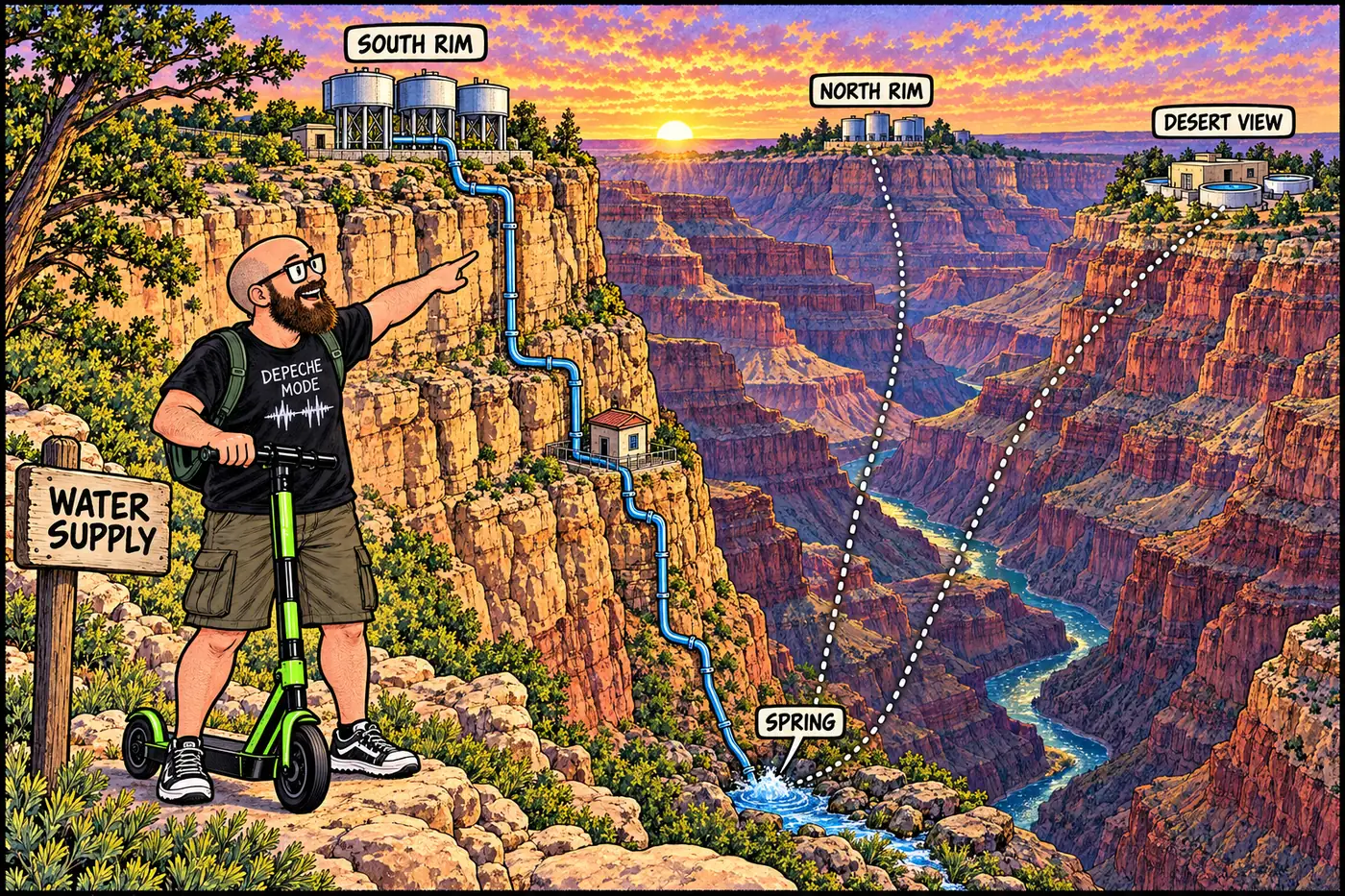
The Grand Canyon has one of the biggest rivers in the American West running through the bottom of it, and for its first three decades as a tourist destination, the South Rim's drinking water arrived by train. More than a century later, virtually the entire park still runs on one spring, moved by pipe across some of the most hostile terrain the National Park Service maintains.
The short version
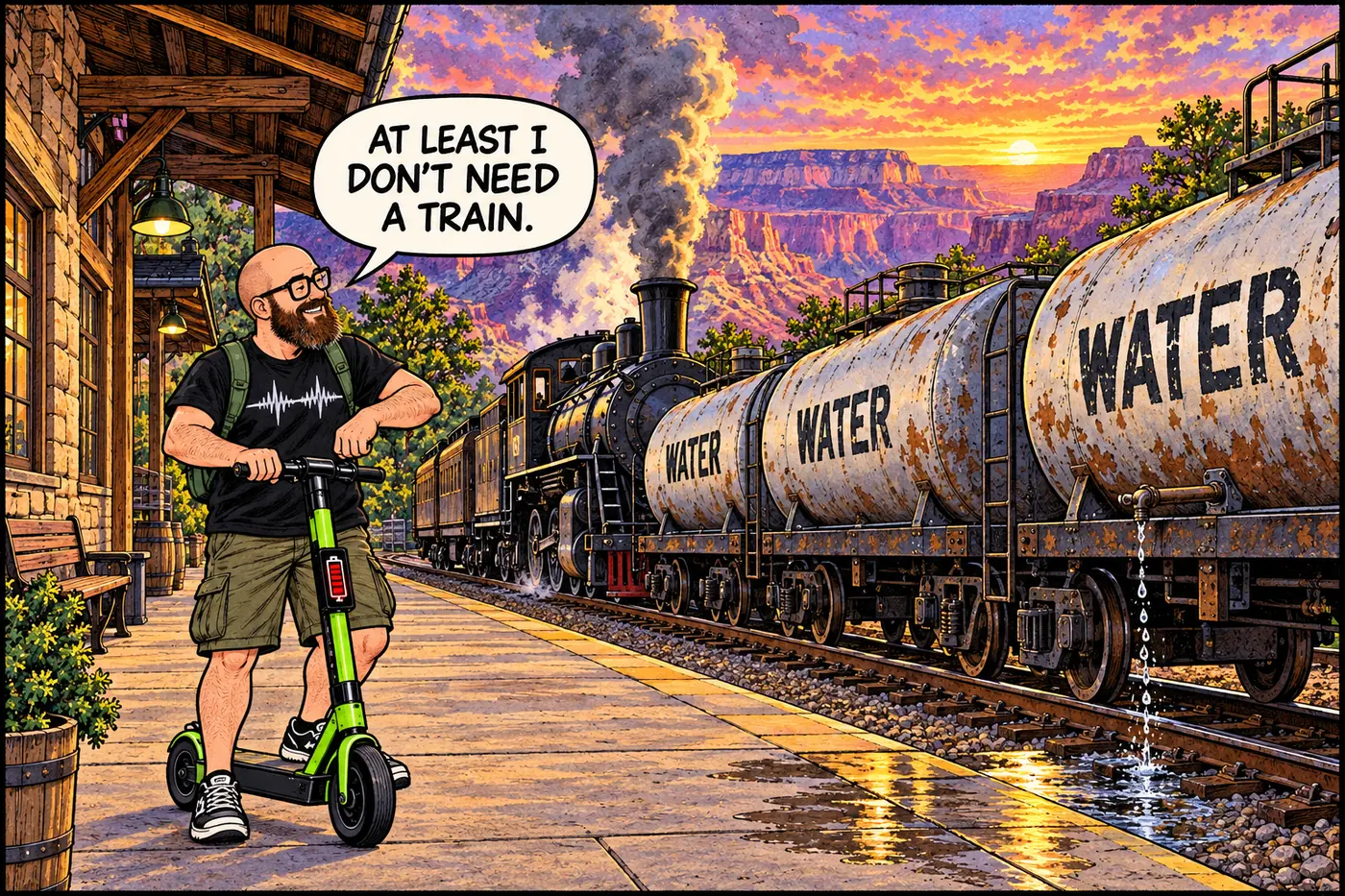
- The South Rim has no usable natural water source of its own; from 1901 to 1932 every drop was hauled in by rail tank car.
- A gravity pipeline from Indian Gardens (now Havasupai Gardens) springs took over in 1932. That wasn’t enough either — the Transcanyon Pipeline from Roaring Springs replaced it starting in 1965 and still supplies almost the whole park today. Full story: the Transcanyon Waterline dossier.
- Roaring Springs does double duty: one branch runs to the South Rim via the Transcanyon line, and a separate, older pump system carries water straight up to the North Rim — a system NPS just approved rebuilding.
- South Rim, North Rim, Desert View, and Phantom Ranch each have their own storage tanks and their own wastewater treatment plant; none share sewage infrastructure.
- NPS’s FY2025 numbers count 3 water systems and 15 wastewater systems parkwide, and rank Water Systems as the single largest deferred-maintenance category in the park: $359 million of a $1.1 billion backlog.
- Nine water/wastewater sites — tanks, plants, lagoons, the Roaring Springs pumphouse — are closed to the public under the current Superintendent’s Compendium, almost all for the same reason: it’s a working public water supply.
Water by train
Grand Canyon Village sits on limestone, and the water table underneath it is too deep to reach by well — Sanford Rowe’s spring-fed well, dug in the early 1890s, was the only viable exception for miles, and it wasn’t enough for a growing village. So the Atchison, Topeka and Santa Fe Railway, which built the depot, the hotels, and eventually the whole utility system, shipped water in on the same trains that brought the tourists — tank cars from Del Rio, 125 miles south, until the railroad found a cheaper source at a Flagstaff reservoir in the mid-1910s.
It was never close to enough. By 1917 the village burned through 10,000 gallons a day on average and up to 100,000 on peak summer days, at rising cost — $3.09 per 1,000 gallons by 1928. Every hotel, tank, and fire hydrant depended on a train schedule. Rail delivery fed a small tank farm behind El Tovar: a 300,000-gallon steel tank from 1905, joined by an 800,000-gallon tank and a 150,000-gallon elevated fire tank in 1927.
Wastewater, before “sustainability” was a word
Getting water in was only half the job. The railroad’s first sewage plant, built near the rail yard around 1905-1906, produced effluent fit for little beyond dumping in a wash, and by the early 1920s overflow into Bright Angel Wash was a public-health problem serious enough to draw in federal inspectors.
One of them, U.S. Public Health Service engineer H.B. Hommon, designed something better: an activated-sludge plant that opened in 1926 and reclaimed 99 percent of the village’s wastewater in its first year — clean enough for locomotive boilers, El Tovar’s lawns, and public toilets. It ran until March 1972, when a new plant took over. The 1926 plant still stands as a closed historic site; see the 1926 Wastewater Treatment Plant dossier.
Gravity finally wins, sort of
In 1927 the railroad tested the flow at Indian Gardens, a spring-fed oasis 4½ miles down the Bright Angel Trail, and found it could supply roughly 576,000 gallons a day. A year of construction later, a 6-inch pipeline began carrying that water 3,400 feet up to the rim, going into service August 26, 1932 — the South Rim’s first real escape from the rail schedule.
Still not enough. By 1954 the railroad had left the tourism business and donated its entire utility system — valued at $1.1 million, covering the Village plus infrastructure at Phantom Ranch, Hermit’s Rest, Yaki Point, and Desert View — to NPS. To buy time, NPS built a tank farm near Mather Point: two 2-million-gallon tanks plus a 30,000-gallon tank in 1957, then three 3-million-gallon tanks in 1961. Detail on that tank farm and its current closure is in the South Rim Water Tanks dossier.
One spring for (almost) the whole park
The real fix was Roaring Springs, a year-round spring below the North Rim, and the 12.5-mile pipeline built to move its water across the inner canyon to the South Rim. Construction started in 1965, survived a near-catastrophic flood before it was even finished, and wasn’t complete until 1970, delivering about 190 million gallons a year. That system’s decades of failures, its $208 million ongoing rebuild, and the flash flood that tore out 40 percent of the old line on August 29, 2026 are covered in full in the Transcanyon Waterline dossier and the Roaring Springs dossier — not repeated here.
Demand already outgrew the pipeline’s 190-million-gallon capacity by 1980, prompting a 13-million-gallon storage tank and pump upgrades in the mid-1980s. In 1986-87 NPS drilled a new borehole route bypassing the original Indian Gardens pipe, which kept freezing every winter. That 1932 line still runs today, gravity-fed, serving the 1.5-Mile and 3-Mile Resthouses — ninety-plus years after it opened.
South Rim, North Rim, Desert View, Phantom Ranch
Each developed area runs its own tanks and treatment plant. South Rim’s wastewater plant is the 1972 original — a 0.5-million-gallon-per-day activated-sludge system NPS now calls outdated, inefficient, and overloaded. It’s being replaced on the same site with a 0.75-million-gallon-per-day membrane bioreactor plant: reuse-grade effluent, aerobic biosolids digestion, UV-plus-chlorine disinfection. The Great American Outdoors Act’s Legacy Restoration Fund is paying $40,456,000 for the plant alone (FY2023), on top of the separate $208 million Transcanyon rebuild. More at the South Rim Wastewater Treatment dossier.
North Rim draws off the same spring but through a separate, older pump system running straight up from Roaring Springs, independent of the Transcanyon line — an arrangement NPS confirms continues after the rebuild. That system is its own aging problem: NPS calls it old, breakdown-prone, and dangerous to repair. In May 2026 NPS approved a Legacy Restoration Fund rehab — new boreholes, a new treatment plant, more tanks, pumphouse work — targeting spring 2027 construction. Detail at the North Rim Water Infrastructure dossier.
Desert View, about 23 miles east of the Village, has its own fenced wastewater plant and lagoons, closed like every other treatment site in the park. How its drinking water gets there — an extension of the South Rim main, or something separate — isn’t clear from the public record found this session. Documented gap, not a guess. More at the Desert View Wastewater dossier.
Phantom Ranch, at the bottom of the canyon, has managed its own water and waste since the start. Its original reservoir dates to 1922, part of the Mary Colter-designed camp the Fred Harvey Company built there; a 1929 sewer system followed, with stone pylons still standing along the Colorado River’s north bank, until a 1957 flood destroyed the pipelines and forced a rebuild. The current plant, installed in the early 1980s, was never sized for today’s rim-to-rim traffic — by 2022 it ran at roughly half the capacity needed to meet Arizona standards, prompting a two-phase, helicopter-supported repair beginning that February. The plant and its raised drying beds sit closed just north of the Colorado River. More at Inner Canyon Water Distribution and Phantom Ranch Utilities.
The money problem
NPS’s FY2025 real-property inventory counts 3 water systems and 15 wastewater systems across the park — likely individual plants, lagoons, and lift stations counted as separate assets rather than one per developed area. Water Systems is the single largest deferred-maintenance category in the park’s $1.1 billion backlog, at $359 million; Wastewater Systems adds $83 million more. This is a park built almost entirely on imported water, and the bill has been accumulating for a hundred years.
The only viable well for miles; not enough to supply a growing village.
Every gallon on the South Rim arrives by train, first from Del Rio, later from Flagstaff.
A pioneering activated-sludge plant reclaims 99% of the village's wastewater in its first year.
A 6-inch gravity line finally frees the South Rim from the rail schedule.
NPS buys time with millions of gallons of new storage while planning a real fix.
Roaring Springs water crosses the canyon to the South Rim; full story in its own dossier.
Replaces the 1926 plant; still operating today, now itself slated for replacement.
Phantom Ranch WWTP repairs, a $208M Transcanyon rebuild, a new South Rim WWTP, and an approved North Rim overhaul are all underway or funded.
What’s actually off-limits (and why)
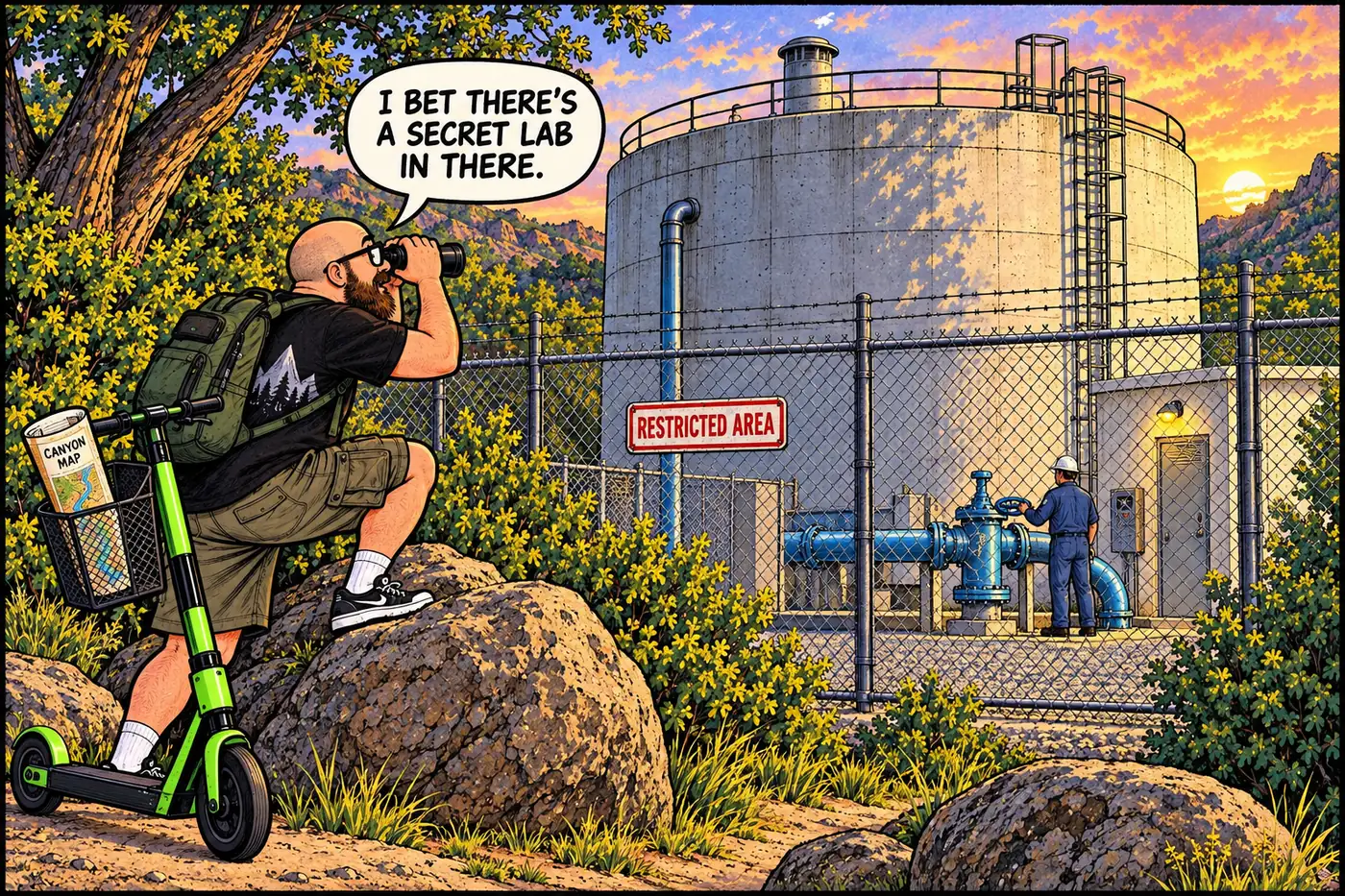
Nine water and wastewater sites are closed to the public under the current Superintendent’s Compendium (effective June 16, 2026), all under 36 CFR § 1.5(a)(2): the South Rim Wastewater Treatment Plant and its lagoons; the South Rim Water Tanks; the Desert View Wastewater Treatment Plant, lagoons, and access road; the 1926 Wastewater Treatment Plant (300-foot public buffer); the Phantom Ranch Wastewater Treatment Plant and its raised drying beds; the Roaring Springs Pumphouse and helistop (100-foot buffer on all water infrastructure); the North Rim Wastewater Treatment Plant and lagoons; and the North Rim Water Tanks.
The reasoning is nearly identical across all nine, citing Arizona Department of Environmental Quality hazard standards directly: this is a live public water supply and active sewage infrastructure. A fenced tank farm and a locked pump house are what you’d expect to find protecting drinking water for several thousand residents and several million annual visitors — not evidence of anything hidden behind the fence.
Sources
- Grand Canyon Village Utilities, HAER No. AZ-76 — Library of Congress / National Park Service Historic American Engineering Record
- Cross Canyon Corridor Historic District, National Register of Historic Places Registration Form (2013) — National Park Service
- Transcanyon Waterline (TCWL) Project — Grand Canyon National Park (NPS)
- Grand Canyon National Park prepares for $208 million multi-year repair to Transcanyon Waterline — NPS News Release
- National Park Service Approves Plan to Modernize Water System Serving the North Rim and Inner Canyon — NPS News Release, May 28, 2026
- Grand Canyon National Park Announces Recovery and Repair Plan Following Flash Flood — NPS News Release, September 8, 2026
- South Rim Wastewater Treatment Plant, Industry Days Briefing (GRCA-257282) — National Park Service
- List of Legacy Restoration Fund (LRF) Projects by State, FY2021-2024 — National Park Service
- Infrastructure Fact Sheet: Grand Canyon National Park (FY2025) — National Park Service
- Phantom Ranch Wastewater Treatment Plant Repairs Begin — DesertUSA (reproducing NPS release)
- Grand Canyon National Park Superintendent's Compendium, effective June 16, 2026 — National Park Service