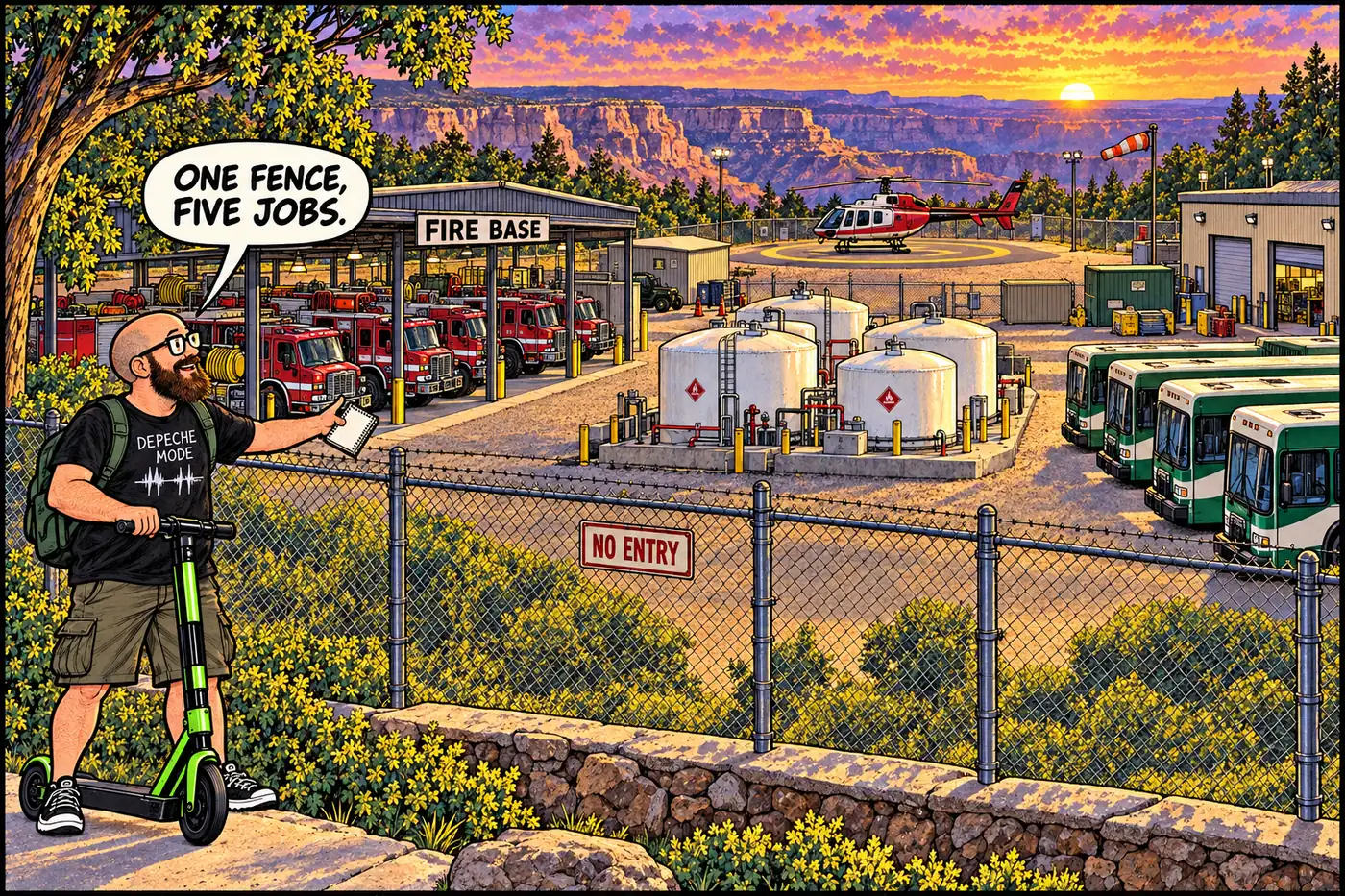
Behind a chain-link fence a few hundred feet off the shuttle road sits the least photographed piece of Grand Canyon infrastructure: the compound that fights the park's fires. It shares a fence line with the maintenance yard, the fuel farm, and the bus barn, and the public record documents what the crews there have done a lot better than it documents the building they work out of.
The short version
- The Wildland Fire Base is part of a single fenced government compound on the South Rim that also holds the NPS Maintenance Operations Center, fueling facilities, the Shuttle Bus compound, and the Aviation Operations Area — all closed to the public under one Superintendent’s Compendium entry.
- Grand Canyon’s fire and aviation program covers the entire 1.2-million-acre park, not just this one facility.
- The park’s helitack crew won a national wildfire EMS award in 2016 for short-haul rescues of injured firefighters — one of the more dangerous jobs in the fire program.
- The 2025 Dragon Bravo Fire, the park’s most consequential recent wildfire, burned on the North Rim, nowhere near this South Rim compound — it destroyed the Grand Canyon Lodge and 113 other buildings before crews stopped it.
- What’s publicly documented is mostly the fire program: named fires, staffing changes, awards. What’s not published is a description of the fire base building itself, and that’s consistent with the whole compound being fenced off from public view.
One fence, five functions
Grand Canyon’s Superintendent’s Compendium — the park’s annual rulebook — doesn’t give the Wildland Fire Base its own separate closure. It’s bundled into a single restricted zone with four other operational functions: the Maintenance Operations Center, fueling facilities, the Shuttle Bus compound (see South Rim shuttle operations), and the Aviation Operations Area. The compendium closes the whole thing at once, “either enclosed by chain-link fencing or public postings along the forested boundary,” and separately closes public access on Shuttle Bus Road itself beyond a point 250 feet south of its intersection with Center Road.
That’s a working government yard, not a single building — fuel trucks, maintenance bays, a fleet of shuttle buses, aircraft support, and wildland fire apparatus all sharing infrastructure and, evidently, a security perimeter. NPS gives one reason for keeping the public out of all of it: protecting government property and files, and “employee safety.”
What the program actually does
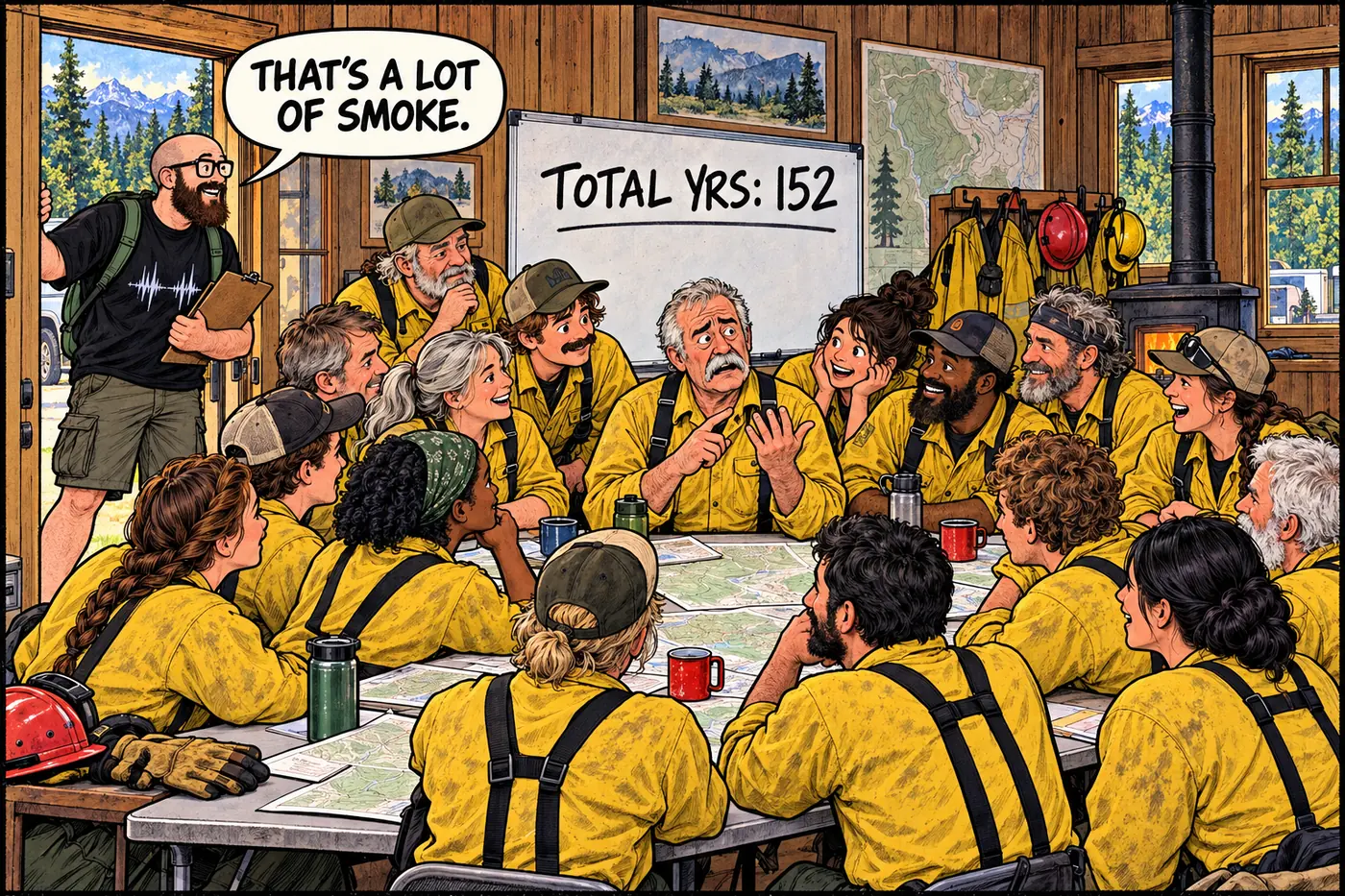
Public records document Grand Canyon’s fire program far more than its facility. The park’s fire and aviation branch covers the park’s full 1.2 million acres. Lucas Minton, who took over as Branch Chief of Fire and Aviation in 2020, had already worked at Grand Canyon once before — as an engine captain from 2001 to 2006 — before returning with 24 years of total fire and leadership experience across hotshot, smokejumper, engine crew, hand crew, and helitack assignments. That career path is normal for the trade: a 2012 program retrospective found that 16 past and present Grand Canyon fire managers, gathered for a single field trip, represented a combined 152 years of fire experience at this one park.
The park runs both suppression and prescribed/managed fire, a balance NPS describes in its own philosophy for the program: fire “has been a part of the Colorado Plateau ecosystem for thousands of years,” but for most of the 20th century it “was feared and aggressively suppressed” — a policy that let vegetation build up across the plateau. Today’s fire managers use monitoring data and fire-ecology research, working with wildlife biologists, vegetation ecologists, and historic-preservation staff, to decide when fire should be allowed to do ecological work and when it needs to be stopped.
2014 is a good year to see both halves of that job in action. The Galahad Fire, discovered May 23 on the North Rim near Kanabownits Cabin, burned 6,137 acres at mostly low-to-moderate intensity (flame lengths of 6 to 12 inches) before being declared out July 15. A second lightning fire, the Kanabownits Fire, ignited July 8 and burned 287 acres before crews declared it out September 3. Tactics that year included hand-line construction, hand ignitions, structure wrapping, and helicopter water drops — the same toolkit any wildland fire program uses, just applied inside a national park with historic structures to protect.
The most physically demanding part of the job is short-haul rescue: extracting injured firefighters by helicopter when there’s no safe place to land. Grand Canyon’s helitack crew won the 2015 National Wildfire Coordinating Group Wildfire EMS Award — presented in 2016 by then-NPS Director Jonathan Jarvis — for exactly that work. In the 2015 season alone, the crew logged 149 days away from their home station as the region’s primary medical and short-haul helicopter for large wildfires, on top of two search-and-rescue calls.
Dragon Bravo, and why it’s a North Rim story
The single biggest fire event in the park’s recent history didn’t touch this South Rim compound at all. The Dragon Bravo Fire started July 4, 2025, from a lightning strike on the Kaibab Plateau, and for its first week burned as a fairly ordinary Grand Canyon wildland fire. Then, on the evening of July 11, unusually strong northwest wind gusts pushed it past containment lines. By the time crews got it fully contained on September 28, it had burned 149,399 acres total — 71,129 of them inside Grand Canyon National Park — and destroyed 114 buildings, including the historic Grand Canyon Lodge, 80 guest cabins, and 24 buildings (11 of them historic) in the North Rim’s headquarters historic district.
A post-fire Burned Area Emergency Response (BAER) assessment modeled runoff increases of two to eight times normal upstream of Phantom Creek, and one to two times normal downstream toward the Colorado River — serious numbers, though the team noted infrastructure in those drainages was built above the modeled floodplains. BAER crews wrote up 15 emergency-stabilization treatments and 6 longer-term rehabilitation treatments covering trails, hazard trees, water systems, and invasive-species control. The North Rim’s developed area stayed closed for the rest of the 2025 season; it reopened for day use and limited backcountry access on May 15, 2026, with the campground following on June 1 and overnight lodging still unavailable for the season as of this writing. (That inner-canyon recovery timeline is separate from the unrelated August 2025 Bright Angel Canyon flash flood covered elsewhere on this site.)
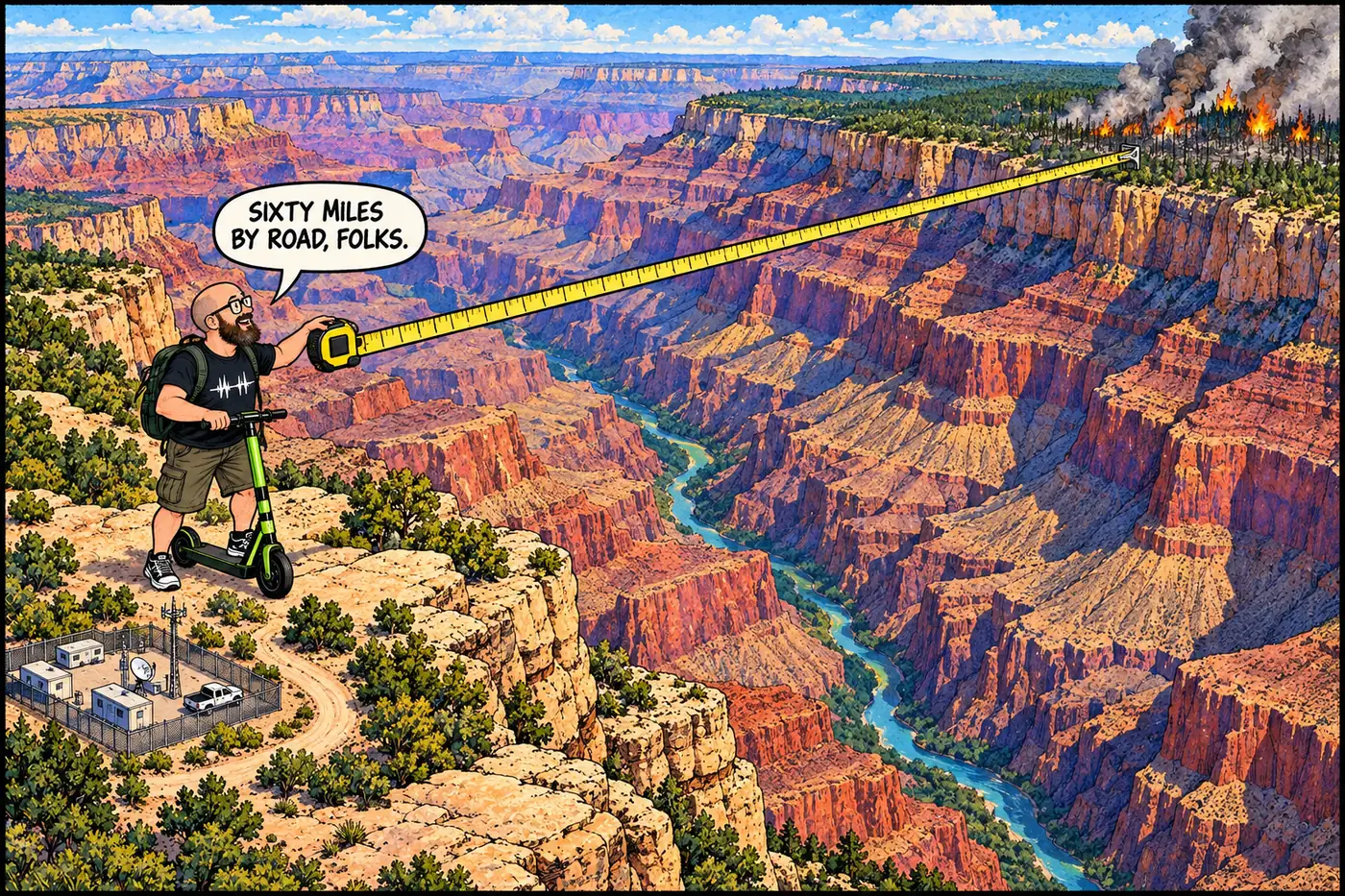
Dragon Bravo is the fire this generation of Grand Canyon staff will measure every other fire against. It’s also a reminder that “wildland fire base” and “the place a specific fire burns” are two different things — the base is infrastructure; Dragon Bravo was 71,000-plus acres of North Rim forest, more than 60 miles from the South Rim compound by any road.
Like most of the American Southwest, Grand Canyon spent most of the 1900s under an aggressive full-suppression policy, letting fuel accumulate on the plateau.
Lucas Minton, later Branch Chief of Fire and Aviation, works his first Grand Canyon fire season as an engine captain.
A program retrospective field trip brings together 16 past and present GRCA fire managers with a combined 152 years of park fire experience.
Two North Rim lightning fires (6,137 and 287 acres) are managed with hand-line, hand ignitions, structure wrapping, and helicopter drops.
Grand Canyon's helitack crew logs 149 days away from base as the region's primary short-haul rescue helicopter, then wins the NWCG Wildfire EMS Award.
He comes back to lead fire and aviation for the full 1.2-million-acre park.
A lightning-caused North Rim fire, pushed by freak wind gusts on July 11, burns 71,129 acres of park land and destroys the Grand Canyon Lodge and 113 other buildings before full containment on September 28.
What’s actually off-limits (and why)
The Superintendent’s Compendium closes the whole South Rim operations compound — Maintenance Operations Center, fueling facilities, Shuttle Bus compound, Wildland Fire Base, and Aviation Operations Area — to public entry, along with the dirt shoulder of Shuttle Bus Road beyond a marked point near its intersection with Center Road. The area is enclosed by chain-link fencing or signed along its forested boundary, under 36 CFR § 1.5(a)(2). NPS’s stated reason is protecting government property and files, and keeping employees safe — this is a working yard with fuel trucks, heavy equipment, and, during fire season, apparatus staging for wildland engines and aircraft support. It’s not a mystery installation; it’s the unglamorous logistics tail every national park needs and few visitors ever think about.
Sources
- Grand Canyon National Park Superintendent's Compendium, effective June 16, 2026 — National Park Service
- Fire Management — Grand Canyon National Park, National Park Service
- Grand Canyon National Park Welcomes New Branch Chief of Fire and Aviation — National Park Service
- Wildland Fire: Visiting Our Past, Building Our Future (GRCA) — National Park Service
- Managing Wildfires in a Fire-Adapted Landscape, GRCA 2014 — National Park Service
- Grand Canyon Helitack Receives Prestigious National EMS Award — National Park Service
- Dragon Bravo Fire BAER Executive Summary — National Park Service
- Status of the North Rim — Grand Canyon National Park, National Park Service