The Sacred Number
You remember Channel 3.
Nobody watched Channel 3.
Channel 3 was where the television went when it needed to become something else.
Want to play a game? Channel 3.
Want the VCR? Channel 3.
Want Dad to say, “Who changed the TV?” from three rooms away? Any channel except 3.
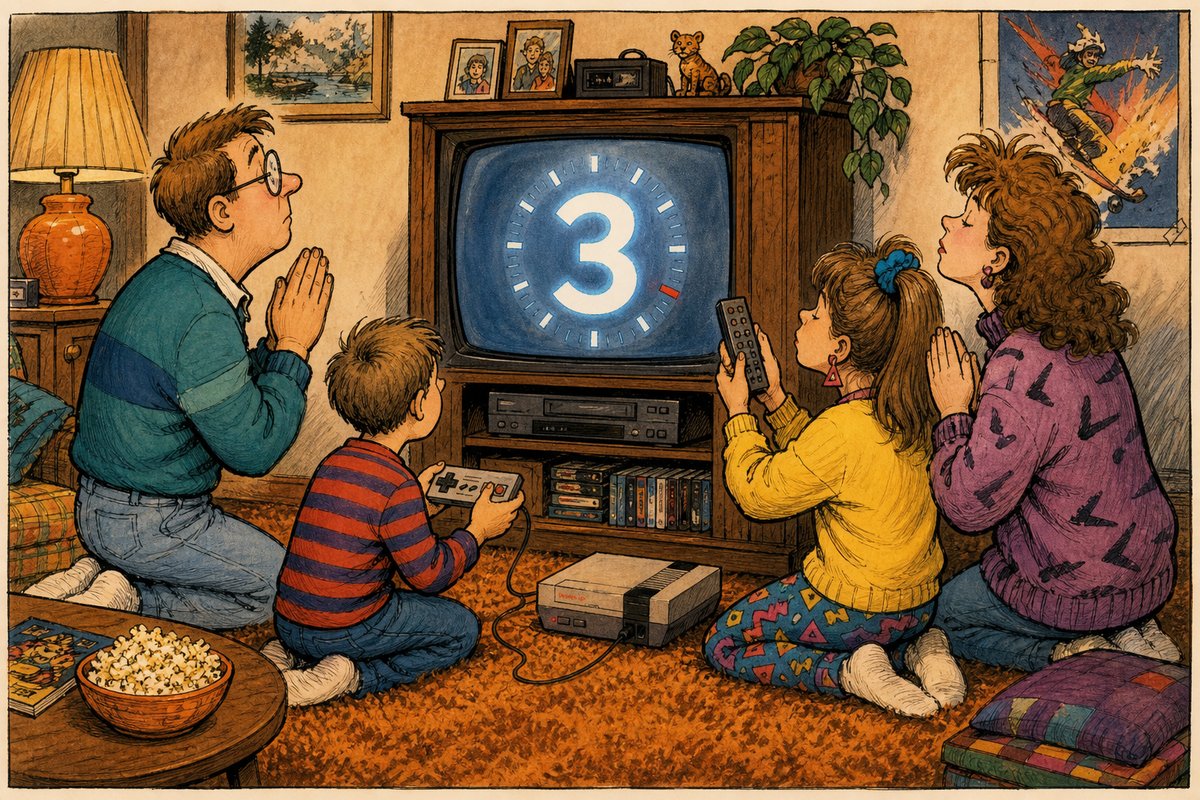
Input selection, before televisions admitted they had inputs.
The ritual had steps:
- Turn on the TV.
- Turn on the mystery box.
- Put the TV on 3.
- Jiggle something.
- If nothing happens, try 4 and question every decision your family has made.
Here is what we thought Channel 3 was:
- a secret channel reserved for machines
- the place video games lived when asleep
- proof that the Nintendo was technically a television station
That last one was weirdly close.
Older televisions often had only an antenna input. No HDMI. No yellow-red-white jacks. Just one round connector expecting a radio-frequency television signal.
So the VCR or game console used an RF modulator. It took picture and sound and packaged them into a tiny pretend broadcast on VHF Channel 3 or Channel 4. The television tuned it exactly like a station, except the “transmitter” was a cable six feet away and the programming director was a kid holding a controller with sticky buttons.
   [ GAME CONSOLE ]
          |
          | picture + sound
          v
     +-----------+
     | RF MAGIC  |  --pretend TV station-->
     |  CH 3/4   |==========================[ CRT ]
     +-----------+                            ( 3 )
Why 3 or 4?
They were adjacent low-band channels that RF hardware could generate cheaply, and the switch let you choose whichever local channel was not already occupied. If a real station used 3, you moved the console to 4. If both were ugly, you learned the ancient repair technique of moving the wire until snow stopped eating Mario.
Modern TVs call this Source, Input, or HDMI 2.
Cleaner? Yes.
But no modern child has ever felt the raw authority of shouting:
“DON’T CHANGE IT. THE GAME IS ON THREE.”