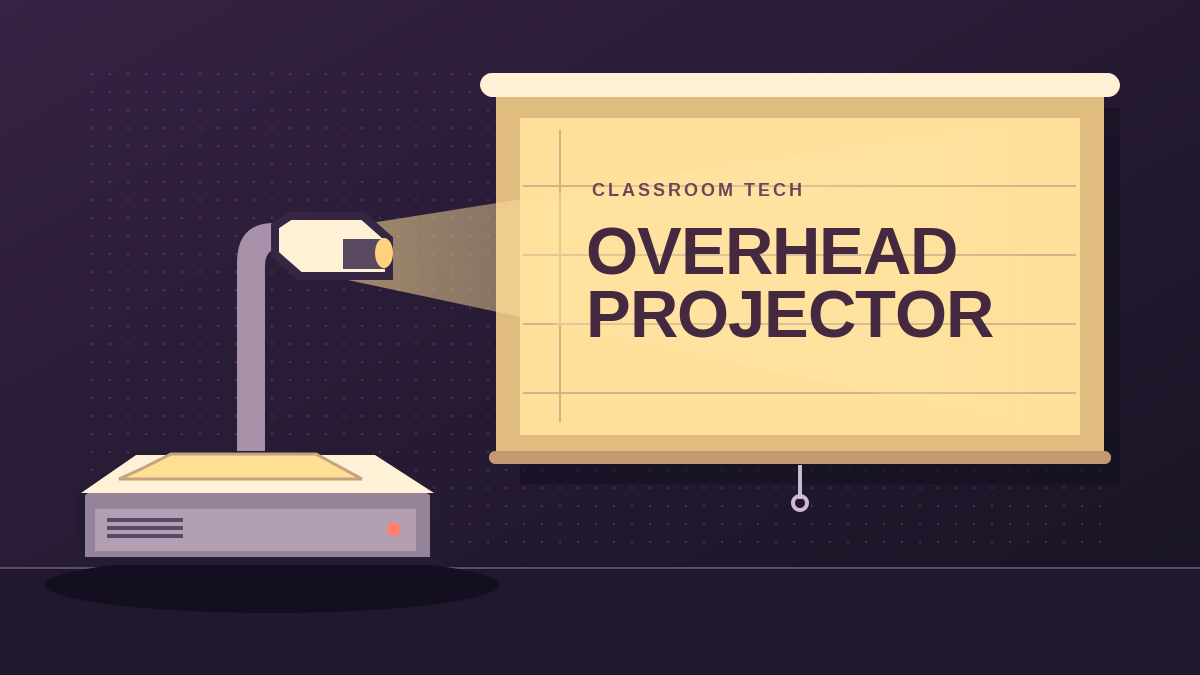
The room went dim. A machine on a cart began humming. On the wall, a math problem grew to the size of a garage door. Then a gigantic hand descended from the heavens and covered question seven.
Question seven was apparently classified.
For a certain kind of 90s classroom, the overhead projector was the closest school came to having a resident wizard. The wizard wore sensible shoes and wanted you to show your work.
The clear-plastic command center
A transparency was an ordinary worksheet promoted into military hardware. It could be stacked, annotated, slid sideways, or partly concealed beneath another sheet of paper.
That last move was devastating. The answers existed. They were right there, physically present in the room. Yet a rectangle of office supplies stood between you and forbidden knowledge.
The projector also transformed small gestures into public events. A pointing finger became a monument. A stray hair could look like a dangerous new symbol in algebra. Someone leaning over the glass briefly acquired a head large enough to address the United Nations.
The secret under the worksheet
The clever part was the Fresnel lens: a relatively thin sheet with concentric grooves. Purdue University’s physics demonstration explains that those angled surfaces provide the lens action without needing the bulk of a conventional curved lens.
In an overhead projector, it gathers and directs light toward the projecting lens assembly. The transparency sits in that light path, and the machine projects its pattern onto the screen. Those rings were doing actual optical work, rather than decorating the world’s least exciting turntable.
lamp + grooved lens
         |
   clear worksheet
         |
   projection optics ---> WALL
                           |
                    GIANT TEACHER FINGER
The entire arrangement made a piece of clear plastic feel improbably powerful. You could hold the lesson in one hand, but once it reached the wall, it had authority.
Please remain behind the paper
There was a particular suspense to a lesson revealed one strip at a time. Presentation software can animate a bullet point beautifully. It cannot quite reproduce the drama of an adult moving a blank sheet downward by three-quarters of an inch.
A document camera can now show a real page or object. Slides can preserve the material without a filing cabinet full of transparent sheets. Both are useful improvements. Neither requires the teacher to become a practical-effects artist whenever a student asks, “Which line?”
The old machine made the mechanism visible enough to wonder about. Light went in; enormous handwriting came out. Somewhere in the middle, a small plastic sheet had become the most important object in the building.
And question seven? Still covered. National security never sleeps.