One Appliance Refused to Panic
The gray telecom cabinet on the scooter route sent me straight back to a 90s power outage.
The television went black. The VCR forgot the time before the lights had finished flickering. Every digital clock began preparing its little 12:00 protest for later.
But the beige corded telephone still had a dial tone.
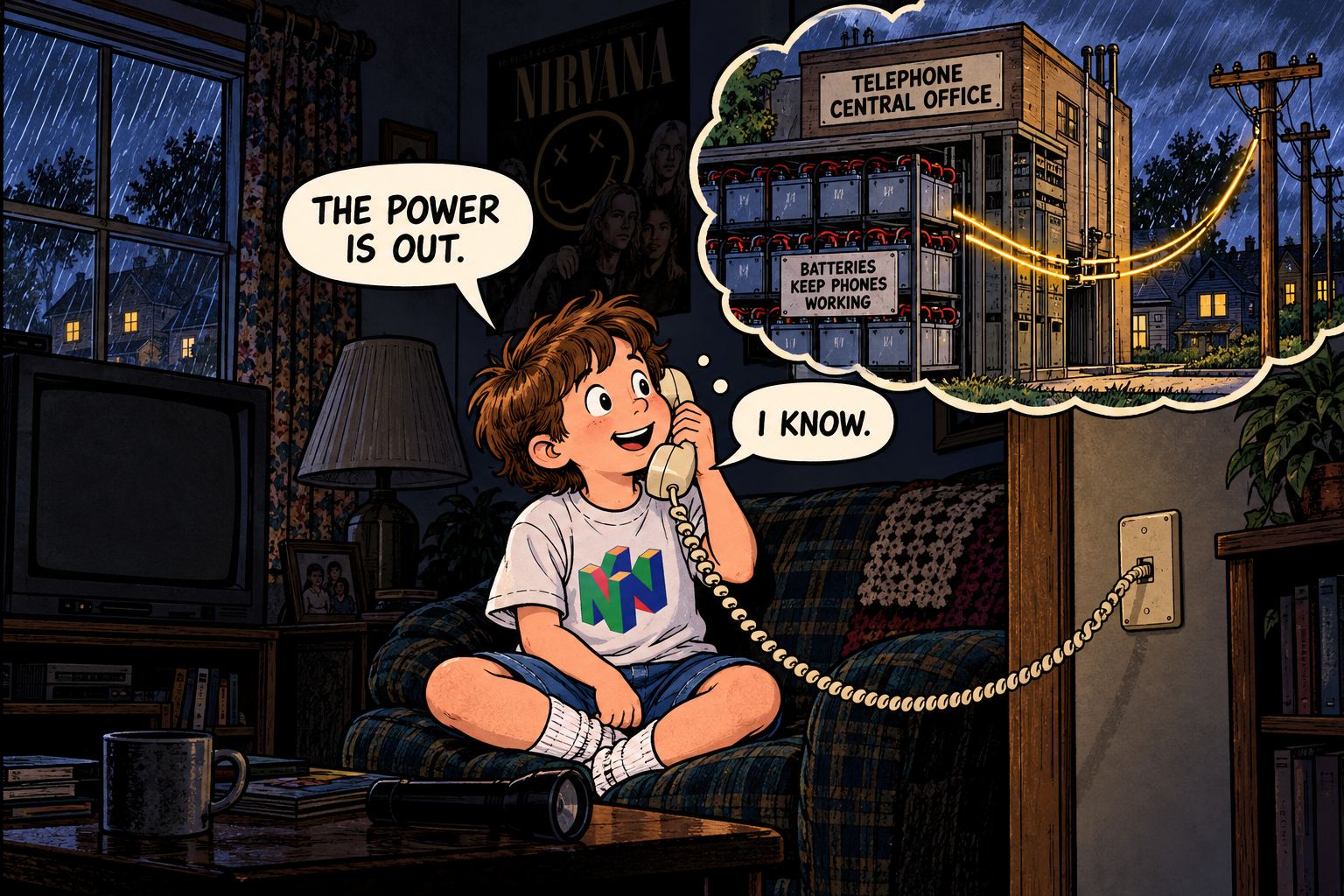
The entire house was dead, but the phone had apparently negotiated a separate treaty with electricity.
As a kid, I assumed telephones were exempt from weather. They had seniority. Maybe the phone company kept lightning in a jar and released a little whenever somebody lifted the receiver.
The ritual was simple:
- Turn on a lamp three times, as if the first two attempts lacked conviction.
- Confirm the television was also dead.
- Pick up the corded phone.
- Hear the dial tone and announce that civilization remained operational.
 [central-office batteries]
             |
        copper pair
             |
         wall jack
             |
      corded telephone
Traditional copper telephone service carried both the voice signal and enough electrical power for a basic corded set over the same wire pair. The telephone network supplied that line power from its own equipment, backed by batteries and generators at central offices. Your house could lose commercial power while the phone’s distant power source kept going.
There were limits. Downed lines still failed. Remote electronics could exhaust their batteries. And the giant cordless phone with the telescoping antenna needed a wall outlet, so it became a stylish brick while the cheap kitchen phone saved the day.
Verizon still explains the distinction plainly: copper voice service can operate with a corded phone during an outage, while fiber voice needs backup power at the customer’s optical terminal. The magic did not disappear; part of the battery moved to your end of the connection.
That old architecture taught a useful infrastructure lesson before I knew the word infrastructure: independence matters. A service can survive your local failure when its power, control, and backup live somewhere else. It can also fail in surprising ways when one hidden dependency is not actually independent.
Modern phones contain more computing power than the entire beige tower in the next room, but they still need charging, towers, backhaul, and working networks.
The old kitchen phone needed one copper pair and absolutely no respect for the darkness.