The Digital Wedding Book of Doom
It was 1997, and my GeoCities homepage looked like a disco ball had exploded inside a computer lab. There were spinning skull GIFs, a marquee banner announcing “WELCOME TO MY HOME,” and a hit counter that ticked up with the solemnity of a church bell. But the crown jewel of this digital estate was not the background music (a MIDI file of the Titanic theme) or the guestbook link pulsing in neon green at the bottom of the screen.
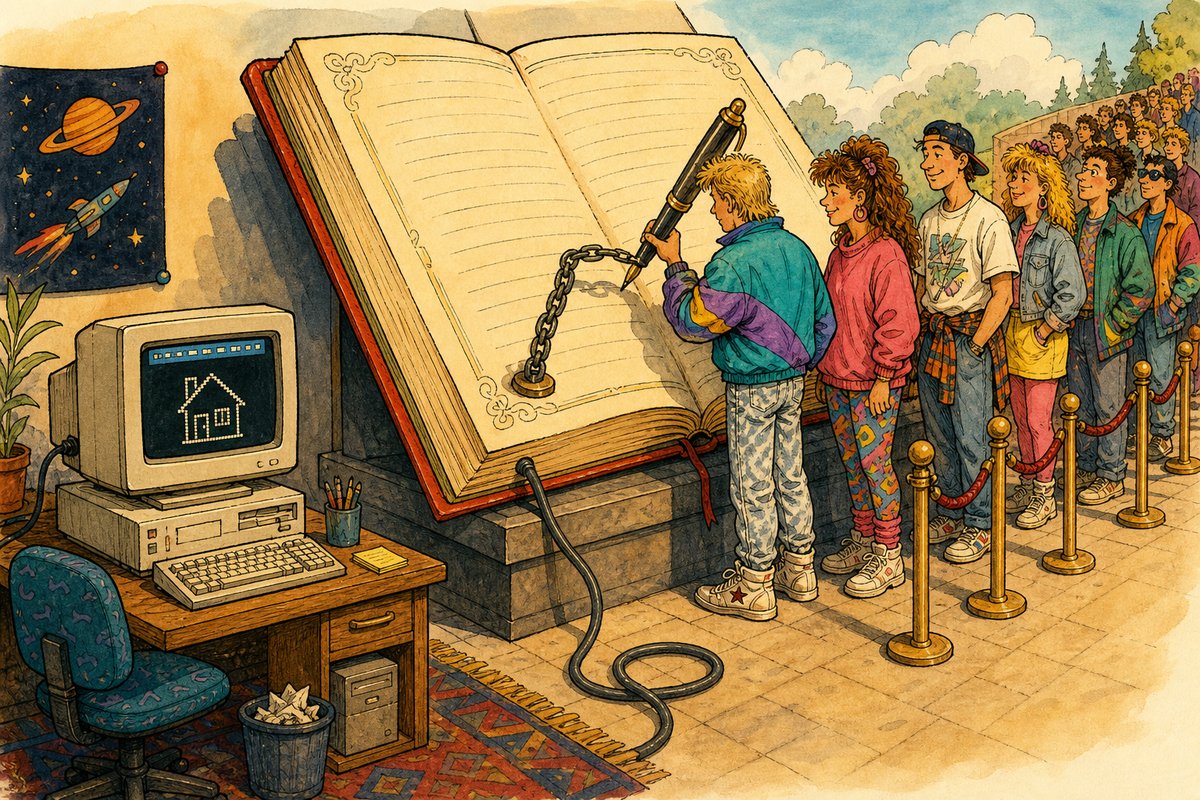
One-panel evidence: the website had no comments section, so strangers wrote in a public digital wedding book.
The guestbook was where we went to sign our names, usually accompanied by excessive use of uppercase letters and wavy underlines. It was a public forum for strangers who found my site via a Yahoo search for “cool stuff.” We treated it like a celebrity autograph album, desperate for validation from people whose IP addresses we could barely pronounce.
The ritual was precise and required the patience of a saint:
- Click the link labeled “Sign My Guestbook” (it was always blue, underlined, and hovered ominously).
- Type your name in the first box, often using Comic Sans or Courier New to look official.
- Scribble a message like “Cool site! Visit mine too!” followed by your URL.
- Hit submit and stare at the loading bar until it disappeared.
- Refresh the main page to see if your entry had actually appeared.
We waited for that refresh with bated breath. If our name was there, we felt seen. If it wasn’t, we assumed the server had rejected us due to poor formatting or a temporary glitch in the matrix. We didn’t know what happened in between; we just knew that this public ledger of digital ink was the only way people could talk back to us across the vast, silent internet.
Here is what we thought: The guestbook was a magical portal where our words floated through the ether and landed permanently on the screen for all eternity. We imagined it as a physical book sitting on a desk somewhere in the cloud, with invisible hands writing in it. We didn’t know about databases or servers; we just knew that if we wrote “KISS ME” in big letters, someone, somewhere, would see it and feel our presence. It was a way of saying, “I exist, and you are witnessing my existence,” which is basically the entire point of social media before we had algorithms to curate our lives for us.
       .   :  .     .    :   .
    :      .  *  .    :   .
  *  .  SIGN MY GUESTBOOK  .
    .   :  .     .    :   .
       '   "  '   "  '   "
The technology behind this magic was surprisingly mundane. Guestbooks used server-side scripts to append visitor-submitted names and messages to a public page. That meant when we clicked submit, our text was sent away to the website owner’s computer, where a simple program stitched it onto the end of an HTML file. There were no databases in the modern sense; just a long list of strings being added one by one. It was efficient, crude, and utterly reliable for its time. We didn’t need search functions or user accounts; we just needed a place to leave our mark before the page refreshed.
So why did it feel so profound? Because in an era before comments sections and reply threads, the guestbook was a monologue that felt like a dialogue. It was a shared space where everyone wrote at once, creating a chaotic tapestry of “LMAO,” “Nice pics,” and “Check out my dragon art.” We weren’t just reading; we were participating in a collective digital scrapbook.
Nowadays, if you want to leave a comment on someone’s post, you have to log in, verify your email, agree to the terms of service, and wait for approval. Back then, you just typed “Cool!” and hit enter. It was faster, messier, and somehow more honest. We didn’t care about engagement metrics or algorithmic visibility. We cared that our name was on the page, even if only for an hour before someone else signed over it.
It turns out we were just building the first version of Twitter, but with better fonts.