The Roaming Signal of Truth
The ritual began with the sacred click of the base station. You lifted the heavy, beige handset from its cradle, feeling the satisfying weight of plastic that promised durability against accidental drops. The green LED blinked once, a beacon of connectivity in the dim hallway. You pressed the power button, and the familiar hum of the internal antenna warmed up. This was not merely a phone; it was your ticket to escape the tyranny of the cord.
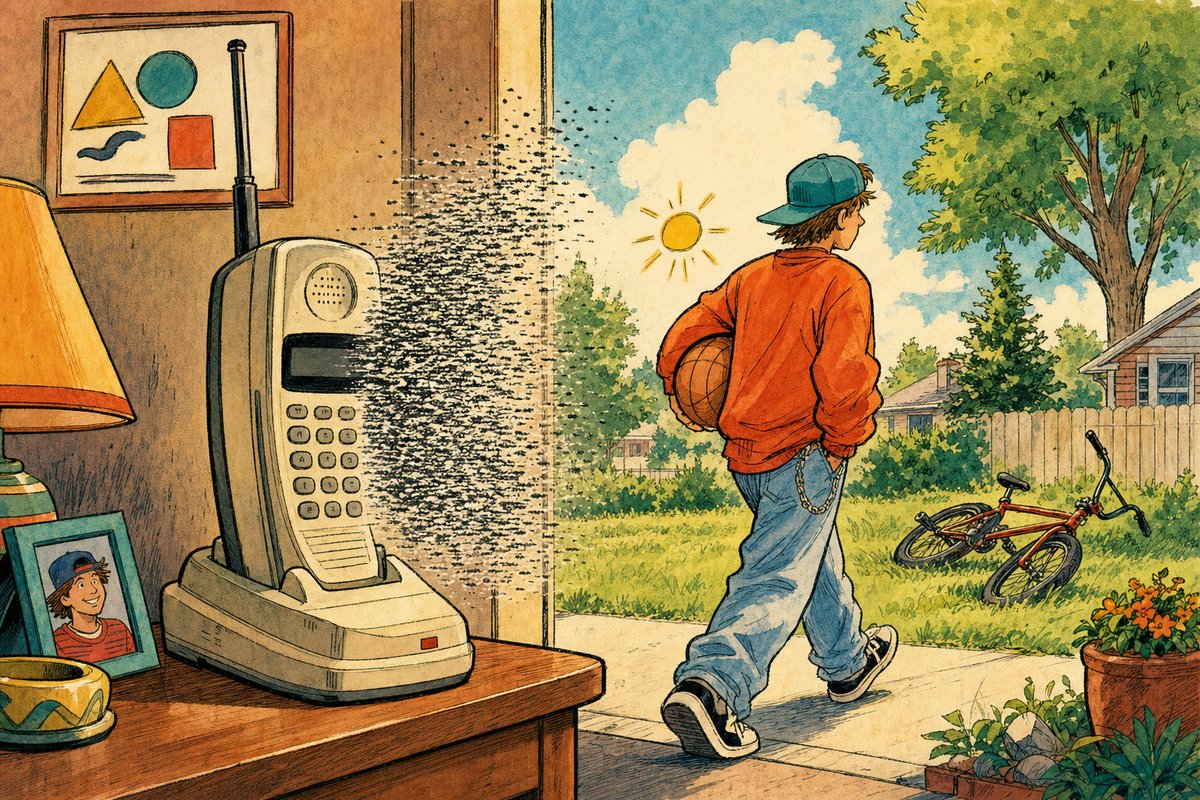
One-panel evidence: freedom meant walking into the yard while the call slowly dissolved into static.
You stepped out the back door. The yard stretched before you, a vast expanse of grass and possibility. You dialed your best friend’s house, or perhaps just held the line open to hear the dial tone breathe. Step one: walk past the patio furniture. Step two: navigate around the garden hose. Step three: approach the fence line. Step four: pause when the voice on the other end began to distort into robotic stutters. Step five: stand perfectly still, rotating slowly like a radar dish, trying to catch the signal’s tail as it drifted away from your head.
The joy was in the movement. You could pace the perimeter of your property while discussing Saturday morning cartoons or planning a skateboard trip. The cordless phone granted you mobility, but that mobility came with a strict geographical contract. As long as you stayed within earshot of the house, the conversation flowed smoothly. But venture too far, and the laws of physics would intervene.
Here is what we thought: The signal was alive. It had a mood. If I stood still, it worked; if I ran, it died. We believed our hair acted as a conduit for radio waves, or perhaps that the phone simply preferred us when we were calm and stationary. We treated the fading audio like a game of hot and cold, convinced that if we just angled our ear toward the roof, we could pull the voice back into clarity. We didn’t know about interference from microwave ovens or the simple fact that walls absorbed energy. We only knew that freedom had a range limit, and it was roughly thirty feet past the oak tree.
The experience was defined by its fragility. A sudden gust of wind might scatter the signal. A neighbor’s new television could interrupt our flow. We accepted these losses as part of the charm, a digital weather pattern we had to navigate. There was a specific tension in holding the phone high above your head while shouting, “Can you hear me now?” into the void, hoping the base station would catch your rising voice before it dissipated into the ether.
      .   :   .
    *  ^^^^  *
      |     |
      |     |
   ~~~|~~~~~|~~~
We were pioneers of limited-range communication, mastering the art of standing still while pretending to be free.