The Scream That Bought You Coffee
The ritual began with a singular, piercing shriek that could shatter sleep or interrupt dinner. It was 1994, and the fax machine in the hallway had just announced its presence. We didn’t run to it; we sauntered. This was not an urgent delivery like a pizza; this was a document from the office, likely a memo about parking rules or a spreadsheet that needed three columns added. The sound was unmistakable: a high-pitched dial tone followed by the rhythmic skrrrt-skrrrt of mechanical acceptance.
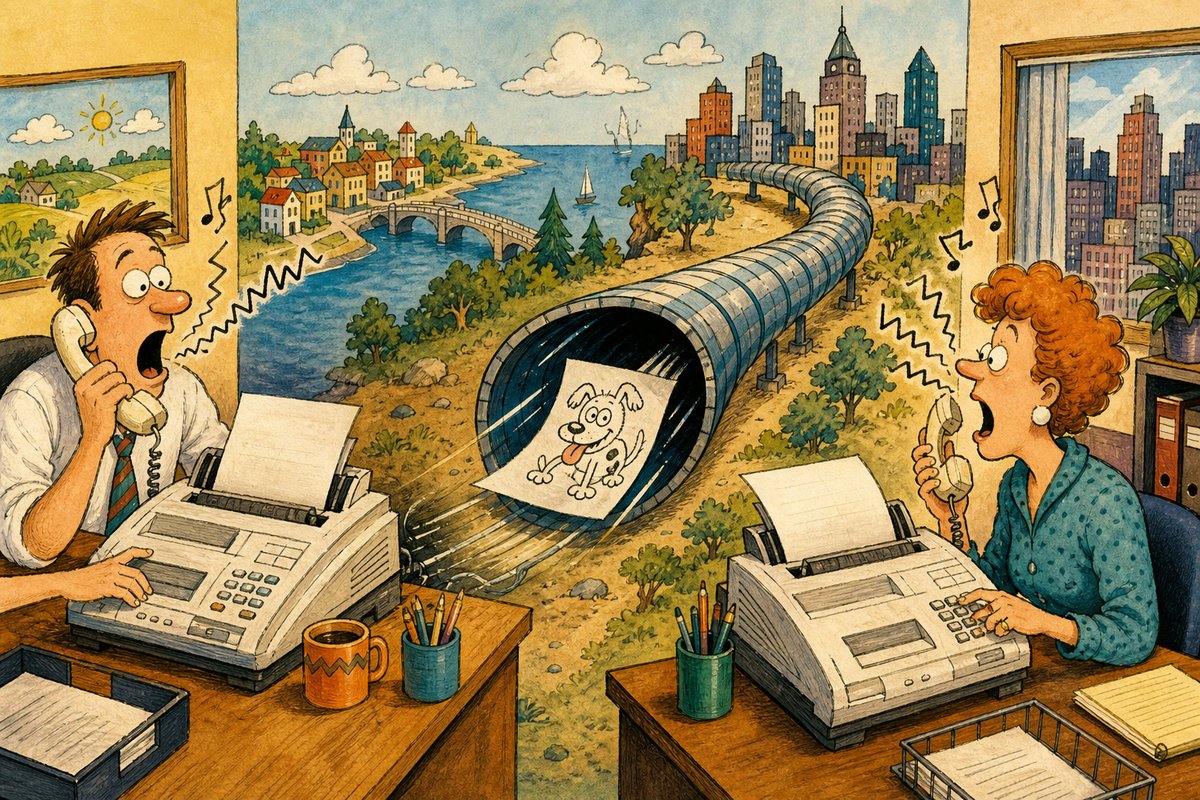
One-panel evidence: one office machine screamed into the phone and another slowly grew a warm paper copy.
I would shuffle out in socks, rubbing sleep from my eyes, while my younger brother argued over who got to be first to touch the warm paper. My mother would shout from the kitchen that I better not track toner dust on the carpet. The prize was a sheet of paper that felt strangely hot to the touch, smelling faintly of ozone and heated plastic. We held it up like a treasure map, squinting at the slightly grainy black-and-white text that slowly emerged from the machine’s belly. It was magic, mostly because we didn’t understand how two rooms could talk without wires hanging between them.
The process always followed these steps:
- Wait for the electronic scream to stop.
- Pull the hot paper out of the tray.
- Shake it gently to dislodge any stray toner bits.
- Read it before the ink fades or someone else snatches it away.
Here is what we thought: The machine was eating a voice and breathing out a picture. We imagined tiny mechanical arms inside, grabbing the sender’s paper with one claw and stamping our copy with another. It felt alive, almost predatory in its noise, but benevolent in its output. If the line was busy, it would beep twice and hang up, which we interpreted as the machine clearing its throat or deciding to nap. We respected the fax machine more than the television because the TV just sat there; the fax machine worked for us.
  ___________
 |  FAX ME   |
 |  NOW      |
 |___________|
    /       \
   /  SKRRT  \
  |   ~~~~    |
  |  HELLO?   |
   \         /
    \_______/
Here is what was really happening: The sending fax machine scanned the lines of the original document, encoding the image data into modem tones. These tones traveled over the phone network as electrical signals. At our end, the receiving machine decoded those tones and reconstructed the page line by line, heating a print head to leave dark marks on plain paper. It was a clever translation service, turning visual information into sound and back again without anyone needing to speak a word.
We never asked how it knew what color the ink should be, because we assumed all important documents were black and white. If someone sent a red stamp, it just looked like a darker gray smudge on our copy. We accepted this limitation as part of the charm, much like accepting that cereal milk turns blue in certain lighting. The fax machine didn’t need to be perfect; it needed to be loud enough to wake us up and fast enough to beat the breakfast rush.
Now we store documents in clouds, but I still miss the warm paper.