The Little Blue Window That Lied To Us All
The ritual began in the living room, usually after dinner or during that sacred window of time before the parents demanded silence for their soap operas. You would haul out the bulky beige console, a monolith of plastic that hummed with the heat of impending chaos. First came the game cartridge, the one you had beaten only once and were now determined to master forever without effort. Then came the Game Genie, a smaller, colorful rectangle that looked like it belonged in a toy chest rather than on top of your electronics.
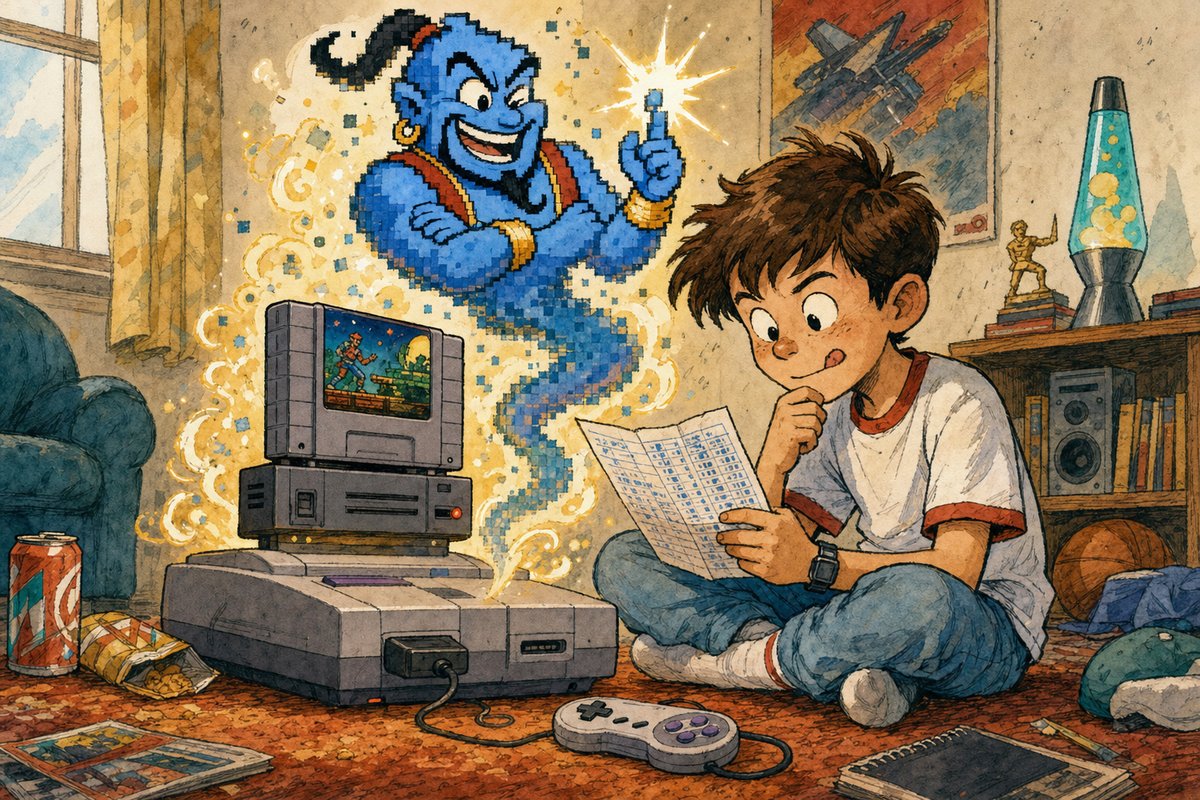
One-panel evidence: a cartridge sat on another cartridge and rewrote reality one suspicious code at a time.
The insertion was delicate business. You had to align the pins with the precision of a surgeon while holding your breath, hoping you wouldn’t bend the tiny metal teeth inside. Once seated, the Game Genie sat proudly atop the game, its bright plastic shell contrasting with the duller cartridge below. It felt substantial, like a piece of armor for your console. You would flip the power switch, wait for the Nintendo logo to fade, and then press Start.
If you were lucky, or if you had memorized the codes from Nintendo Power magazine, the little blue window on the front of the device would appear. It was a tiny LCD screen that promised infinite lives, unlimited ammo, or the ability to skip levels entirely. You would punch in a sequence of letters and numbers - usually six or eight characters long - and watch as the game transformed before your eyes. Suddenly, the final boss wasn’t so scary. Suddenly, you had enough coins to buy every item in the shop. It felt like magic, but it was actually something far more bureaucratic: intercepting address/data reads and substituting values to alter game behavior. The device sat between the cartridge and the console, acting as a middleman that asked the game for its current health or score, got an answer, and then handed back a different number if you had programmed it to do so.
Here is what we thought:
- Insert Game Genie into the cartridge slot.
- Plug the game cartridge into the top of the Genie.
- Turn on the console and wait for the title screen.
- Enter the cheat code using the directional buttons.
- Press Start to activate the modified game state.
The most magical part was the little blue window itself. It wasn’t just a display; it was a portal into a parallel universe where gravity didn’t apply and enemies dissolved upon contact. We would sit on the floor, legs crossed, eyes wide as we typed in codes like “ZXC” or “QWE,” trusting that these random-looking letters were actually keys to a hidden kingdom of invincibility. When the code worked, there was a collective gasp from anyone watching. We weren’t just playing a game; we were hacking reality with plastic and electricity. The satisfaction wasn’t in beating the game, but in breaking it completely.
  ___________________
 |                   |
 |   [ GAME GENIE ]  |
 |  _______________  |
 | |               | |
 | |   12345678    | |
 | |_______________| |
 |___________________|
       ||     ||
      (O)     (O)
It was the first time we realized that video games weren’t fixed stories, but flexible rulesets that could be bent with enough persistence. We didn’t know how it worked, and frankly, we didn’t care. We just knew that our character couldn’t die anymore, and that was all that mattered.
Now I realize the game wasn’t broken; I was just too lazy to jump over the lava pit correctly.