The Great Interrupt Standoff of 1996
The house was quiet, save for the rhythmic thumping of bass from the living room stereo. I sat cross-legged on my bed, eyes glued to the CRT monitor, waiting for the internet to load a Geocities page about dinosaurs. My hands hovered over the keyboard like a pianist before a solo. The modem was screeching its familiar handshake song - a digital dial tone that sounded like an angry robot falling down stairs. I held my breath. This was it. Connection established.
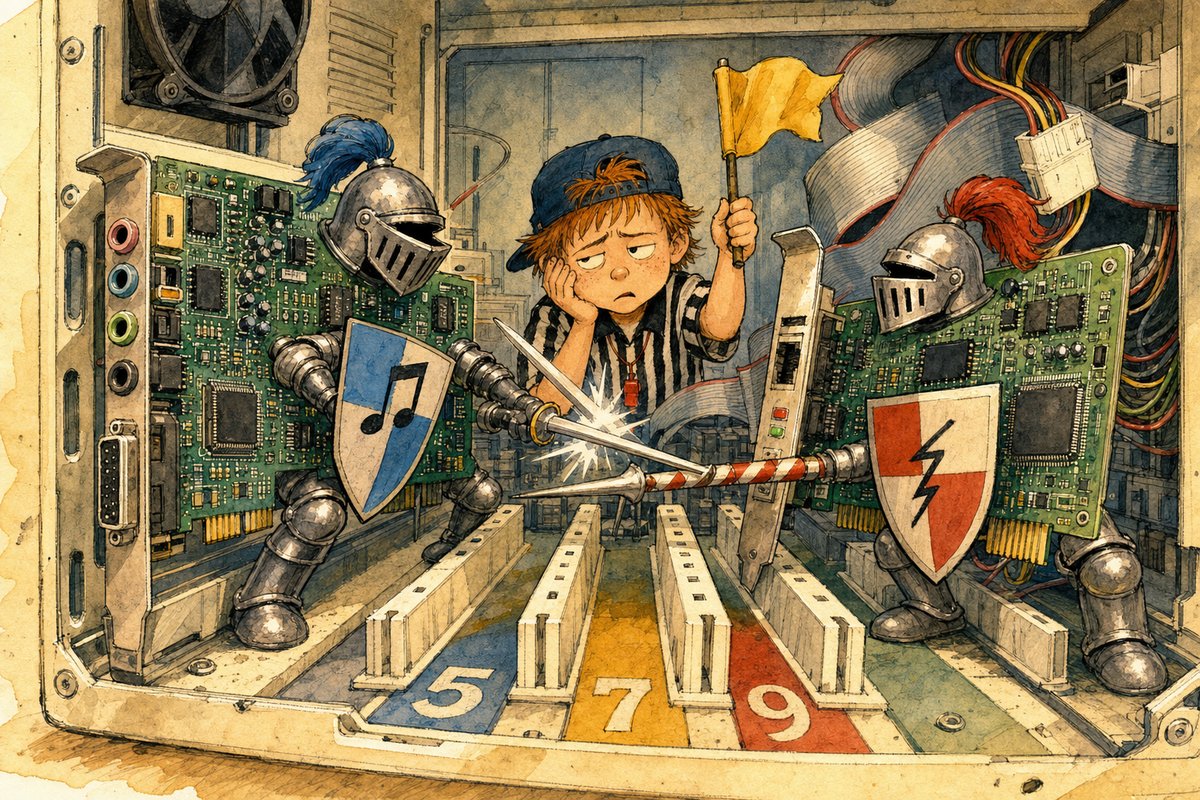
One-panel evidence: the sound card and modem wanted the same number, so neither would speak to the family.
I clicked on the link to “T-Rex Facts.” Nothing happened. The cursor spun in its little blue circle for three seconds, then stopped. I tried again. Same silence. But outside my door, my sister’s CD player cut out abruptly. Inside my computer case, the sound card let out a confused blip. We were stuck in a traffic jam inside the machine.
The ritual was always the same when this happened:
- Close all programs to free up memory (even though that wasn’t the problem).
- Restart the computer with the “safe mode” command, just in case a ghost had entered.
- Boot into MS-DOS because Windows 95 was too slow for serious troubleshooting.
- Open
SETUP.EXEon the sound card driver diskette. - Manually change the IRQ number from 5 to 7 and pray.
Here is what we thought: The computer had two separate personalities fighting for attention. One personality wanted to hear music; the other wanted to send email. They were both screaming at the CPU at the same time, so the brain just froze up. We imagined them as roommates who hated each other, yelling over who got to use the bathroom first. If we could just convince them to take turns, everything would work perfectly again.
In reality, it was a logistical dispute over real estate in the motherboard’s hallway. ISA-era devices often needed manually assigned interrupt requests, I/O addresses, and DMA channels that could conflict. Think of IRQs as dedicated phone lines for hardware components. The sound card had claimed line 5 to play MIDI files, but the modem also wanted line 5 to talk to the telephone company. When both tried to use the same line simultaneously, neither got through. It wasn’t magic; it was just bad scheduling. We weren’t calming angry ghosts; we were simply swapping a reservation from one extension to another so they wouldn’t step on each other’s toes.
It felt like surgery. You had to open the case, look at the tiny plastic switches, and move them with tweezers while holding your breath. One wrong switch meant no sound and no internet. We treated these boxes like sacred relics because if you messed up the configuration, you lost your voice. The anxiety was real. Was the modem broken? Had my ears gone deaf? Or had I just accidentally told the computer that silence was its native language?
  SOUND CARD: "I have line 5!"
  MODEM:      "No, I claimed it!"
  CPU:        "Who's talking?"
  ME:         "Both of them!"
  RESULT:     *Blip* ... *Screech*
  FIX:        Move switch to IRQ 7.
We spent more time configuring the hardware than actually using it, but that was part of the charm. You earned your connection by proving you understood the machine’s quirks. Today, USB devices plug in and just work, which is convenient but boring. Back then, every successful boot felt like a victory against chaos. We didn’t have auto-detect; we had intuition, patience, and a screwdriver.
My sister still thinks I’m a wizard because I can fix the internet by flipping three tiny switches on a green circuit board.