The Dialect of Desperation
The ritual began with a singular, solemn click. You pressed the stylus against the plastic screen of your PalmPilot, holding your breath as if the device were a volatile chemical mixture. Your thumb hovered over the trackball, waiting for permission to exist in digital form. This was not typing; this was calligraphy under pressure, performed with a finger that sweated slightly from nervous anticipation. You weren’t writing words. You were drawing symbols, trusting that the machine would decode your artistic interpretation of the letter ’e'.
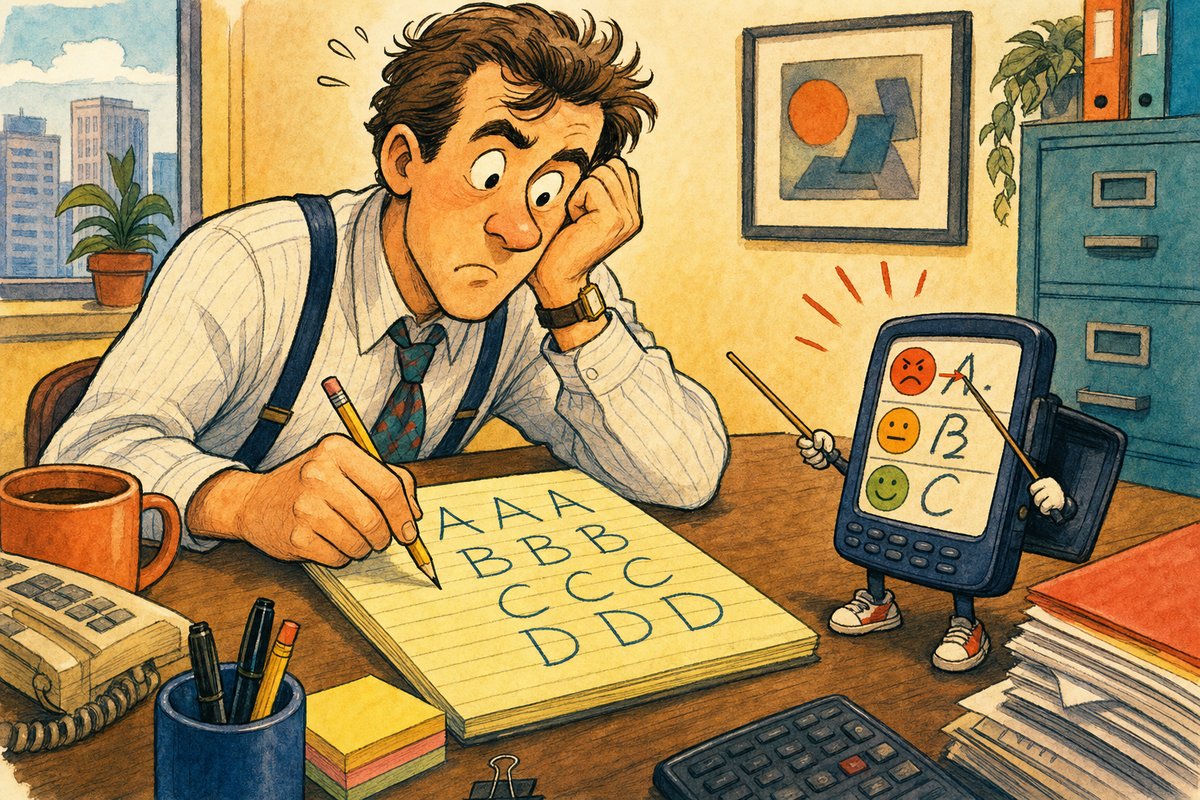
One-panel evidence: the computer understood handwriting after you agreed to stop writing letters like a human.
The process followed a strict, unspoken choreography:
- Tap the input field to summon the virtual keyboard.
- Select the Graffiti icon to enter single-stroke mode.
- Write a character with a confident, fluid motion.
- Hope the cursor doesn’t jump three lines away in disappointment.
The magic happened because you agreed to stop writing letters like a human. In the wild world outside the PalmPilot, an ’l’ might be a tall loop or a straight line; a ’t’ might have a crossbar that floats or hangs low. But inside the device, chaos was inefficient. Graffiti used simplified single-stroke character shapes to make recognition practical on limited handheld hardware. By forcing you to reduce every letter to one continuous movement without lifting your finger, the software eliminated ambiguity. It didn’t care about your artistic flair; it cared about geometry and efficiency. A ‘b’ wasn’t a stick with a belly; it was a specific angle followed by a curve. You became fluent in this new language quickly, learning that speed mattered more than style, and that lifting your stylus mid-word was the equivalent of speaking with a stutter.
Here is what we thought: The device had learned to read my mind because I stopped thinking like a writer and started drawing like an engineer. We believed that if we just held the pen at the perfect forty-five-degree angle and trusted our muscle memory, the PalmPilot would understand us even when we were tired, rushing, or holding it with one hand while eating a bagel. It felt like telepathy. It was actually just aggressive pattern matching disguised as intuition.
The frustration was real but shared. When you wrote a sloppy ‘w’ that looked like a zigzag mountain range, the screen would stare back at you with blank ignorance. You’d erase it, sigh, and try again, this time committing fully to the single stroke. It taught us patience and precision in equal measure. We learned that clarity was not just an aesthetic choice but a functional requirement for communication. The device demanded honesty from our hands; it didn’t accept excuses or half-measures.
The ASCII art of our lives looked something like this:
   __
  /  \
 |    |  <- A confident 'P'
  \__/
   |
   |     <- A lonely tail
   |
It was a small screen, but it held the weight of our entire social calendar. We carried our lives in our pockets, written in a shorthand that only we and our gadgets understood. And when it finally recognized your ‘q’ as a ‘g’, you felt a surge of pride so potent it could have powered the device for a week.
My handwriting got better because my PalmPilot had low standards and high expectations.