Choose Who Gets to Live
The game was ready.
You had snacks.
You had the good controller.
You had three uninterrupted hours before anyone needed the television.
Then the screen said:
NOT ENOUGH FREE SPACE.
The evening had become an ethics hearing.
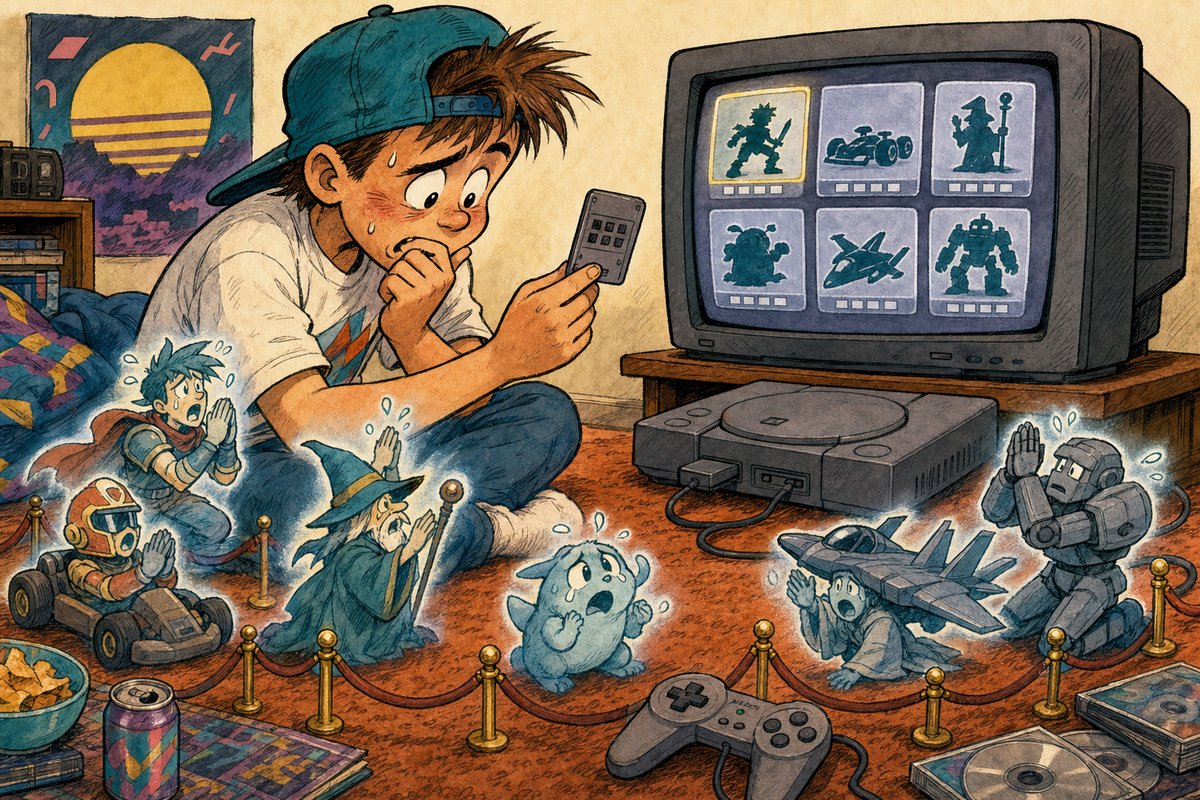
Cloud saves, before the cloud and with substantially more family politics.
The original PlayStation did not normally save progress inside the console. You plugged a little memory card into the slot above the controller port. The standard card presented 15 save blocks.
Some games needed one.
Some needed several.
Every save belonged to somebody.
Deleting a block was not housekeeping. It was manslaughter with a D-pad.
Here is what we thought was inside:
- tiny versions of our game characters, waiting patiently
- a battery that would die the moment we became happy
- exactly fifteen microscopic filing cabinets
The last answer was spiritually correct.
The card used nonvolatile flash memory. It kept data without needing constant power, unlike older battery-backed cartridges that relied on a small cell to preserve RAM. The console organized that memory into fixed blocks so games and players could see how much space remained.
     MEMORY CARD: 15 BLOCKS
   +---+---+---+---+---+
   | X | X | X | X | X |
   +---+---+---+---+---+
   | X | X | X | X | X |   <- your sibling's saves
   +---+---+---+---+---+
   | X | X | ? | ? | ? |   <- family court begins
   +---+---+---+---+---+
Memory cards also made saves portable. Bring the card to a friend’s house and your progress came with you. The player profile was not an account on a server. It was a gray rectangle in your pocket that could survive the trip only if you remembered which pocket.
Modern consoles hide this behind internal storage, user accounts, synchronization, and cloud backups.
That is safer.
It is also less honest.
The little card told you exactly how much memory remained and forced the brutal decision while everybody watched.
Today the cloud quietly says “sync conflict” and deletes the wrong universe by itself.