The Backpack That Shook Your World
The ritual was always the same, usually during a tense final round of Super Smash Bros. or whenever you needed to feel like a dinosaur in Turok. You would sit on the floor, knees pulled up, controller resting on your thighs. With the solemn focus of a surgeon, you would lift the back plate of the gray brick. Inside sat two bulky D-cell batteries that weighed more than the console itself. You’d slide the rectangular accessory into the cavity until it clicked, then snap the cover shut with enough force to loosen a tooth.
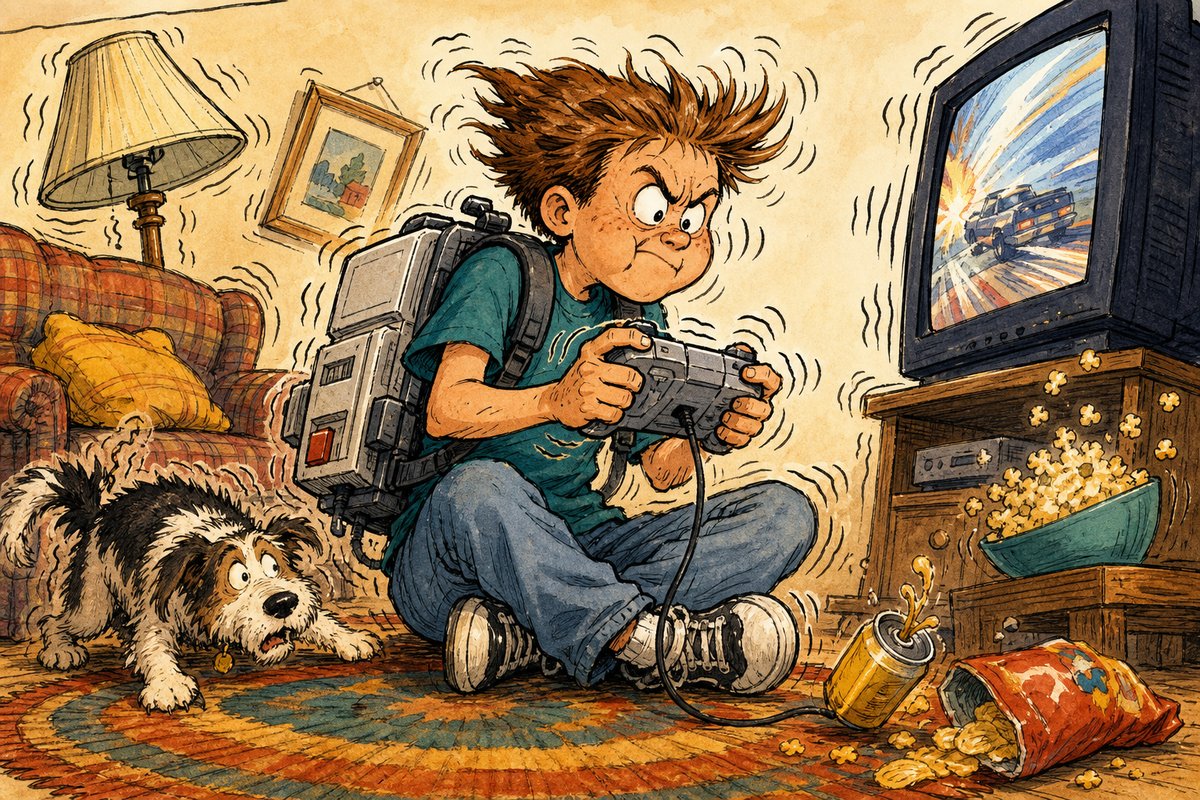
One-panel evidence: the controller grew a battery-powered backpack so the game could physically disagree with you.
You plugged in the cable from the controller’s expansion port and turned on the TV. The game loaded. Your character stood ready. And then, the moment arrived.
Here is what we thought: The video game was literally shaking hands with us, or perhaps grabbing our shirt collar and pulling us toward the screen. It wasn’t just visual feedback; it was physical proof that the digital world had mass and momentum. When your character landed a heavy blow, the controller didn’t just beep; it thumped against your palm like a second heartbeat. We believed this rumble was a secret language between the software and our nervous system, a tactile whisper saying, “You hit him hard.”
The magic happened because of simple physics hiding in plain sight. A small motor with an eccentric rotating mass created vibration when software commanded the accessory. That means inside that plastic brick, there was a tiny engine spinning a weight that wasn’t perfectly centered. As it spun, the off-center mass pulled the motor slightly to one side, creating an imbalance. This imbalance caused the whole unit to wobble and shake rapidly. The game code would turn this motor on or off in quick bursts, translating digital hits into physical jolts you could feel in your fingers. It was clever engineering disguised as magic, turning electricity into a gentle shove.
We treated these controllers with reverence. If the batteries died mid-match, the silence felt like betrayal. We carried spares AA batteries everywhere, wrapped in rubber bands for quick swaps during commercial breaks. The rumble pack didn’t just make games better; it made us feel more involved, more present in the action. It was our first taste of haptic feedback, a sensory bridge between the pixelated world and our living room.
  .-""""-.
 /        \
|  RUMBLE  |
|   PAK    |
|  ~~~~~~  |
 \  ^^^^  /
  '-....-'
Looking back, the technology was rudimentary - just a spinning weight - but the effect was profound. It added a layer of immersion that we didn’t know we needed until it was gone (and then came back stronger in every controller since). We spent hours adjusting our grip to maximize the shake intensity, treating each thump as validation of our gaming prowess. The rumble pack taught us that games could touch us, not just show us things. It was a small accessory with a big impact, literally shaking up our childhoods one vibration at a time.
My thumbs still twitch when I see a boss take damage.