The Guilt Trip That Started Before Breakfast
There was a specific kind of silence that fell over the house at 7:00 AM on a Saturday. It wasn’t the quiet of sleeping parents; it was the held breath of a child hovering over the mouse, waiting for the software to load. We didn’t have high-speed internet. We had a modem that sounded like a robot choking on gravel and a cartridge slot that smelled faintly of burnt dust. But we had that game. The one my friend Mark mailed in a bubble-wrap envelope because the floppy disk was too precious to send through the post office.
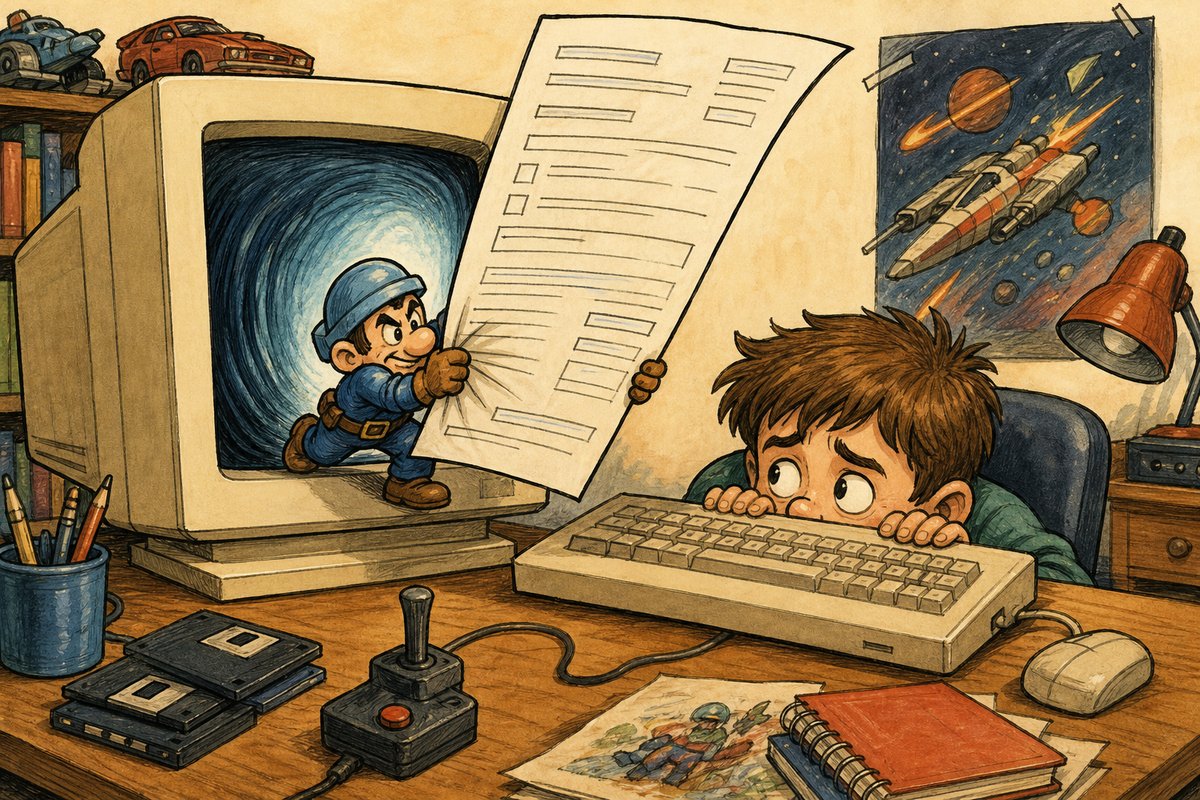
One-panel evidence: the game was free, except for the guilt letter that appeared every time it started.
The ritual was precise, honed by years of trial, error, and parental interruption:
- Insert the disk into the drive with gentle firmness, ensuring it sat flush.
- Press Enter on the command prompt, ignoring the blinking cursor’s judgmental stare.
- Watch the screen flood with pixelated graphics while waiting for the inevitable pop-up.
We all knew what was coming. It wasn’t a crash. It wasn’t a freeze. It was the letter. A white box appeared in the center of the screen, containing text that looked less like code and more like a handwritten note from a stern teacher. We had played the first three levels. We had defeated the boss. But the game refused to let us proceed without a signature on the dotted line.
Here is what we thought: The software was trapped inside the computer, waiting for us to pay it a ransom so it could unlock the rest of its potential. It felt personal. If I didn’t send in my name and address, the game would stay locked forever, a prisoner of my own stinginess. We imagined the developers sitting in a dimly lit room, watching our playtime meter tick down, waiting for us to feel bad enough to write a check. There was no subscription fee, no monthly charge, just this one-time plea for recognition that hung over every session like a low-hanging cloud.
+------------------------------------------+
|  SHAREWARE NOTICE                        |
|                                          |
|  You have used the trial version.        |
|  Please register to continue playing.    |
|                                          |
|  Name: _______________________________   |
|  Address: _____________________________  |
|  Zip Code: ___________                   |
|                                          |
|  Thank you for your support!             |
+------------------------------------------+
It was a clever little trap. The developers encouraged us to copy the disk, to pass it around our friend group, to play until we were utterly addicted to those simple graphics and basic mechanics. Once we invested ten hours into saving the digital princess or collecting the virtual coins, the nag screen wasn’t an annoyance; it was a receipt for our time. We sent in postcards with our names scrawled in blue ballpoint pen. Sometimes we got a confirmation letter back. Sometimes we didn’t. Either way, we felt like we had officially joined the club, provided we remembered to type our address correctly next time.
The beauty of it was that you could play forever without paying, but you’d have to endure the reminder every single time you launched the program. It was a persistent, polite nagging that asked for nothing more than acknowledgment. We sent in our details not because we loved the company, but because we loved the game enough to pay the toll.
I still have some of those postcards. They’re sitting in a drawer next to a handful of unmailed coins and a rubber band that has lost its elasticity.