Maximum Computer
Some beige PCs had a button marked TURBO.
This was the greatest button ever installed on anything.
The family car did not have Turbo.
The television did not have Turbo.
The toaster had one lever and no ambition.
But the computer had Turbo, and you pressed it because you were not a coward.
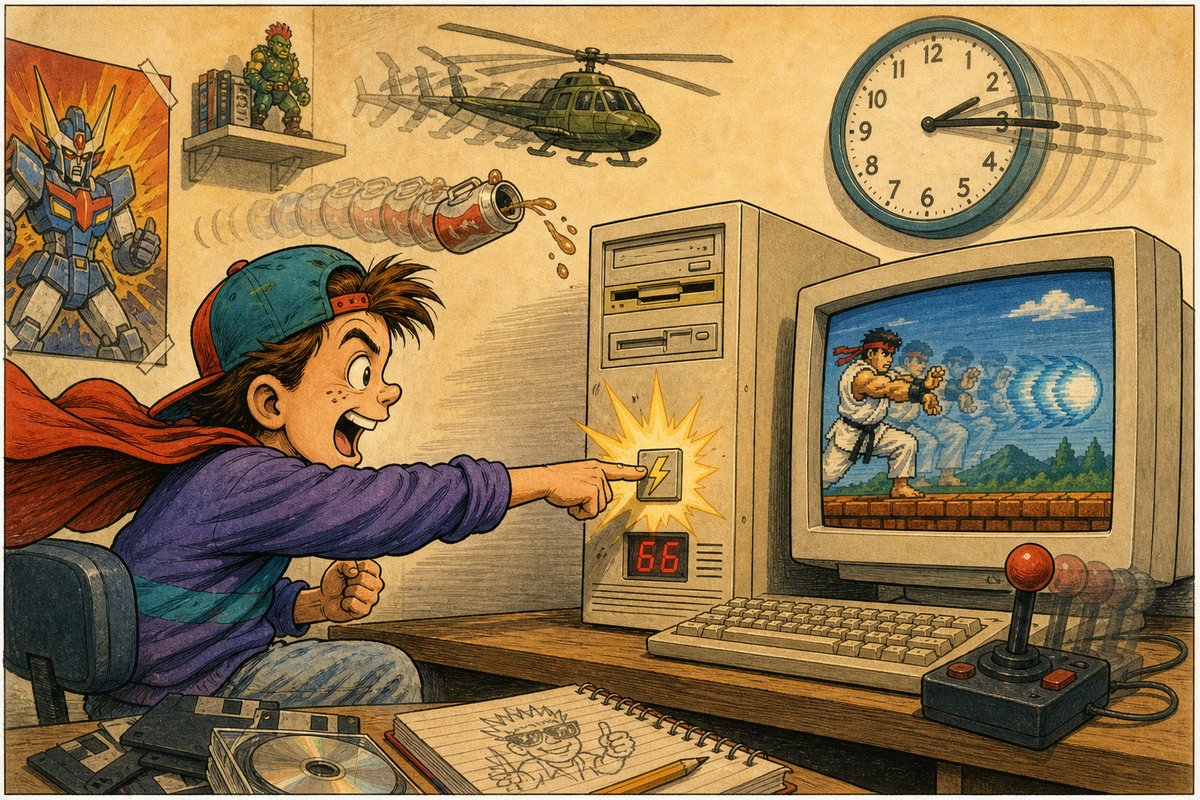
The computer equivalent of painting flames on a lawn mower.
Beside it, a red LED display might change from 33 to 66, or from LO to HI. Sometimes the numbers were only wired display segments, not a measurement of anything. The case was basically wearing a novelty speedometer.
Here is what we thought Turbo did:
- added horsepower
- made homework calculate faster
- unlocked the processor’s secret adult mode
- improved every game because the word sounded expensive
The actual purpose was compatibility.
Early PC software often timed itself by counting how quickly the processor executed instructions. That worked when many machines ran at roughly the speed the programmer expected.
Then processors got faster.
Some old games ran too fast. Animations raced. Enemies teleported. A tasteful flight simulator became a guided missile into the runway.
The Turbo system let a newer computer run at full speed or drop to a slower mode that behaved more like an older PC.
      TURBO ON                 TURBO OFF
   +------------+           +------------+
   | FAST PC    |           | FAST PC    |
   | 66  [*]    |           | 16  [ ]    |
   +------------+           +------------+
      normal speed          compatibility crawl
The joke is slightly unfair: correctly wired, “Turbo on” usually meant full speed, and turning it off slowed the machine. But from a kid’s perspective, pressing the exciting button could appear to make old software behave slower.
Modern computers still change speed constantly. CPUs boost, throttle, sleep cores, limit power, and reduce clocks when hot.
The difference is that software decides now.
We lost the button.
This is progress only if you believe computers should control their own Turbo, which is exactly what a computer would say.